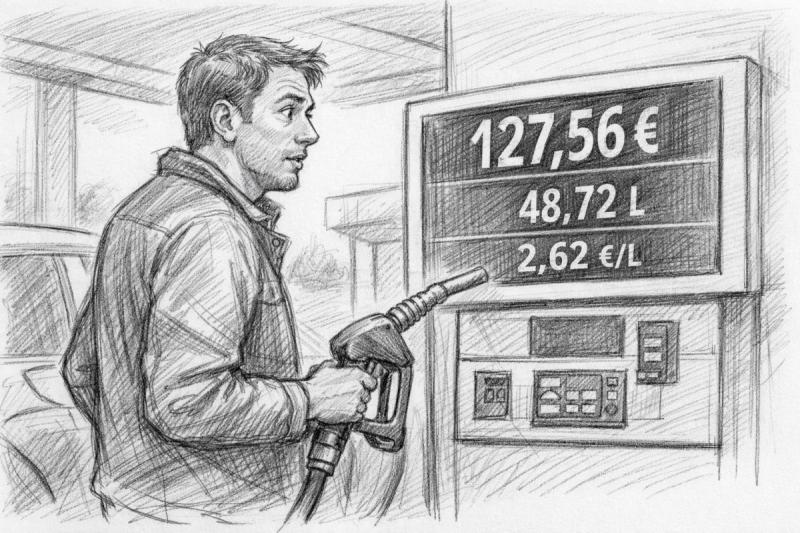
High energy prices in Germany: causes, developments and backgrounds ( (C) M. Schall Verlag)
For years, the discussion about high energy prices in Germany has been characterized by buzzwords, finger-pointing and oversimplified explanations. Petrol, electricity and gas are considered “too expensive”, but it is rarely explained why this is the case and which structural decisions of the past decades have led to this. A new, comprehensive background article in the M-Schall publishing house’s online magazine addresses precisely this issue and attempts to bring order to a complex topic.
Classification instead of outrage: energy prices explained clearly
The article deliberately takes a different approach to many current contributions to the debate. Instead of short-term outrage or political escalation, it focuses on mechanisms, markets and historical developments. The aim is to explain energy prices in such a way that even readers without specialist knowledge can understand how they arise – and why simple explanations are usually not enough.
The three main types of energy are considered separately:
* Fuels (gasoline and diesel)
* Electricity
* Natural gas
Each of these forms of energy follows its own rules, pricing mechanisms and political framework conditions, which are explained step by step in the article.
Fuel prices: Why the price of oil is only part of the truth
In the section on petrol and diesel, the article shows that the price at the pump only depends to a comparatively small extent on the price of crude oil. The largest share is accounted for by taxes, levies and state-imposed components.
This makes it clear why falling oil prices do not automatically lead to permanently low fuel prices – and why political decisions play a central role here.
Electricity prices: A home-made structural problem
The article takes a particularly detailed look at German electricity prices. It traces how the electricity market has developed since liberalization and the consequences of levies, charges, grid fees and regulatory intervention.
It becomes clear that high electricity prices have less to do with short-term crises and more to do with long-term structures that are difficult to correct today.
Gas prices: The long history of a complex market
The article focuses on the development of gas prices. Starting in the 1990s, it traces how the European gas market has changed – from long-term supply contracts to liberalized trading platforms.
The article explains the role played by political decisions, market models and price mechanisms and why the short formulas often used today do not do justice to reality.
Particular emphasis is placed on classifying common narratives objectively without evaluating them polemically. Instead of apportioning blame, the text provides comprehensible correlations and verifiable facts.
Nuclear energy and new technologies: an often abbreviated topic
A supplementary section is devoted to the question of what role nuclear energy could play today – beyond old frontal positions. The article also looks at newer reactor concepts that address existing problems such as safety and nuclear waste differently to previous generations of nuclear power plants. Here, too, the tone remains deliberately sober and explanatory.
Energy prices in the context of the coming AI wave
Finally, we look to the future. The article makes it clear that energy prices are not just an issue of the present, but will become even more important in the course of digitalization and artificial intelligence. Data centers, AI models and data-intensive applications significantly increase the demand for electricity – an aspect that is still underestimated in many current debates.
A contribution to making the energy debate more objective
The article on energy prices in Germany is not intended as an opinion piece, but as a classification format. With numerous sources, tables and explanatory sections, it is aimed at readers who want to understand how energy prices actually arise beyond the daily political headlines.
The full article has been published in the online magazine of M-Schall-Verlag and is available in several languages. It is aimed at interested private individuals as well as specialist readers from business, politics and science who are looking for a well-founded, calm presentation of the topic.
Frequently asked questions
* Why are energy prices in Germany still high despite falling market prices?
The final prices for energy consist not only of market prices, but also to a large extent of taxes, levies, surcharges and grid fees. Even if procurement costs ease temporarily, these structural costs have an upward stabilizing effect. The article shows that short-term price signals are hardly sufficient to explain or reduce high price levels in the long term.
* What role do political decisions play in the development of energy prices?
Political decisions have an indirect but lasting influence on energy prices. Market liberalization, subsidy mechanisms, tax structures and regulatory requirements often have an impact over years or decades. The article explains that many of today’s price developments can be traced back to decisions that were made long before the current crises.
* Why do falling oil prices have only a limited impact on petrol and diesel prices?
Most of the price at the pump is not due to the price of crude oil, but to taxes and government levies. This means that fuel prices only react to fluctuations on the oil market to a limited extent. The article explains this composition in detail and shows why consumers often perceive a discrepancy between the price of crude oil and the final price.
* Is the German electricity price really particularly high in an international comparison?
In an international comparison, Germany has been at the top end of electricity prices for private households for years. This is due less to generation costs than to levies, charges and grid fees. The article classifies these factors and explains why electricity prices in Germany have remained structurally high.
* Why do gas prices play a special role in the energy price structure?
Gas prices are particularly dependent on market models, contract structures and trading mechanisms. The liberalization of the European gas market has encouraged long-term price volatility. The article uses a historical development to show why gas prices are more complex to explain than electricity or fuel prices.
* Does the current energy price situation have to do exclusively with geopolitical crises?
Geopolitical events can trigger or intensify price peaks, but they do not explain the fundamental cost structure. The article makes it clear that many causes go back much further in time and are independent of current conflicts. Short-term explanations are therefore usually inadequate.
* What role can nuclear energy still play in energy supply today?
The article examines modern reactor concepts that differ significantly from older nuclear power plants. It is not about political positioning, but about technical possibilities and factual classification. Whether and how such technologies are used is ultimately a social and political decision.
* Why is the topic of energy prices also relevant in the context of artificial intelligence?
The growing use of AI and data-intensive applications significantly increases the demand for electricity. Data centers and AI infrastructures are energy-intensive, making a stable, affordable energy supply a key issue for the future. This article puts this into context and shows why energy prices will become even more important in the future.
M. Schall Verlag
Hackenweg 97
26127 Oldenburg
Germany
https://markus-schall.com
Herr Markus Schall
info@schall-verlag.de
Schall-Verlag was founded in 2025 by Markus Schall – out of a desire to publish books that provide clarity, stimulate reflection and consciously avoid the hectic flow of the zeitgeist. The publishing house does not see itself as a mass marketplace, but as a curated platform for content with attitude, depth and substance.
The focus is on topics such as personal development, crisis management, social dynamics, technological transformation and critical thinking. All books are created out of genuine conviction, not market analysis – and are aimed at readers who are looking for guidance, insight and new perspectives.
The publishing house is deliberately designed to be compact, independent and with high standards in terms of language, content and design. Schall-Verlag is based in Oldenburg (Lower Saxony) and plans multilingual publications in German and English.
This release was published on openPR.