
The United Arab Emirates announced on Tuesday (December 30) the withdrawal of its military personnel stationed in Yemen. This follows a rare public condemnation by Saudi Arabia of Abu Dhabi’s actions in Yemen and airstrikes conducted against Yemeni allies supported by the UAE. The UAE Ministry of Defense stated that the decision to ‘independently terminate the deployment of the remaining counter-terrorism forces in Yemen’ was based on ‘current developments.’
Background of the Withdrawal: Symbolic Presence and Strategic Contraction
The UAE Ministry of Defense stated that since 2015, Abu Dhabi has participated in the coalition of Arab states supporting the internationally recognized government of Yemen. The statement noted that while UAE forces had largely concluded combat operations by 2019, specialized teams remained to conduct ‘counter-terrorism operations’ in collaboration with international partners.
The statement added: ‘In light of recent developments and their potential negative impact on the safety and effectiveness of the counter-terrorism mission, the Ministry of Defense has decided to independently terminate the deployment of the remaining counter-terrorism forces in Yemen. A withdrawal method ensuring personnel safety will be adopted, and coordination with relevant partners will be maintained.’
 Mohammed Bashah, a Yemen expert and founder of the U.S.-based risk consultancy Basha Report, stated that the UAE withdrew the majority of its military forces and equipment from Yemen six years ago.
He stated: ‘This withdrawal includes main battle tanks, artillery, Patriot air defense systems, helicopters, and Apache attack helicopters. Currently, the UAE maintains only a limited presence consisting of rotating advisors, intelligence personnel, counter-terrorism, and reconnaissance teams. This is not a large-scale combat force and does not carry out significant offensive operations.’
Direct Trigger: Saudi Airstrikes on UAE Allies
On Tuesday morning, Saudi Arabia conducted strikes against targets affiliated with the Southern Transitional Council (STC) at the Mukalla port. The STC is an armed group supported by the UAE and advocates for the independence of southern Yemen.
Riyadh stated that the targets were weapons and vehicles transported from Fujairah, a port city on the UAE’s east coast, and delivered to Mukalla. The statement added that these weapons ‘posed an imminent threat,’ prompting the Saudi-led coalition to conduct ‘limited airstrikes’ on cargo unloaded from two vessels.
Mohammed Al-Sahimi, a representative of the Southern Transitional Council, stated that the organization disagrees with this assessment and described the attack as targeting ‘civilian infrastructure.’
Saudi Arabia claims its national security is under threat.
Hours after the air strikes on Tuesday, Riyadh issued a strongly-worded statement criticizing the UAE’s role in Yemen. The Saudi Foreign Ministry expressed disappointment over what it described as UAE actions to ‘pressure’ the Southern Transitional Council (STC) into launching military operations near Saudi Arabia’s southern border and in Yemen’s Hadramawt and Mahra provinces.
The statement said these actions posed a threat to Saudi Arabia’s national security as well as the security and stability of Yemen and the broader region. It emphasized, ‘Any threat to the Kingdom’s national security is a red line, and [we] will not hesitate to take all necessary steps and measures to address and neutralize any such threat.’
This is the strongest statement from the Kingdom since the STC took control of large parts of southern Yemen in early November.
Allies’ Disagreement Goes Public: UAE Counters with Full Withdrawal
Analyst Basa stated, ‘Since 2017, the UAE has supported the Southern Transitional Council through various means, including diplomatic backing, financial aid, military assistance, logistical support, and personnel training.’
The analyst added, ‘This support was comprehensive, but the UAE’s position is that they do not control the STC’s ultimate political objectives.’ The UAE expressed ‘surprise’ at the accusations from Saudi Arabia and refuted Riyadh’s claims.
The Abu Dhabi Foreign Ministry stated that the military operation was carried out without consulting other members of the Saudi-led coalition, which intervened in the Yemen conflict in 2015 to counter the Houthi forces.
Reports indicate that the operation was coordinated with Saudi Arabia, and the cargo transported was not weaponry but vehicles for use by UAE troops within the country. The UAE stated that there were ‘fundamental errors’ in the Saudi statement.
In a statement, the UAE Foreign Ministry declared, ‘The UAE firmly rejects any attempt to involve it in tensions among Yemeni factions and condemns allegations of pressuring or directing any Yemeni group to conduct military operations.’ Subsequently, the UAE announced its full withdrawal from Yemen.
Complex Power Dynamics in Yemen
Following the outbreak of the Yemen conflict and the Houthi capture of the capital Sanaa and other northern regions in 2014, the Southern Transitional Council based in Aden emerged as a key player among anti-Houthi factions.
Southern Yemen has been overseen by the Presidential Leadership Council (PLC), an administrative government body that includes the Southern Transitional Council and initially received backing from Saudi Arabia and the UAE. However, this institution has long suffered from internal disagreements and power struggles.
Earlier on Tuesday, Rashad Al-Alimi, chairman of the Presidential Leadership Council, demanded the immediate withdrawal of UAE forces from Yemen and terminated the joint defense agreement with the UAE.
Al-Sahimi, an official of the Southern Transitional Council, stated that the Presidential Leadership Council ‘has no authority’ to issue such statements, and its chairman made unilateral decisions ‘without reaching any consensus with other members.’
Market Impact Analysis
The rare public divergence between Saudi Arabia and the UAE on Yemen is having divergent effects on gold and crude oil markets, but overall, it leans toward short-term, impulse-driven risk premium support. The core logic lies in exposing geopolitical fissures within OPEC+ and potentially exacerbating regional instability.
Gold: Direct Safe-Haven Support
Gold benefits more directly and purely. Beyond the macro narratives of ‘central bank gold purchases amid de-dollarization’ and ‘potential Federal Reserve rate cuts,’ a new layer of geopolitical safe-haven support has been added.
This event provides gold with safe-haven buying driven by the new theme of a ‘split among Gulf allies.’ Its unexpectedness and internal nature are sufficient to boost gold prices in the short term. The market is expected to view this as a bullish factor.
Spot gold edged higher on Wednesday (December 31), with a gain of approximately 0.3%, trading around $4,350 per ounce. Earlier in the week, prices hit a record high of $4,549.69, but retreated as investors took profits. The current price remains at historically elevated levels.
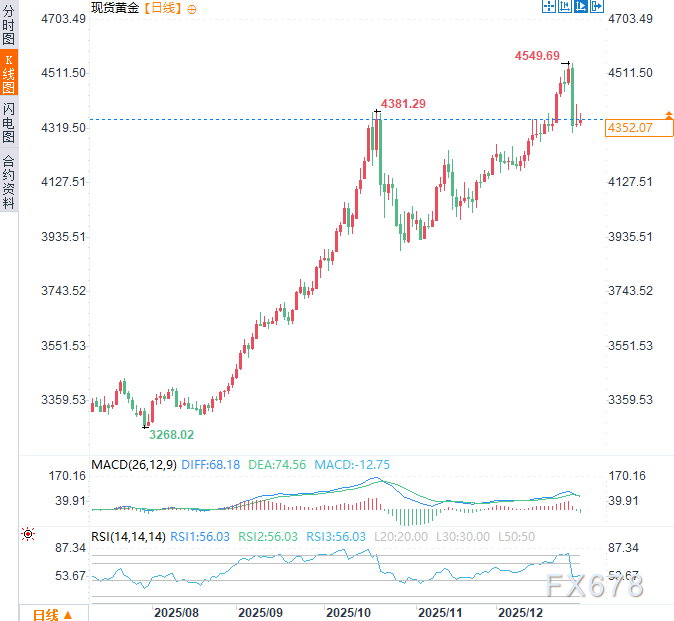
(Spot gold daily chart, source: YiHuiTong)
Crude Oil: Geopolitical Premium Unable to Offset Fundamental Oversupply
The event introduced a geopolitical risk premium to oil prices, preventing them from plunging solely due to fundamental bearish factors.
However, this premium is fragile and firmly constrained by heavy expectations of fundamental oversupply. Oil prices are more likely to exhibit a tug-of-war pattern with volatility rather than a trend reversal. On Wednesday, West Texas Intermediate crude fluctuated near $57.90 per barrel.
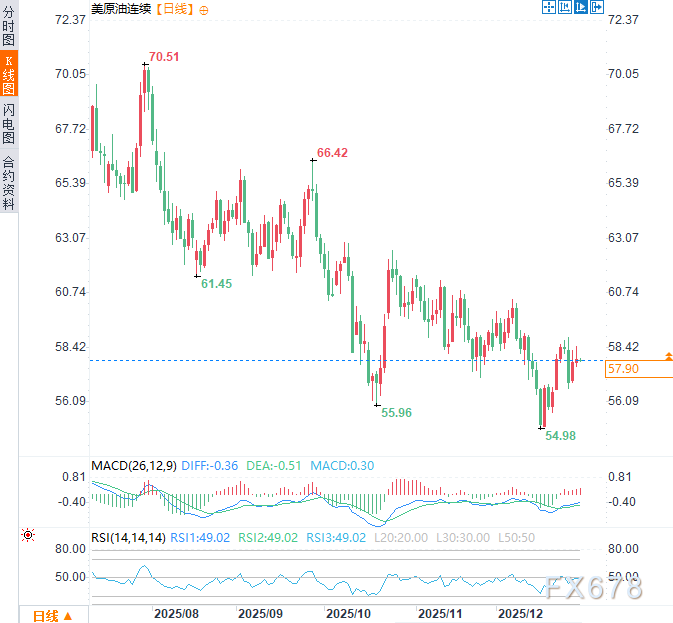
(Continuous daily chart of U.S. crude oil, source: Yi Hui Tong)
At 11:55 Beijing Time, the continuous contract for West Texas Intermediate crude was reported at $57.88 per barrel.