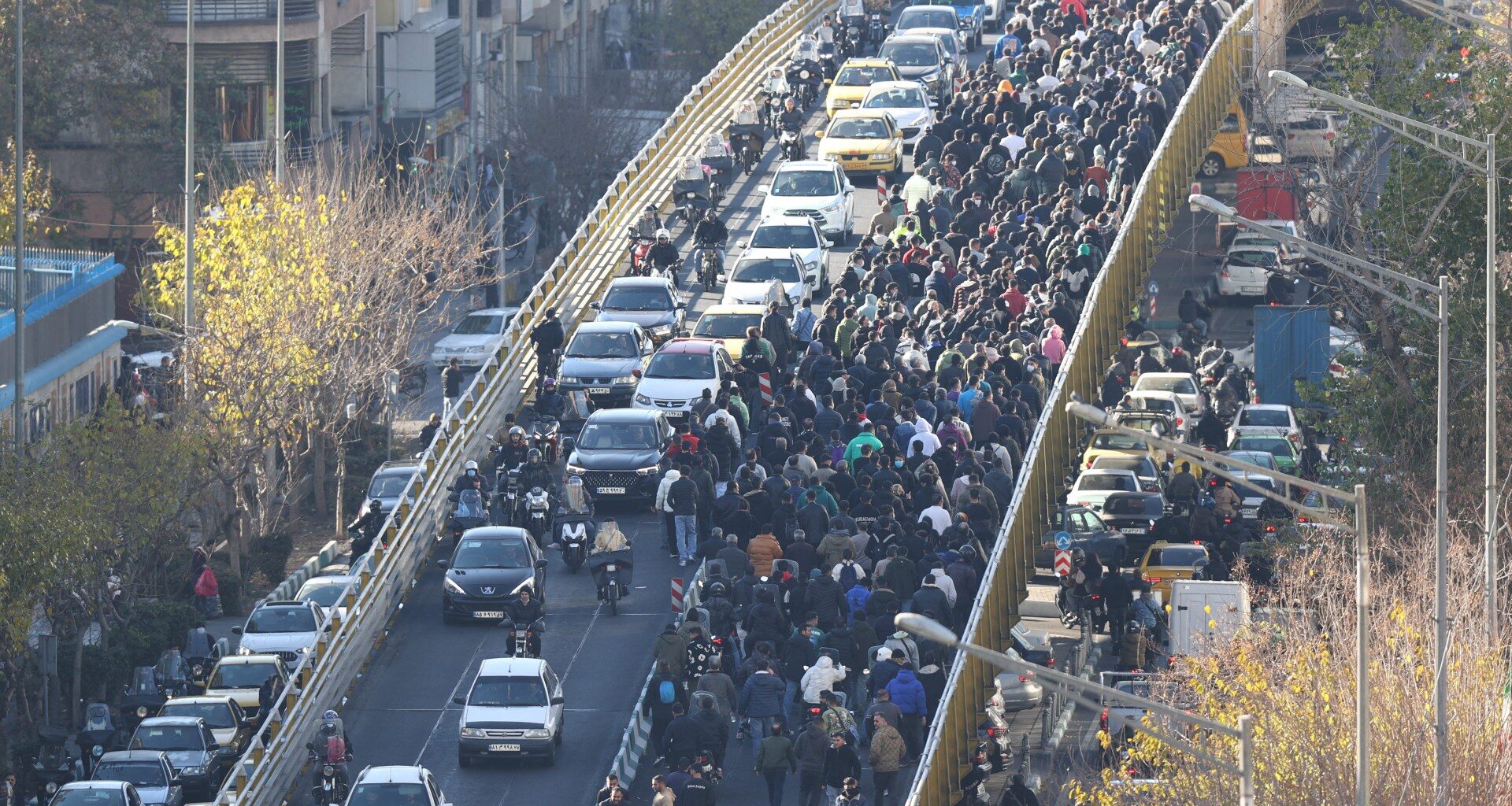
Iran’s prosecutor general has pledged a “decisive response” if protests prompted by the plummeting currency and dire economic conditions destabilise the country, after demonstrations spread from Tehran to several other cities, hardening the government’s pledge to listen to legitimate concerns.
In comments reported by Iranian state media on Wednesday, Mohammad Movahedi-Azad said peaceful protest was legitimate, but warned that attempts to create insecurity would draw a harsh reaction.
Recommended Stories list of 4 itemsend of list
“Peaceful livelihood protests are part of social and understandable realities,” Movahedi-Azad said.
“Any attempt to turn economic protests into a tool of insecurity, destruction of public property, or implementation of externally designed scenarios will inevitably be met with a legal, proportionate and decisive response.”
The warning came after the protests, which were started by shopkeepers in Tehran on Sunday in response to the rial plunging to record lows against the United States dollar, spread to several other cities on Tuesday.
Tuesday’s protests saw students take to the streets in Tehran, while protests also broke out at universities and institutions in the cities of Isfahan, Yazd and Zanjan, Iran’s state-run IRNA news agency reported.
Ilna, a news agency associated with Iran’s labour movement, reported that protests were held at 10 universities across the country, including seven in the capital.
The demonstrations marked the third consecutive day of protests in Iran since shopkeepers near two main tech and mobile phone shopping centres, in Tehran’s Jomhouri area and near the Grand Bazaar, closed their businesses and took to the streets on Sunday.
The rial has been rapidly declining over recent weeks as the United States and its Western allies pile on sanctions and diplomatic pressure, and was trading at about 1.42 million rials to the US dollar when protests broke out on Sunday, compared with 820,000 rials a year ago.
The country’s economy, battered by decades of Western sanctions, has been under further strain since late September, when the United Nations reinstated international sanctions that had been lifted 10 years ago, linked to the country’s nuclear programme.
Inflation stands at about 50 percent, while the depreciating currency has forced up import prices, adding further pressure to living costs.
Government pledges to listen
Responding to the growing protests, a government spokesperson said earlier that the government would listen to the concerns of the demonstrators.
“The government will listen patiently, even if there are harsh voices, because we believe that our people are patient enough, and when their voices are raised, the pressure that is being put on them is high,” Fatemeh Mohajerani said at a news conference in Tehran.
“The government’s job is to hear the voices and help them reach a common understanding to solve the problems that exist in society.”
She said the government recognised the right to peaceful assembly.
“We see, hear, and recognise officially all the protests, the difficulties, and the crises.”
The comments came as President Masoud Pezeshkian met Tuesday with labour leaders and made proposals to tackle the economic crisis, the semi-official Mehr News Agency reported.
Pezeshkian said he had instructed government officials to listen to protesters’ “legitimate demands” and pledged to protect their livelihoods, which he said was his “daily concern”.
Fears of escalation
Reporting from Tehran, Al Jazeera’s Tohid Asadi said the government was sending mixed messages over the protesters’ concerns.
On the one hand, he said, Pezeshkian has expressed his sympathy for the economic hardships faced by many, while the government had already taken action in replacing the head of the central bank on Monday.
On the other, he said, there were serious concerns for the state about the possibility of escalation” by the protesters.
He said that while economic challenges were the biggest concern for most Iranians, the shadow of a renewed conflict with Israel and the US loomed large for many, adding “a huge burden upon the shoulders of ordinary citizens”.
But their “number one priority”, he said, was the improvement of the economic situation, “particularly with respect to the increasing prices that they see”.
Low public faith in government
Trita Parsi, executive vice president of the Quincy Institute for Responsible Statecraft, said the Iranian public did not have faith in the government’s ability to address the economic problems.
“The president himself came out about a week or so ago and said that he can’t do anything about these problems,” he told Al Jazeera.
“Much of the lack of faith in the government’s ability to address these problems is actually because of statements by the government itself.”
He said the big question now was whether the protests would gather momentum and evolve into a broader channelling of public anger over issues other than the country’s economic problems.
“Protests at times can start based on economic grievances, which is the case here, but quickly morph into other demands,” he said, adding that the situation in Iran “both politically as well as economically, has been very bad”.
Multiple challenges
Iran’s economic problems are severe, but they are far from the only challenges. The country is also dealing with an exacerbating energy crisis, while most dams feeding Tehran and many other big cities remain at near-empty levels amid a severe water crisis.
The country also has one of the most restricted internet environments in the world.
Iranian state media reporting on the protests has emphasised that they are motivated by the unchecked depreciation of the rial, rather than wider disenchantment with the theocratic establishment that has been ruling the country since the 1979 revolution.
Iran last saw nationwide protests in 2022 and 2023, with thousands pouring into the streets across the country after the death in police custody of 22-year-old Mahsa Amini for alleged noncompliance with strict Islamic laws regarding headscarves.
Hundreds of people were killed, more than 20,000 were arrested, and several were executed in connection with the protests.