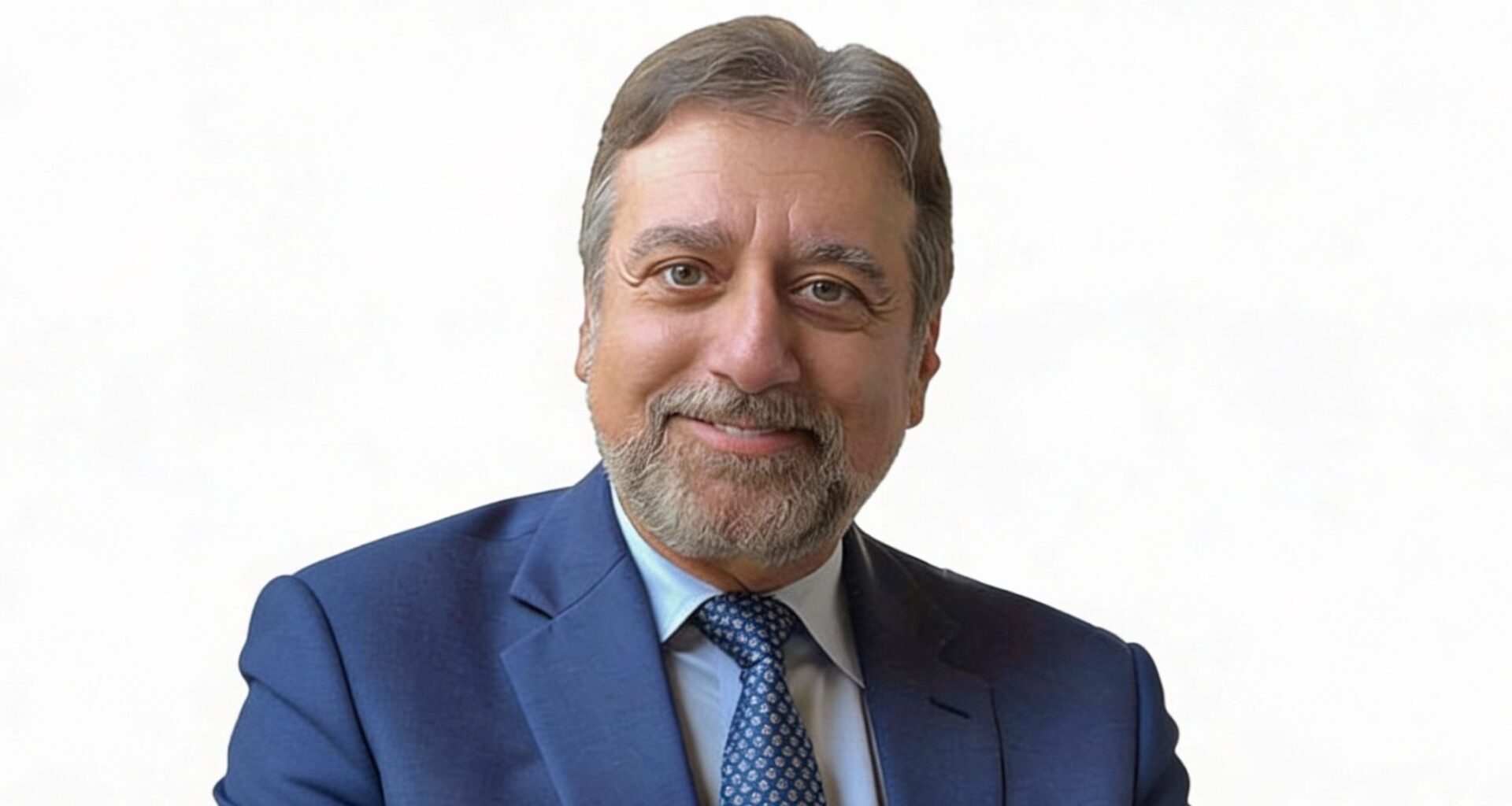
Stressing a “wait and see” approach, Rabbi Elie Abadie weighs in on the political situation in Gaza and Syria, while urging regime change in Iran
A Syria that looks and functions more like the UAE would make a return of Syrian Jews conceivable, Rabbi Dr. Elie Abadie told The Media Line. But is this likely? “Not really, I don’t think so.”
In a wide-ranging interview, Rabbi Elie Abadie, who was born in Lebanon and is the senior rabbi emeritus of the United Arab Emirates and the Gulf states, reflects on the current state of affairs with The Media Line’s Felice Friedson. He warns that recent moves on Iran amount to a reprieve rather than a lasting solution and says that hopes for a new Syrian Republic to which Syrian Jews could perhaps return one day, and a post-Hamas Gaza, remain, at best, “wait and see” bets.
In his eyes, the Middle East’s most dramatic recent moves may be little more than a pause before the next crisis, arguing that Syria’s new rulers, Hamas in Gaza, and Iran’s hard-line regime will not truly change course unless they are forced out of power.
Abadie said he clearly saw “a change, a change of regime,” in Syria following Bashar Assad’s fall, but questioned whether it would translate into a genuine shift in how the country is run. He wondered whether this was “politics as usual in any Arab country, where one dictator falls and another one assumes power,” noting that new strongmen often arrive as saviors of their people and eventually become the same tyrants and dictators that they had deposed years before.
He described his own approach to Syria as “wait and see,” saying he had been invited to visit and even lead a group to the country, but chose to delay for “a year or two” to determine whether there would be “a reawakening of a new Syria, a new Syrian Republic.” Some early developments, he said, were “encouraging,” but he cited reports of “massacres that took place with the Druze and with other groups” and public executions that raised serious doubts about real change.
[The] … group of hooligans … We don’t know—do they represent the government or they don’t represent the government
Abadie voiced alarm at accounts of people being executed in the street by “some group of hooligans,” saying it remained unclear whether those groups were acting on behalf of the state. “We don’t know—do they represent the government or they don’t represent the government,” he said, adding that if they did not, “the government should reign on them and control them,” and if they did, “then it’s a big problem.”
This ambiguity over who holds power on the ground reinforced his view that the new order should be greeted with guarded optimism, not “full security that yes, we have a new regime and a new Syrian Republic.” Watching developments “from your home in the United States,” he suggested, made it easier to see both the promise and the peril of the transition with some emotional distance.
Asked about the growing number of American Jewish groups visiting Syria “despite some of the problems, even sometimes the security issues,” Abadie said he knew several of the travelers personally and praised them. “It is wonderful that they had the courage to go there,” he said, noting that most were people who left Syria “30 years ago, 35 years ago” and wanted to see their former homes and what remained of “the Syria of yesterday.”
At the same time, he warned of what he called an “opportunistic situation” in which some might try “to be there the first, they want to be there to represent the community.”
Abadie mentioned his concern that none of the people who traveled to Syria were official representatives of the Syrian Jewish community, saying, “They only represent themselves and whatever organization they have, if they have any,” and raising questions about who, if anyone, can truly speak for Syrian Jewry today.
Pressed on whether the near-vanished Jewish presence in Syria—described in the interview as only six Jews still living there—could one day be rebuilt, Abadie was blunt. “That would be a fantasy to tell you the truth,” he said, arguing that the last generation to leave departed 30 to 35 years ago and their children, born abroad, had become “full Americans” or citizens of Mexico, Panama, Brazil or Israel.
He said some “elderly people” might go back to claim their real estate or their property, but he did not foresee “a full community” reemerging for at least the next five to seven years, a delay that would only make such a revival more difficult and much less likely.
Despite the demographic collapse of the Syrian Jewish community, Abadie insisted it remained “very important for the Jews of that country to keep in touch and to be the bridge to connect.” That bridge, he said, should endure “no matter if there is a Jewish community living there or not living there,” suggesting that Syrian Jews in the diaspora can still link their ancestral homeland, Israel and the broader Jewish world.
Abadie has long argued that Jews from Arab countries can play a unique bridging role, drawing on shared language, culture and history to foster understanding even where formal communities no longer exist. In the Syrian case, he indicated, that role may increasingly be exercised from abroad rather than from within the country’s borders.
On President Donald Trump’s “vision and dream and hopes” for normalized relations between Israel and Syria, Abadie said, “there is a reality, but the reality is not that close to what we hope it will be.” He described the region as a “chess game” crowded with actors, including Turkey, which “wants significantly great influence in that country,” and Russia, which, despite giving a safe harbor to Bashar Assad, still seeks to influence Syria and to maintain military bases there.
If Syria is smart, if the leadership of Syria wants to be part of the new Middle East that is growing and becoming, then they ought to know that the only way is through Israel and the United States
He noted that “those two nations are not very favorable to Israel,” and therefore might not advance the relationship between Israel and Syria. Nonetheless, he argued that “if Syria is smart, if the leadership of Syria wants to be part of the new Middle East that is growing and becoming, then they ought to know that the only way is through Israel and the United States,” even as he cautioned again, “wait and see,” and said, “I am hopeful and I’m optimistic, but I don’t think it’s going to be as quick as possible.”
Turning to Gaza and what was described as the “peace organization” Trump is formulating, Abadie was unequivocal about Hamas. “Hamas definitely does not want to disarm,” he said, adding that it also does not want to give up a leadership role, making him doubt that “phase two” of the plan would proceed, “unless the United States and the Gulf Arab countries, excluding Qatar, will press on Hamas to do so.”
Abadie contended that it is in the interest of most regional governments to curtail Hamas. “I know that the Gulf countries, … including Egypt, Jordan, and many do not want to see Hamas in control, do not want to see Hamas armed,” he said, but added that they are not pressing their position publicly, but perhaps only through quiet, behind-the-scenes diplomacy with Washington.
From Abadie’s perspective, most Arab governments “know Hamas is already the old world,” view it as “a terrorist organization,” and understand that it “will always be a thorn in the peace process.” In contrast, he said, “you have Turkey and Qatar, that want Hamas there because that’s their influence,” describing Ankara and Doha as supporters of Hamas “financially, morally, and probably objectively also.”
This alignment, he said, created “an impasse as to the application of phase two.” He pointed to the unresolved return of the final hostage as a formal barrier, saying, “officially, we’re not on phase two until that cadaver is returned, that body is returned,” and warning that even after that, “Hamas will not do it unless it is forced, and not just by diplomatic or political pressure, but probably by military pressure,” especially while it feels it has backing from Turkey and Qatar.
On Iran, Abadie asserted that “the victory against Iran has not taken place yet,” despite recent military blows. He said that bombing nuclear facilities, degrading the air force and other installations, and targeting major military leadership and some political leadership merely “delays the eventuality that Iran needs to be completely vanquished.”
We’re not on phase two until that cadaver is returned, that body is returned. Hamas will not do it unless it is forced, and not just by diplomatic or political pressure, but probably by military pressure.
“Without a new regime in Iran, without a democratic regime in Iran,” he warned, “Iran will continue to build up, will continue to try to make their nuclear arsenal viable, and will continue to be a nuisance and a thorn, and not just in Israel and the Arab world, but in Europe and the entire Western world.”
He said Trump and Israeli Prime Minister Benjamin Netanyahu “have come to that realization that they need to do something about that,” but cautioned that “without a change in regime in Iran, we haven’t done much, we haven’t done much,” beyond “buying time for Iran to again rearm itself.”
When asked directly what the point of phase one on Iran was, Abadie replied, “I think it’s just to buy time.” He said that “according to calculations, Iran was merely a few weeks away from arming a nuclear missile,” calling that prospect “a tragedy,” and positing that Trump understood that they needed to act immediately to hinder Iranian progress for perhaps a few months, or a year or two.
Still, he stressed that this had not destroyed Iran’s desire, capability, and progress towards a nuclear weapon. In his view, only a wholesale overhaul of Iran’s leadership will work, and the country must replace Islamist rule not with a slightly softer version but with a genuinely democratic government seeking to restore the more Western-oriented character Iran had under the Shah.
Asked why the United States and Israel did not appear to back mass protests in Iran that some believed could have toppled the regime, Abadie said Washington had had several opportunities for regime change, during the administration of President Barack Obama and later on. He pointed back to major waves of protests in Iran, saying demonstrators mounted a serious challenge to the authorities in Tehran, yet, in his view, President Obama openly declined to back them or pursue regime change, and that a similar stance was evident under President Joe Biden.
“I’m not exactly sure what’s the interest of the United States on not having a regime change,” he said, though he referenced writings about “some personal interest of some members of the government of Obama and Biden that they may have had with Iran, either business interests or other family interests.” He added that he was “not exactly sure about that,” marking the claim as speculative.
Regarding the current Trump administration, Abadie said he was “not exactly sure if they want or they don’t want,” regime change in Iran, even though he was “sure that Israel wants a change in regime and is supporting that.”
The only way that Iran will change its color, so to speak, is with a change of regime
He argued that “the only way that Iran will change its color, so to speak, is with a change of regime.” He elaborated by saying that the required shift cannot mean swapping in a marginally softer Islamist government but instead must bring in leaders committed to turning Iran into a genuinely democratic state with a more Western-oriented outlook.
Abadie expressed the hope that President Trump and Prime Minister Netanyahu would meet and come to the realization that this is the only way to change Iran. If they do not, he cautioned, Iran will go on backing the Houthis, Hamas, “the Hezbollahs of Iraq” and other militant groups, and he noted that some observers have even linked Tehran to the attack at Bondi Beach in Australia.
Again and again, Abadie returned to the same refrain: From Syria’s fragile transition to Gaza’s stalled roadmap and Iran’s unresolved nuclear ambitions, the region’s future, he said, remains a matter of “wait and see.” With so many players still unwilling or unable to force real change, his assessment of the Middle East’s next chapter was less triumphant than wary.
Rabbi Dr. Elie Abadie is a Lebaneseborn rabbi and physician who grew up in Mexico City and later moved to the United States, where he was ordained at Yeshiva University’s Rabbi Isaac Elchanan Theological Seminary and earned an M.D. from SUNY Downstate Medical Center. He founded several prominent Sephardic institutions in New York, including the Edmond J. Safra Synagogue, and is currently senior rabbi emeritus of the Jewish community in the United Arab Emirates and the Association of Gulf Jewish Communities, where he played a leading role in Jewish life and interfaith engagement in the Gulf following the Abraham Accords.