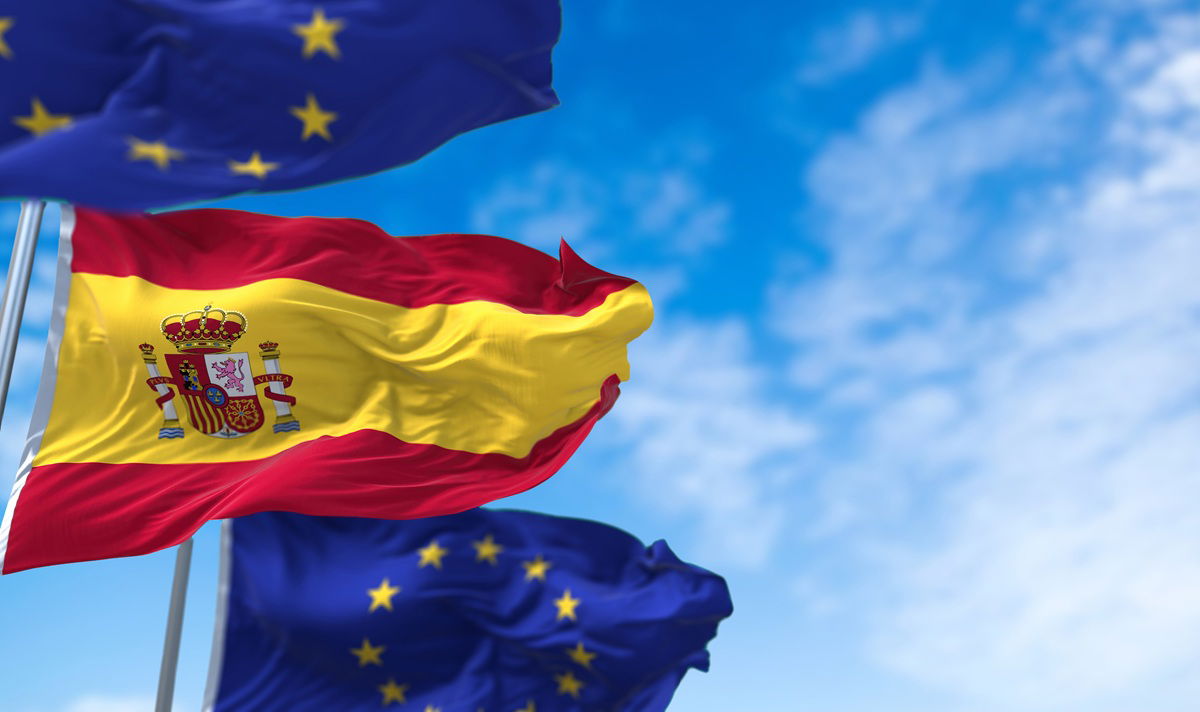
Spain marks 40 years as a member of the European Union.
Credit : rarrarorro, Shutterstock
Spain’s entry into the European Union didn’t arrive with fireworks. On January 1 1986, there were no dramatic scenes, no sudden overnight transformation. But forty years later, it’s hard to imagine the country without Europe running through almost every part of its public life.
Back then, Spain was emerging from decades of dictatorship and isolation. Joining what were then the European Communities marked a clean break with the past and the start of something more open, more connected. Four decades on, that decision has reshaped not just Spain’s economy and politics, but the way people live, work and move across the continent.
From outsider to familiar face in Brussels
Spain didn’t stay on the margins for long. Since joining, it has held the rotating presidency of the Council of the EU five times, most recently in the second half of 2023. These six-month periods placed Spain at the heart of European decision-making, steering negotiations and setting priorities at key moments.
Most Read on Euro Weekly News
Spanish figures have also become regular fixtures in Brussels. Over the years, nine Spanish commissioners have served on the European Commission. Manuel Marín was one of the earliest and most influential, even stepping in as interim Commission president in 1999. Others followed, including Joaquín Almunia, Miguel Arias Cañete and Josep Borrell, who later became EU High Representative for foreign policy.
Today, Spain continues to hold senior positions within EU institutions, a far cry from its early days as a newcomer learning the rules.
The same evolution can be seen in the European Parliament. Spain currently has 61 MEPs, and over the years has produced three presidents of the Parliament, a role few countries have managed to claim repeatedly.
Where EU money made a visible difference
For many Spaniards, the most tangible effects of EU membership didn’t come from Brussels debates, but from construction sites, rail lines and improved services at home.
Over the past forty years, Spain has received more than €150 billion in EU cohesion funds, aimed at reducing economic and regional gaps. That money helped build infrastructure that now feels routine – high-speed rail networks, upgraded roads, and broadband connections reaching millions of households.
Since 2007 alone, billions have gone into rail infrastructure, while more than seven million homes gained access to faster internet. Nearly 150,000 businesses have benefited from EU-backed funding, helping them modernise, expand or survive during difficult periods.
Alongside this came support from the European Social Fund, which has backed training, employment and job creation programmes. According to official figures, more than 32 million people in Spain have benefited from these initiatives over the years.
An economy that looks very different
Spain’s economic landscape has been transformed since 1986. Access to the single market – and later the euro – helped double the country’s GDP over four decades.
Employment followed a similar trajectory. In the year Spain joined the EU, around 10.8 million people were in work. Today, that figure stands at over 21 million, reflecting both population growth and a more diversified economy.
Trade tells its own story. Spanish exports have grown from €12.6 billion in 1986 to more than €140 billion today, nearly doubling their share of GDP. EU trade agreements with dozens of countries have played a central role in that expansion.
And then there’s Erasmus. Since the programme began in 1987, more than 200,000 Spanish students have studied elsewhere in Europe. For an entire generation, Europe stopped being an abstract idea and became a lived experience.
More than numbers
Spain’s EU membership is often measured in statistics, but its deeper impact is harder to quantify. It changed expectations, opened borders, normalised mobility and embedded the country firmly in European decision-making.
Forty years on, Spain isn’t just part of the EU – it helps shape it. What began as a step away from isolation has become one of the defining choices of modern Spain, still quietly influencing daily life across the country.
Stay tuned with Euro Weekly News for more news from Spain