
 New homes scheme
Thanet council has been put forward for a government pilot scheme which aims to fund local authorities to buy properties or refurbish derelict buildings to house people seeking asylum and awaiting decisions on their status.
As reported by Inside Housing, initially properties would be leased to the Home Office at Local Housing Allowance rates for an expected period of 10 years, but would then revert to social housing. The funding is for homes that are in addition to those the council already provides or plans to secure in the future.
Some 198 councils have reportedly expressed interest in the £100m scheme. Councils named as being put forward to take part include Thanet, Brighton and Hove, Peterborough and rural Welsh authorities. These were apparently chosen after applying for round four of the Local Authority Housing Fund, which provides additional accommodation for Ukrainian and Afghan citizens on government approved schemes.
Local Authority Housing Fund
Thanet has already taken part in the previous three rounds. In 2023 the council was allocated £1.19m of government funding towards the purchase of nine properties to temporarily accommodate Ukrainian and Afghan refugees as part of a national £500 million scheme to enable local authorities to purchase properties in their area to accommodate both Ukrainian and Afghan refugee households for an initial period of three years.
The funding allocation – which covers around 40% of the cost- was offered to 182 local authorities in England, who were deemed to have the greatest need.
Once the homes are no longer needed by these families, they become part of the council’s social housing stock.
Earlier this year it was agreed to provide a further four homes using a £632,100 allocation from the government’s Local Authority Housing Fund . This was to provide one home for temporary accommodation and three properties for resettlement families.
Round 4 of that fund has a £950 million pot to run from 2026-27 through to 2029-30.
The aim of the new pilot scheme is to end the high cost use of hotels for asylum-seeker accommodation.
Hotel accommodation costs
The expected cost of the Home Office’s asylum accommodation contracts with providers- such as Clearsprings in the South – for between 2019–29 has more than tripled, from £4.5 billion to £15.3 billion.
At the end of 2018 around 47,500 asylum seekers were accommodated by the Home Office. As of June 2025, the Home Office was responsible for accommodating around 103,000 people. The number of asylum seeking people in hotels was 32,059 as of June 2025, compared to 56,042 in September 2023.
The Government has committed to reducing the cost of the asylum system and ending the use of hotels by 2029. The contracts with the main providers – Clearsprings, Serco and Mears – have a break clause from March 2026 and end in 2029.
Accommodation providers used hotels as Contingency Accommodation for asylum seeking people prior to 2020, but the use of hotels increased dramatically as a result of the Covid pandemic.
A report by the Home Affairs Committee says hotels are significantly more expensive than Dispersal Accommodation (flats, houses, HMOs). The Home Office has estimated that the average cost per person per night of accommodating asylum seekers is £23.25 in Dispersal Accommodation, compared to £144.98 in contingency hotels. This is because hotels are full board, fully catered, with security services on site as opposed to self-catering at a property in the community.
The quality of hotel accommodation is also noted to vary considerably with some deemed not appropriate.
Home Office spending on asylum support rose from £739 million in 2019–20 to a peak of £4.7 billion in 2023–24. In 2024–25, the Home Office spent £4 billion on asylum support, of which £2.1 billion was spent on hotels.
In a bid to reduce this the Home Office says: “The Home Office has worked closely with MHCLG (Ministry of Housing, Communities and Local Government ) to begin to develop a 10-year Accommodation Strategy.
“Greater emphasis is being placed on engagement and collaboration with local authorities, and a variety of options are being tested for the longer-term model.”
It is reported in The i Paper that Serco, Mears and Clearsprings want private landlords with homes in multiple occupation (HMOs) to take on a bigger role in providing asylum seeker accommodation.

Cllr Helen Whitehead, Deputy Leader of Thanet District Council and Cabinet Member for Housing, said: “We have previously taken part in three rounds of the Local Authority Housing Fund, which provides additional accommodation in the District for Ukrainian and Afghan citizens on government approved schemes.
“We have applied for round Four of the LAHF funding to deliver more homes, and this round of funding included automatic submission to the Home Office Accommodation Pilot. We have been shortlisted for inclusion in this pilot based on our LAHF application, and we are awaiting further information on how this fund can be used.
“We are committed to the provision of high quality accommodation for all across our District, and the previous LAHF funds have allowed us to support Ukrainian and Afghan families, as well as providing long term accommodation for Thanet residents and high quality temporary accommodation for homeless families. We have already brought over two thirds of homeless Thanet residents in historic out of area placements back home to Thanet, and the use of LAHF funding has the potential to accelerate this further.
“The historic use of expensive and often poor quality and unsuitable private sector temporary accommodation to support homeless families is not a system that we support. It frequently provides poor quality accommodation for those in need, at great financial cost.
“We welcome the potential to provide more safe and suitable temporary housing and to add to our council portfolio in doing so.”
‘Rapid action’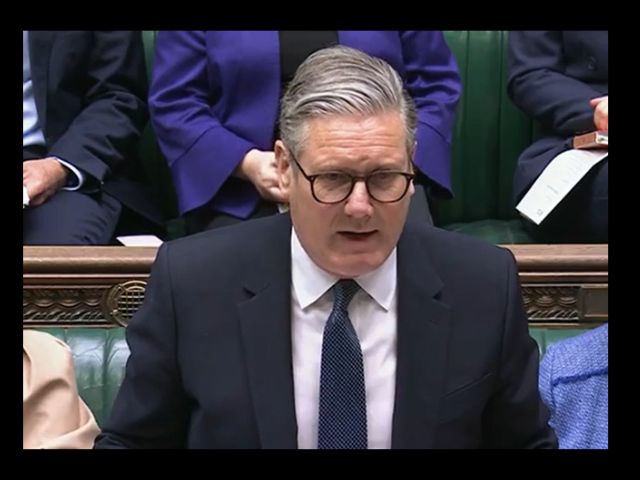 PM Keir Starmer Image Parliament Live
A letter written by PM Keir Starmer in October says: “The Government is committed to ending the use of asylum hotels. We have taken rapid action, including by accelerating the volume of asylum decision making. This makes sure that fewer people are stuck in limbo, dependent on support from the State, and so that more failed asylum seekers can be removed from the UK.
“To further support that goal, we are investing £500 million in a new, more sustainable accommodation model, developed in consultation with local authorities. In particular, this Fund will support local authorities to make available basic alternative accommodation so that it can be used on a temporary basis to house asylum seekers waiting for their cases to be processed.
“In the longer term, our ambition is that this investment will leave a lasting legacy of housing for local communities and reduce pressure on local housing markets.
“This new funding will complement ongoing Home Office reforms to the asylum accommodation estate, including pilot schemes to repurpose derelict buildings and to develop other community-led alternatives to the use of hotels.”
The Home Affairs Committee report in October said: “Greater collaboration with local authorities could help address some of the challenges to procuring new Dispersal Accommodation. Local housing authorities will inevitably have greater knowledge of the housing market in their area than Home Office officials.”