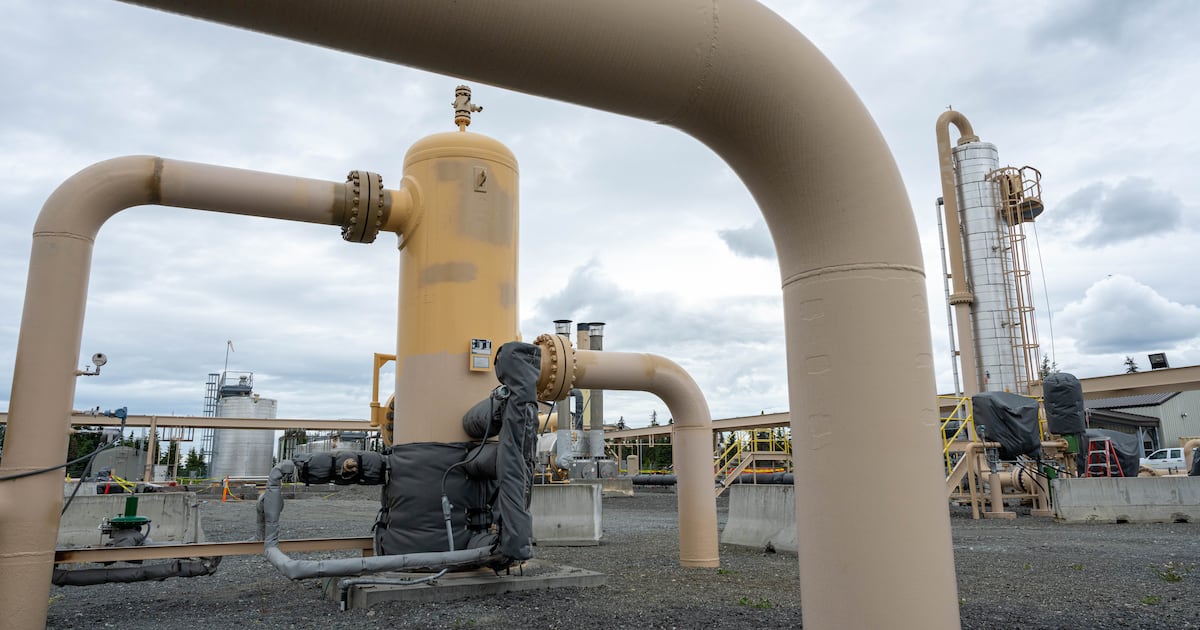
 Pipes lead to a filtration system at the Cook Inlet Natural Gas Storage Alaska facility on July 1, 2024 in Kenai. The facility takes natural gas from producers, including Hilcorp, and stores the gas underground in a depleted gas field until it is needed by its customers, which include Enstar and Chugach Electric. (Loren Holmes / ADN archive)
The natural gas utility for Southcentral Alaska said a prolonged cold snap in recent weeks increased the demand for gas from the region’s main storage facility.
But the facility, called Cook Inlet Natural Gas Storage Alaska, still contains enough gas to meet demand, said Lindsay Hobson, a spokeswoman with Enstar.
“We’re not concerned with supply right now,” Hobson said Wednesday. “We’re not concerned with being able to serve our customers.”
Hobson said that over the last three weeks, Enstar has pulled more gas from the facility than it had planned, an additional 1 billion cubic feet, as temperatures often plunged below zero.
It’s been 20% to 30% colder than anticipated, she said. But the storage facility on Wednesday held 7.4 billion cubic feet of natural gas to help heat and power homes in Southcentral.
CINGSA, constructed about 15 years ago from depleted natural gas reservoirs in Cook Inlet, plays a critical role in winter, providing stored gas that meets increased demand alongside the gas available from producing wells.
Another major utility in the region, Chugach Electric Association, said Wednesday that it has taken some gas out of the storage facility.
But Chugach Electric’s gas needs are being met by produced gas under its contract with producer Hilcorp, and from the Beluga River gas field where the utility is the majority, working-interest owner, said Julie Hasquet, a spokeswoman with Chugach Electric.
The Beluga River field in Cook Inlet is exceeding production forecasts and has been the basin’s top producing field these last two years, Hasquet said.
“We have no concerns,” Hasquet said, referring to the utility’s current gas supply after the cold snap.
Nearly two years ago, apprehension about immediate gas supply rose sharply in the region during an especially brutal cold snap that pushed temperatures in Anchorage to 20 below.
But that period was also marked by damage to two gas wells at the storage facility, which is operated by Enstar. The failure of those wells reduced the facility’s ability to deliver gas by 30%, sharpening fears of an emergency shortage that didn’t materialize.
Since then, a $68 million overhaul has upgraded and expanded the facility, which now counts seven operating gas wells, up from five.
That has expanded the facility’s ability to meet demand, Hobson said.
“That has put us in a much better spot,” she said.
Still, there’s reason to be cautious, she said.
If temperatures were to stay unseasonably cold for several weeks on end and demand for gas continued at its recent pace, gas deliverability could eventually be a problem, much like the air leaving a balloon slows as it runs out, Hobson said.
If a problem with gas deliverability were to arise, Enstar and other utilities would take additional steps to ensure that the region has enough gas to meet current needs, Hobson said.
That could include asking electric utilities to maximize the use of other sources of fuel beyond natural gas and a public awareness campaign that encourages customers to use less heat and power.
Hopefully, as winter continues, the demand on stored gas will slow and perhaps the balance of gas can be expanded with gas from producing wells in Cook Inlet, she said.
“We’re looking ahead and hoping that we have a normal or warm spring to help offset the cold we’ve had and the balance that we’ve had to draw down to respond to that,” she said.
Longer-term, Southcentral Alaska faces a shortage of gas from Cook Inlet, where production has waned over the decades.
Utilities are looking at importing natural gas in the coming years, which is expected to add to energy costs.
That bigger issue means concerns about short-term gas supply will likely crop up again during very cold stretches, Hobson said.
With less gas available, there’s less resilience in the system to respond to abnormal temperatures, she said.
“This is something that is probably going to come up every year as a reality of the Cook Inlet market and declining production,” she said.