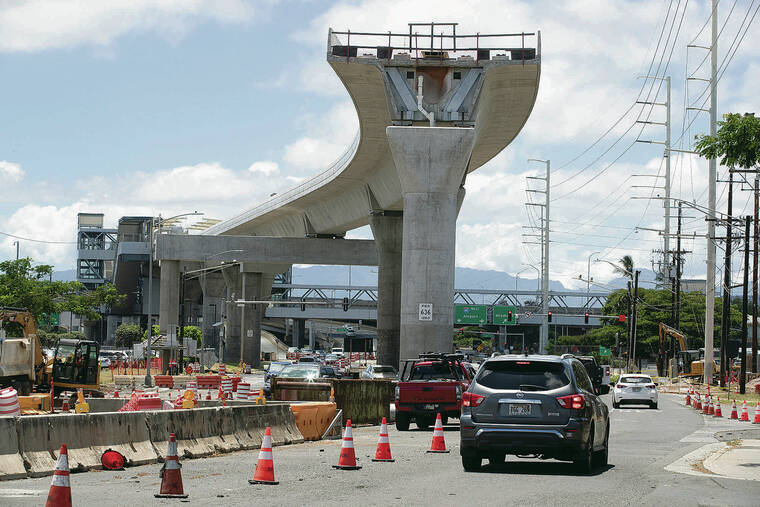
Hawaii’s 2026 is sure to feature a busy election season with many state and county seats on the ballot, and plenty of traffic disruptions as the ongoing rail construction heads into the Dillingham corridor and downtown.
Less certain — but still likely to dominate the headlines this year — will be the state of Hawaii’s economy and it’s No. 1 industry, tourism, both of which have been languishing under tariffs, federal budget cuts and high prices in 2025.
The primary election in August and general election in November will decide races for Hawaii’s two U.S. House seats, the governor and lieutenant governor, 14 of the 25 state Senate seats, all 51 state House seats, the Office of Hawaiian Affairs, Maui and Kauai County mayors and various seats on the Kauai, Maui and Honolulu councils.
The state Legislature, beginning in January, also will consider a recommendation from the state Office of Elections to consider eliminating Hawaii’s widely popular mail-in voting system and return instead to one day of in-person voting, in response to President Donald Trump’s continued insistence that the 2020 election was stolen from him.
Gov. Josh Green in 2025 teased a potential presidential run. But last month, Green told the Honolulu Star-Advertiser that he remains committed to seeking his second and final term as governor for another four years. He currently faces no major Republican or Democratic challenger.
The Legislature appears unlikely to follow the recommendation from the Office of Elections to eliminate mail-in voting, which was driven by a majority of the commission, which continues to cast doubt on the security of Hawaii’s elections.
Stay in touch with breaking news, as it happens, conveniently in your email inbox. It’s FREE!
Republican election observers, however, have told the Star-Advertiser during recent election cycles that they saw no evidence of vote tampering or election impropriety as mail-in ballots travel from the Post Office to be counted at the state Capitol.
In the 2024 presidential election, 95% of the state’s 551,036 ballots were cast by mail-in voting. On Oahu only 17,204 voters, or 3.1%, voted in person.
Although small in numbers, those who vote in person across Hawaii have delayed the timely release of election returns since 2020 because Hawaii law prohibits the release of any results until the last person waiting in line by 7 p.m. has voted. Any eligible voter also can register on Election Day and vote, further holding up lines at polling places. The first tally of election night returns includes all mail-in ballots and represents a key indicator of voter preferences.
In 2020 and again in the 2022 midterm elections and the 2024 presidential election, long lines of in-person voters wrapped around Honolulu Hale and Kapolei Hale, delaying the release of the first vote tallies for hours.
Rail comes to town
In urban Honolulu this year, ongoing work to relocate utility lines along the busy Dillingham corridor is expected to continue throughout 2026, along with construction of underground shafts to hold columns to support overhead Skyline tracks heading into the final station in Kakaako, which is scheduled for completion in 2031.
But the City Council this year could vote on whether to allow the Honolulu Authority for Rapid Transportation to consider pushing the 18.5-mile rail route further west in Kapolei and further east, possibly to its original final destination at Ala Moana — or even all the way to the University of Hawaii.
The original rail plan called for 20.2-miles of track and 21 stations but was cut to 18.75 miles and 19 stations to get the system open within the current budget, and to restore trust with the Federal Transportation Administration. The change resulted in the first influx of federal funds that had been frozen since 2017.
If the Council approves Bill 60, Mayor Rick Blangiardi and HART CEO and Executive Director Lori Kahikina would have to work with the HART board to figure out how to fund an extended system.
“Anything further (than Kakaako) requires approval from the mayor and the Council,” Kahikina told the Star-Advertiser. “If Bill 60 passes, it would authorize us to start looking at different (route and funding) options. It takes a lot of time to plan. So the sooner HART gets authorization, the sooner we can start to plan.”
Dollars and sense
Economic forecasts last year consistently predicted that Hawaii’s economy will slow in 2026 for a variety of reasons, including Trump administration policies such as tariffs and federal spending cuts; the slowdown in island tourism; reduced hiring by private employers; the increase in Hawaii’s minimum wage, which rises $2 an hour today to $16; higher grocery bills; and overall jittery consumer confidence.
Trump administration cuts to state programs and nonprofits are also expected to continue, bringing more economic uncertainty even as Gov. Josh Green has prepared a supplemental state budget that tries to anticipate more federal cuts this year.
At the same time, the state will begin collecting millions of dollars in additional hotel room tax revenue starting today. The so-called green fee is designed to help the state adapt to changes brought by climate change, funding efforts to prevent wildfires and fight beach erosion, coral reef damage, and the effects of sea-level rise.
Valley Isle housing
Maui residents, visitors and the vacation rental industry will be watching closely for what comes next after the County Council in December passed Maui Mayor Richard Bissen’s Bill 9 to transition 6,208 short-term vacation rentals into long-term housing for local residents.
Owners of 43 vacation rental units in the Ka‘anapali Royal condo complex in West Maui quickly filed the first legal challenge to Bill 9, claiming it violates their property rights, among other grievances.
Under Bill 9, owners of short-term vacation rentals in West Maui have three years to convert to long-term use, followed by five years for South Maui owners.
But property values have dropped as much as 30% since Bissen proposed Bill 9 in 2024 and it remains to be seen how owners will respond as lawsuits move through the courts.
Property owners insist the new law will make it impossible for lenders to offer mortgages for local residents to buy their units.
Some 94% of the short-term vacation rental property owners live outside of Maui and several of them told the Council during months of public testimony that they would rather hold on to condo units for their occasional personal use — along with other vacation rentals they own on Maui — rather than rent them to local residents. Others said they will have to fire the housekeepers, plumbers, electricians and other workers who maintain the properties.
Army negotiations
Discussions are also likely to continue this year over the future of Army land leases that are scheduled to expire in 2029 across the state.
In 1964, the Army obtained $1 leases for parcels of land at Pohakuloa on Hawaii island, and on Oahu in Makua Valley, the Kahuku Training Area and Kawailoa-Poamoho.
But Army Secretary Dan Driscoll said over the summer that he hoped to reach an agreement with the state before the 2029 deadline while also informing Green that seizing state lands through eminent domain remained a possibility rather than renegotiating Army leases with the state Board of Land and Natural Resources.
Driscoll’s position angered many Hawaii residents who remain upset by the U.S. military’s vast presence in Hawaii. Many residents also continued to be concerned about unexploded military ordnance on the islands and that occasionally washes up on beaches.