by Vanguard Staff
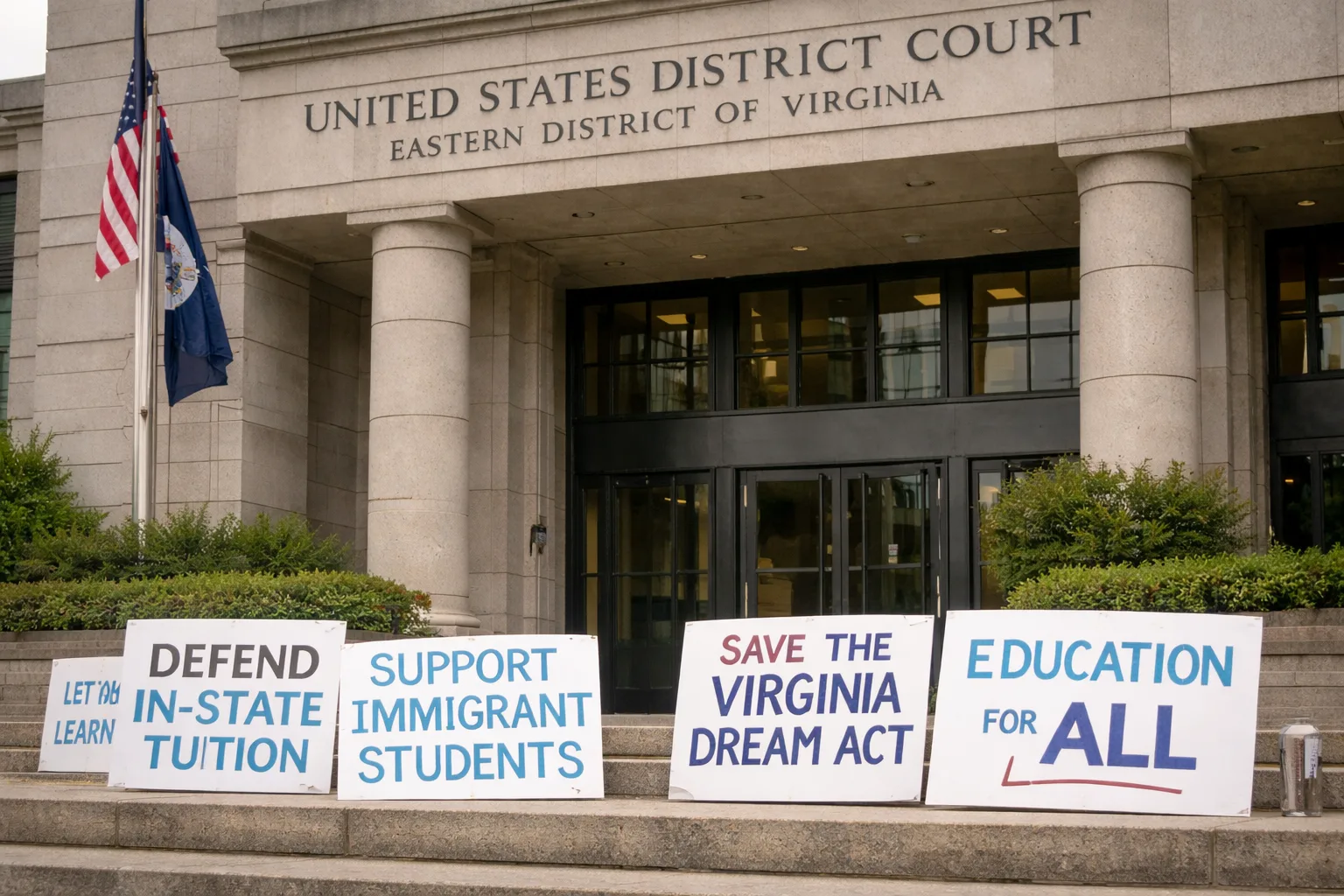
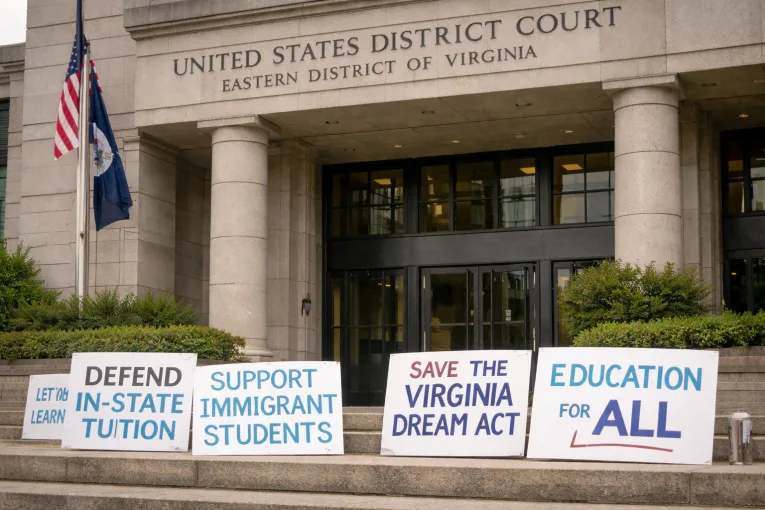
RICHMOND, Va. — Immigrant rights advocates filed an emergency motion this week seeking to intervene in a federal lawsuit challenging Virginia’s in-state tuition law for immigrant students after state officials agreed to invalidate the statute without mounting a defense, a move advocates say could immediately upend the educational futures of thousands of students.
On behalf of the Dream Project, attorneys with the Legal Aid Justice Center and the ACLU of Virginia filed the motion in U.S. District Court for the Eastern District of Virginia after the Trump administration sued the Commonwealth over its in-state tuition policy and Virginia joined the federal government in seeking a consent judgment to end the law.
The lawsuit, filed Monday by the U.S. Department of Justice, challenges Virginia’s statute allowing students who attended Virginia high schools and whose families pay state taxes to qualify for in-state tuition regardless of immigration status. The following day, Virginia entered a joint motion with the federal government asking the court to declare the law invalid, a step that would prevent any adversarial testing of the statute’s legality.
Advocates say the state’s rapid capitulation leaves immigrant students without any voice in a case that could determine whether they can afford to remain in college.
“These are Virginia students who grew up in the Commonwealth, graduated from our high schools, contribute to our communities, and made life-altering decisions for their futures relying on a state law that has existed for years,” said Rohmah Javed, director of the Immigrant Justice Program at the Legal Aid Justice Center. “They are Virginians in every way that matters, and they deserve someone to stand up and fight for them. We want to intervene for the court to consider the real-world impact on Virginia students before making a final decision.”
The emergency motion asks the court to allow the Dream Project to intervene, extend deadlines for filings, and pause consideration of the proposed consent judgment until students and advocates have an opportunity to present arguments in defense of the law.
“The Attorney General of Virginia has abandoned his duties to defend Virginia law and the people of the Commonwealth, so we must,” said Sophia Gregg, senior immigrants’ rights attorney for the ACLU of Virginia. “Attorney General Jason Miyares has sided with the Department of Justice—intentionally working in secrecy and over a holiday weekend—to manufacture a predetermined outcome to deprive Virginian students of not only their futures but their day in court.”
The Dream Project is a Virginia-based nonprofit that supports immigrant students pursuing higher education through scholarships, mentorship and advocacy. Many of its scholars rely on in-state tuition rates because they are ineligible for federal financial aid, making the tuition differential between in-state and out-of-state rates financially decisive.
If the consent judgment is approved, students could lose their in-state tuition eligibility immediately, potentially forcing some to withdraw from classes or abandon college plans mid-year.
“The motion by the Trump administration was deliberately filed over a holiday in the dead of night without briefing, without public scrutiny, and without hearing from our scholars and families who would be impacted by this judgment,” said Zuraya Tapia-Hadley, executive director of the Dream Project. “Through our students, volunteers, and leaders, the Dream Project contributed to pivotal work to achieve the passage of the Virginia Dream Act. The state and federal administrations are attempting to re-legislate and set aside the will of the people.”
Tapia-Hadley said the consequences would extend beyond individual students to institutions and communities across Virginia.
“If we don’t intervene, that essentially opens the door for settled law to be thrown out with the wave of a pen via a judgment,” she said. “Virginia will lose the many talents that our scholars contribute to institutions throughout our Commonwealth. It’s also an existential challenge to the Dream Project and would undermine our core mission, disrupt ongoing scholarship and mentorship programs, and require the diversion of our limited resources to provide crisis support for students facing sudden, severe, and irreparable financial hardship.”
According to the motion, Virginia’s law was carefully crafted to comply with federal requirements and mirrors similar statutes in other states that have survived legal scrutiny. Advocates argue that the state’s immediate agreement to invalidate the law denies students the opportunity to have their interests represented before the court rules on an issue with far-reaching consequences.
The filing also points to recent federal lawsuits in other states, including Texas and Oklahoma, where similar challenges were resolved rapidly through consent judgments, sometimes within days, without full adversarial proceedings. In contrast, comparable cases in Illinois, Minnesota and Kentucky have involved active defenses by attorneys general or intervenors, allowing courts to consider constitutional arguments on both sides.
The case was filed as United States v. Commonwealth of Virginia, Case No. 3:25-cv-01067. The Dream Project’s motion to intervene asks the court to stay action on the joint motion for a consent judgment until the intervention request is resolved.
The Legal Aid Justice Center and the ACLU of Virginia are providing pro bono representation in the matter.
Follow the Vanguard on Social Media – X, Instagram and Facebook. Subscribe the Vanguard News letters. To make a tax-deductible donation, please visit davisvanguard.org/donate or give directly through ActBlue. Your support will ensure that the vital work of the Vanguard continues.
Categories: Breaking News Immigration National Issues Tags: Civil Rights Higher Education Immigration in-state tuition Jason Miyares Rohmah Javed Sophia Gregg The ACLU of Virginia The Dream Project Trump Administration Virginia Dream Act Zuraya Tapia-Hadley