Should have asked for more, maybe we could have had enough money to finish the wall
If they managed to rearm, they weren’t paying enough.
I won’t spoil it for you but >!thanks to the Anglos stabbing us in the back by trying to return to business as usual, Germany managed to not pay the already low reparations, while not having to deal with its WW1 debt, and rebuild their military industry all at the same time !<
Treaty of Versailles wasn’t harsh enough and Germany never paid their reparations. Also they were “saved” by those Anglos bankers, who quite destroyed Germany in 1929. Anyway, nuka-cola Germonkey.
Weren’t the French actually quite lenient on the Germans all things considered
Unlike the treaties at Frankfurt and Brest-Litovsk, which surely were fine and dandy?
Hans gets a bad rap sometimes, but this was silly a century ago and remains silly today.
Versailles was nothing compared to 1870.
And we paid everything 😉
Sorry, Pierre, Hans actually paid his WWI reparations off with his final payment on 3 October 2010.
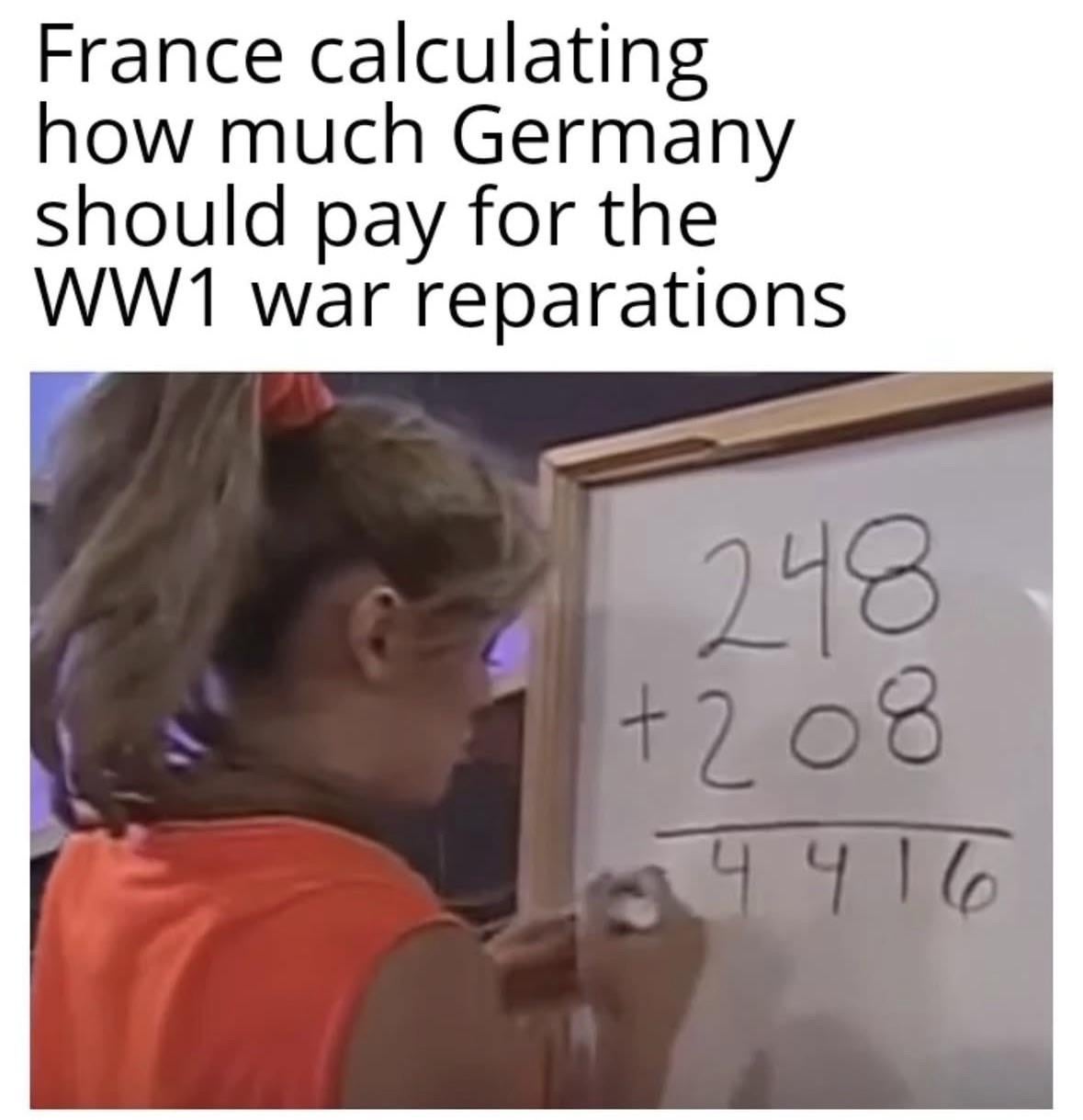
This pic actually shows Aziza calculating the reparations Algeria is demanding from Pierre for 130 years of colonialism.
The reparation asked were similar to the ones asked by Germany from France in 1871, which were paid in 4 years.
France lost in 1871 about the same % of land, but some of its most industrialised and coal producing parts, not bits of Poland.
War reparations didn’t do Jake shit in the rise of nazism. In 1928, NSDAP scores are one digit and Germany is paying theme for a decades. In 1932 they are through the roof.
This one is solely on the Americans and their habit to fuck up Europe economy with bubble.
>There are those, not all German, who claim reparations were unpayable. In financial terms, that is untrue. After 1871, France, with a much smaller economy than Germany’s fifty years later, paid nearly as much in two years (by French estimate) to liberate its territory as the Weimar Republic paid from 1919 through 1932…Of course Germans did not want to pay; nobody ever wants to pay, and Weimar was determined not to do so. As Gerald Feldman remarked, “No one has accused the Germans of honestly and forthrightly attempting to fulfil their obligations under the treaty.”60 That does not mean they could not pay. The real reparations bill of 50 milliard gold marks was within German economic and financial capacity. Berlin protested it could not pay or claimed to London that an export drive that would hurt Britain’s battered trade balances was the only means for it to do so. But Germany’s tax rates were abnormally low and remained so, though the treaty required a rate commensurate with those of the victors. 61 Raising taxes would have provided ample funds, as the Dawes Committee discovered.62 Weimar could have borrowed from the citizenry, as France did after 1871. Despite the reams written about the need for German economic reconstruction, 63 that economy was intact, having been spared devastation and denudation. There were lavish social subsidies, unmatched by the victors. A fiscal and monetary housecleaning would have facilitated foreign loans. And after 1924 Germany’s railways easily contributed substantially to reparations.
They could have raised taxes. They didn’t, unlike other countries. In fact, Germany’s tax rates were abnormally low, well below that of the victorious countries.
They could have started new taxes, as France did, with an income tax, which would have raised Germany a lot more money, with its larger population. They didn’t.
They could have borrowed from the citizenry. They didn’t. There were still lavish social subsidies available, which never went away.
In fact, despite considerable financial and economic capability, Germany did not pay. Not because it could not pay. But because it would not.
Weimar Germany received more money than they ever paid out. They arranged payments in kind to other countries (coal, steel, timber, etc) and then printed off untold amounts of marks, destroying the value of their own currency, which created the hyperinflation crisis of 1923 (the children playing with stacks of banknotes photos, which everyone loves to bring up). This had the effect of evaporating domestic war debt, because so what if the government owed an armaments conglomerate 100 million marks, when 100 million marks is the price of a sandwich tomorrow. It also had the effect of minimising the costs of payments in kind, e.g. the government pays a mining corporation to deliver x tons of coal to France at y marks per ton for the next z months. The cost of this rapidly became almost nothing, as the contract preceded the beginning of the hyperinflation Germany caused.
1920-1922 for instance, Germany fell short by some 15,000,000 tons of coal, while it was simultaneously exporting coal to Austria and Switzerland at a good markup. This is especially indicative of bad faith for several reasons; payments were based upon, and revised downwards from, German offers, the shipments were arranged by Germany at a fixed price in paper marks, which Germany had intentionally devalued, allowing them to fund such deliveries at impossibly low prices, and shipments continued to fall short, even as Germany received further funding in loans and bounties for development of industries and deliveries respectively.
Pierre also calculating how much Haiti owed them for killing their slave masters
14 comments
Should have asked for more, maybe we could have had enough money to finish the wall
If they managed to rearm, they weren’t paying enough.
I won’t spoil it for you but >!thanks to the Anglos stabbing us in the back by trying to return to business as usual, Germany managed to not pay the already low reparations, while not having to deal with its WW1 debt, and rebuild their military industry all at the same time !<
Treaty of Versailles wasn’t harsh enough and Germany never paid their reparations. Also they were “saved” by those Anglos bankers, who quite destroyed Germany in 1929. Anyway, nuka-cola Germonkey.
Weren’t the French actually quite lenient on the Germans all things considered
Unlike the treaties at Frankfurt and Brest-Litovsk, which surely were fine and dandy?
Hans gets a bad rap sometimes, but this was silly a century ago and remains silly today.
Versailles was nothing compared to 1870.
And we paid everything 😉
Sorry, Pierre, Hans actually paid his WWI reparations off with his final payment on 3 October 2010.
This pic actually shows Aziza calculating the reparations Algeria is demanding from Pierre for 130 years of colonialism.
Versailles was to Harsh.
You break shit, you pay for it
https://preview.redd.it/mm52pg4qysag1.jpeg?width=1080&format=pjpg&auto=webp&s=bc769a9050d47e89f2fc5ee941d50a70ff5fdd5d
You don’t want to be our sugar daddy anymore ? 🥺
Vae victis
It was on pare with what was usual at the time.
The reparation asked were similar to the ones asked by Germany from France in 1871, which were paid in 4 years.
France lost in 1871 about the same % of land, but some of its most industrialised and coal producing parts, not bits of Poland.
War reparations didn’t do Jake shit in the rise of nazism. In 1928, NSDAP scores are one digit and Germany is paying theme for a decades. In 1932 they are through the roof.
This one is solely on the Americans and their habit to fuck up Europe economy with bubble.
>There are those, not all German, who claim reparations were unpayable. In financial terms, that is untrue. After 1871, France, with a much smaller economy than Germany’s fifty years later, paid nearly as much in two years (by French estimate) to liberate its territory as the Weimar Republic paid from 1919 through 1932…Of course Germans did not want to pay; nobody ever wants to pay, and Weimar was determined not to do so. As Gerald Feldman remarked, “No one has accused the Germans of honestly and forthrightly attempting to fulfil their obligations under the treaty.”60 That does not mean they could not pay. The real reparations bill of 50 milliard gold marks was within German economic and financial capacity. Berlin protested it could not pay or claimed to London that an export drive that would hurt Britain’s battered trade balances was the only means for it to do so. But Germany’s tax rates were abnormally low and remained so, though the treaty required a rate commensurate with those of the victors. 61 Raising taxes would have provided ample funds, as the Dawes Committee discovered.62 Weimar could have borrowed from the citizenry, as France did after 1871. Despite the reams written about the need for German economic reconstruction, 63 that economy was intact, having been spared devastation and denudation. There were lavish social subsidies, unmatched by the victors. A fiscal and monetary housecleaning would have facilitated foreign loans. And after 1924 Germany’s railways easily contributed substantially to reparations.
https://www.jstor.org/stable/10.1086/670825
They could have raised taxes. They didn’t, unlike other countries. In fact, Germany’s tax rates were abnormally low, well below that of the victorious countries.
They could have started new taxes, as France did, with an income tax, which would have raised Germany a lot more money, with its larger population. They didn’t.
They could have borrowed from the citizenry. They didn’t. There were still lavish social subsidies available, which never went away.
In fact, despite considerable financial and economic capability, Germany did not pay. Not because it could not pay. But because it would not.
Weimar Germany received more money than they ever paid out. They arranged payments in kind to other countries (coal, steel, timber, etc) and then printed off untold amounts of marks, destroying the value of their own currency, which created the hyperinflation crisis of 1923 (the children playing with stacks of banknotes photos, which everyone loves to bring up). This had the effect of evaporating domestic war debt, because so what if the government owed an armaments conglomerate 100 million marks, when 100 million marks is the price of a sandwich tomorrow. It also had the effect of minimising the costs of payments in kind, e.g. the government pays a mining corporation to deliver x tons of coal to France at y marks per ton for the next z months. The cost of this rapidly became almost nothing, as the contract preceded the beginning of the hyperinflation Germany caused.
1920-1922 for instance, Germany fell short by some 15,000,000 tons of coal, while it was simultaneously exporting coal to Austria and Switzerland at a good markup. This is especially indicative of bad faith for several reasons; payments were based upon, and revised downwards from, German offers, the shipments were arranged by Germany at a fixed price in paper marks, which Germany had intentionally devalued, allowing them to fund such deliveries at impossibly low prices, and shipments continued to fall short, even as Germany received further funding in loans and bounties for development of industries and deliveries respectively.
Pierre also calculating how much Haiti owed them for killing their slave masters
Comments are closed.