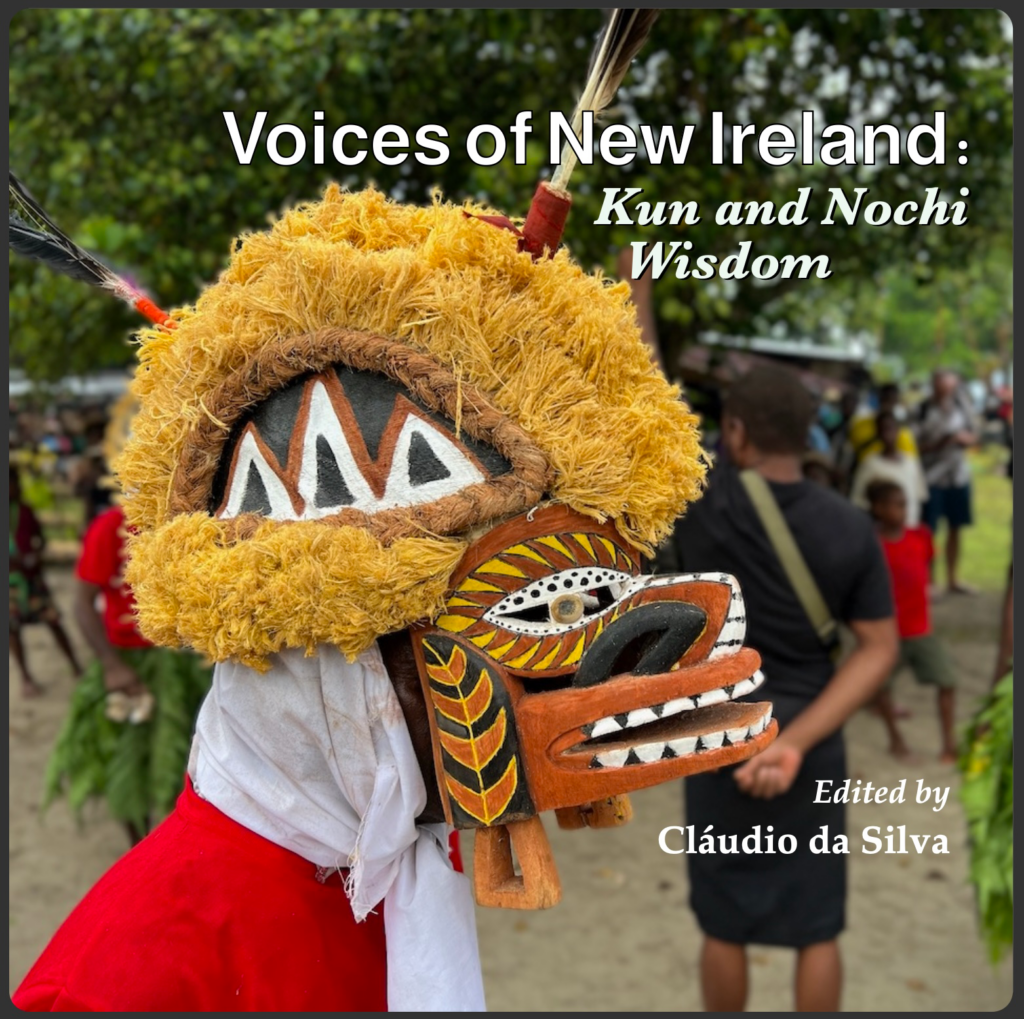
ON Dec 9, 2025, parents and students at Langenia Primary School in New Ireland hosted the launch of a community-authored book Voices of New Ireland: Kun and Nochi Wisdom.
The lively event brought together traditional leaders and community members from the three villages directly involved in the project: The Kun village of Liedan and the Nochi villages of Langenia and Lossu II, together with students from the school.
The launch marked the conclusion of a project that began in 2022 and was celebrated as a meeting point between different generations and ways of knowing. Throughout the event, students and community members presented traditional dances and songs, highlighting the vitality of local knowledge and the collective participation that shaped the entire process.
Created through shared effort
Voices of New Ireland: Kun and Nochi Wisdom is part of a project led by Brazilian-Portuguese researcher Cláudio da Silva, a PhD candidate in Education at the Faculty of Psychology and Education Sciences of the University of Porto, Portugal, in partnership with the three communities.
Cláudio had previously developed a similar collective book with the Nalik community, also in New Ireland, in 2016. In this new initiative, support from the Portuguese Foundation for Science and Technology (FCT) made it possible for him to remain in New Ireland for several months and work in close relationship with the communities involved.
Over six months, he facilitated the workshop Our Book Project at Langenia Primary School, in which students actively took part in every stage of the book’s development. Activities began with discussions about the structure of books and their social role, helping students understand the different forms of knowledge and genres a book can bring together. From there, students themselves collectively decided on the themes to be included, such as the everyday life of the school and its natural environment, village life, and Kun and Nochi traditions.
To develop the content, students carried out interviews with family members and local leaders, took part in classroom discussions, analysed maps and materials related to New Ireland Province, and visited villages to take photographs. Alongside this work by the students, Cláudio da Silva also conducted interviews with community leaders and elders, gathering additional information, deepening the topics explored and complementing what students were bringing into the project.
At the same time, an art workshop was held, where students created illustrations, maps and drawings that appear throughout the book. Texts, images and songs came together as interconnected ways of expressing and producing knowledge, reflecting different ways of learning and narrating life in the villages.
While most of the texts were written in English, the book also includes words, expressions and many songs in Kuot, the language of the Kun people, and in Nochi, spoken by the Nochi communities. This was a decision made by the students themselves. The book will supplement the school curriculum, which often has limited connection with the everyday lives and cultural knowledge of these communities.
Throughout the workshop and during the editing of the book, community members closely followed the process, reviewing, complementing and, when necessary, vetoing content that did not adequately represent their perspectives. This collective validation process was essential to ensuring that the book genuinely reflects the voices, knowledge and worldviews of the Kun and Nochi communities themselves, da Silva said.
Education, belonging and valuing local knowledge
Reflecting on the project as a whole, Cláudio da Silva said, “initiatives like this show how indigenous knowledge, often marginalised within formal schooling, can contribute to more dynamic and meaningful learning experiences. By linking history, geography, science and the arts to local knowledge, students were able to connect classroom learning with their own lived experiences, memories and cultural references.”
He went on to say that the project behind Voices of New Ireland demonstrates that dialogue between school knowledge and traditional knowledge broadens the curriculum and strengthens students’ sense of belonging, identity and self-esteem. “Seeing their own cultures represented and respected in books at school helps schools become more inclusive spaces, grounded in the communities they serve,” he said.
Besides its value as a tool for classroom work, the book stands as an important record of the histories, practices and knowledge of the Kun and Nochi communities, produced through a participatory process. According to da Silva, “I hope that this experience will inspire similar initiatives, supporting forms of education that recognise and value cultural diversity as a living part of everyday learning.”
lMore information about the book and the workshops that created it is available from da Silva at [email protected]