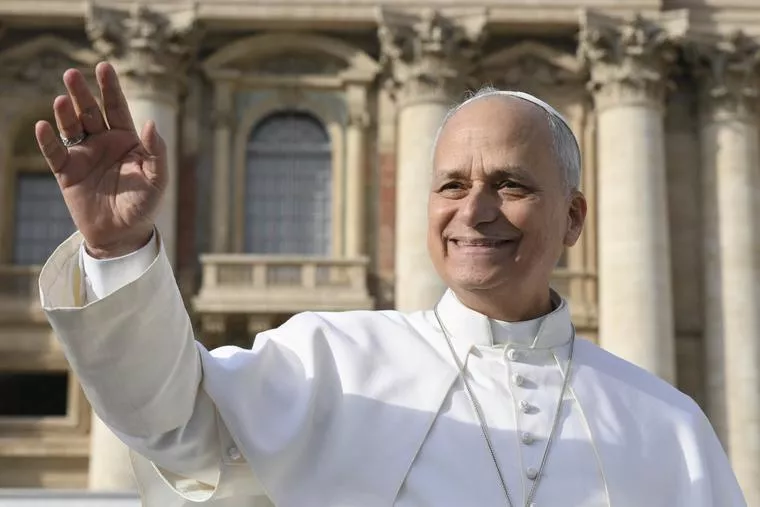
While 2025 will forever be remembered as the year the Catholic Church got its first American pope, 2026 is likely to be the year that he begins to fully make his mark.
Pope Leo XIV’s impact on the Church and the world is expected to come into fuller focus in 2026, his first full calendar year as pontiff. The Chicago-born successor to Pope Francis will set his own course on everything from Vatican governance and liturgy to papal travel and major teaching documents.
Other forces will shape the year ahead as well, from the rapid advances of artificial intelligence (AI) and how to regulate the technology to America’s geopolitical realignment and the start of the transition to a post-Trump political landscape.
Underneath it all lies a current of potential spiritual renewal, headlined by a special consecration of the United States on a pivotal anniversary and the possibility of new American saints, all under the gaze of the first pope to hail from the Land of the Free.
Pope Leo’s Year
Elected on May 8, Pope Leo has already made a significant impact on the Church and the world, from his emphasis on unity to his frequent hat tips to his American roots. At the same time, this past year was still defined, in part, by the late Pope Francis.
Not only was 2025 marked by the last few months of the Argentinian’s pontificate and his April 21 death, but also by Francis’ schedule and priorities.
For the first several months of his pontificate, Leo followed through on initiatives that his predecessor already had in the works, from the recent trip to Turkey to commemorate the 1,700th anniversary of the Council of Nicaea to the publication of an exhortation on love of the poor, Dilexi Te.
Leo certainly made each of these initiatives his own, whether by adding his own personal reflections as a missionary to Peru to Dilexi Te or by tacking on a visit to Lebanon during his Middle East trip, but the impetus was still Francis’.
But in 2026, it will be all Leo, all the time, as there will be no more inherited events or appointments on the agenda.
To mark this transition, the Pope has called an extraordinary consistory of cardinalsto meet with him in Rome Jan. 7-8, just after the 2025 Jubilee ends. The purpose won’t be to create new cardinals, but to discuss important issues facing the Church.
EWTN Vatican expert Andrea Gagliarducci called this gathering of the top ranks of Church leadership “a fundamental turning point” in the papacy of Leo XIV.
“From the Pope’s words, from the way he conducts the consistory, we can understand how the Pope’s pontificate will unfold,” Gagliarducci wrote.
According to the Italian newspaper Il Giornale, synodality, Vatican governance and the liturgy are topics to be discussed.
The consistory may mark the symbolic start of a fully Leonine papacy, with other significant decisions set to follow.
For instance, what papal trips will the American Pope prioritize in 2026? Returns to either the United States or Pope Leo’s beloved Peru are rumored to be in the works, as is a potential trip to Algeria, the birthplace of St. Augustine of Hippo, a source of papal inspiration.
Furthermore, Pope Leo is also poised to make big moves to restructure Vatican leadership. Several heads of departments, such as Cardinal Arthur Roche of the Dicastery for Divine Worship and the Discipline of the Sacraments, have passed the 75-years-of-age threshold when prelates submit their letter of resignation.
And 2026 is also likely to be the year that Pope Leo releases his first major teaching documents, including a highly anticipated social encyclical on artificial intelligence.
AI, Geo-Politics and Electoral Politics
Speaking of AI, the technology — and debates about how to regulate it — will continue to be a defining theme of the coming year.
As one sign of AI’s continued integration into nearly every aspect of life, worldwide spending on the tech is expected to surpass $2 trillion in 2026, up from nearly $1.5 trillion in 2025.
Increased productivity, predictive power and advances in areas like health care are frequently cited advantages of the technology, while labor displacement, security risks, and the loss of human creativity and relationality are frequently mentioned concerns.
While the Catholic Church has consistently said that AI must be regulated for the sake of the common good, the Trump administration has embraced a position of radical deregulation — and also intends to penalize states that pass laws that are inconsistent with the U.S. achieving “global dominance of AI.”
The new year is also likely to be a year of geopolitical reckoning, with the Trump administration poised to continue its “America First” foreign policy. The stakes are high, and not everyone is thrilled about the apparent direction.
“2026 could well be the year that determines whether history’s verdict in the Cold War is overturned by a combination of Russian aggression, Trumpian quasi-isolationism and European fecklessness,” said the Catholic writer George Weigel. “I hope that doesn’t happen. If it does, the people of the United States will eventually regret it.”
On the domestic front, Trump’s campaign of mass deportation of people illegally in the United States will continue to be a major touch point in American political life. The U.S. bishops have forcefully pushed back against it, while most American Catholics continue to indicate their support for Trump’s approach.
The American public will have the opportunity to weigh in on the Trump administration’s agenda via midterm elections in November 2026. Republicans currently control both the U.S. Senate and House.
But the midterms will also be something of a threshold, marking the start of unofficial campaigning for the 2028 presidential election. With Trump ineligible to run again, Catholic politicians like Vice President JD Vance and Secretary of State Marco Rubio are top contenders on the GOP side, while Gavin Newsom, the Catholic governor of California, is one of the leading Democrats.
More broadly, the transition from Trump to whomever comes next will begin to play out in 2026 and may provide an opportunity for a reset of American political life.
“The big question in our domestic politics is whether someone will stand up and say, ‘Hello, I’m the adult in the room and I’m going to talk with you and to you as if we’re all adults,’” said Weigel. “That person, should he or she emerge, will attract a considerable following across the political spectrum.”
Spiritual Renewal in America
While political and social life in 2026 is expected to be as turbulent as ever, the new year could also present opportunities for profound spiritual renewal in the United States.
Most notably, the U.S. bishops plan to consecrate the nation to the Sacred Heart of Jesus ahead of the 250th anniversary of the American founding.
“This is a timely and much-needed occasion,” said Michael Heinlein, a Catholic author, “for us as a Church to reflect on the source of our unity and holiness; to invite the larger society to encounter Christ’s heart; and for all of us to discover therein the answer to all of our longings.”
Heinlein added that he hopes parishes and dioceses equip the faithful “with resources, devotions and offer occasions to gather in prayer, seizing this opportunity and giving it a chance to bear much fruit throughout America.”
The consecration will take place amid a fascinating set of trends in American religious life that could continue into 2026. Even while overall levels of religiosity continue to fall, stories of young people drawn especially to Catholicism (and its more traditional devotions and liturgical expressions) have seized both secular and Catholic attention. Likewise, observers will be keen to note in 2026 if there is any kind of “Leo effect” on vocations to the priesthood in the U.S., after another year of declining numbers.
Heinlein suggests another storyline for 2026 that could be influenced by the presence of an American Pope: the advancement of the sainthood cause of Archbishop Fulton Sheen, whose process has been “postponed” since 2019. Pope Leo could also prioritize the cause of another American holy man: Blessed Michael McGivney, the founder of the Knights of Columbus.
The recognition of an American saint would be a fitting highlight for a year set to be marked by both the consecration of the country in its 250th anniversary year and the full-fledged reign of the first American Pope.
This article was originally published by NCRegister.