Facebook
Twitter
LinkedIn
Pinterest
Reddit
Email
Print
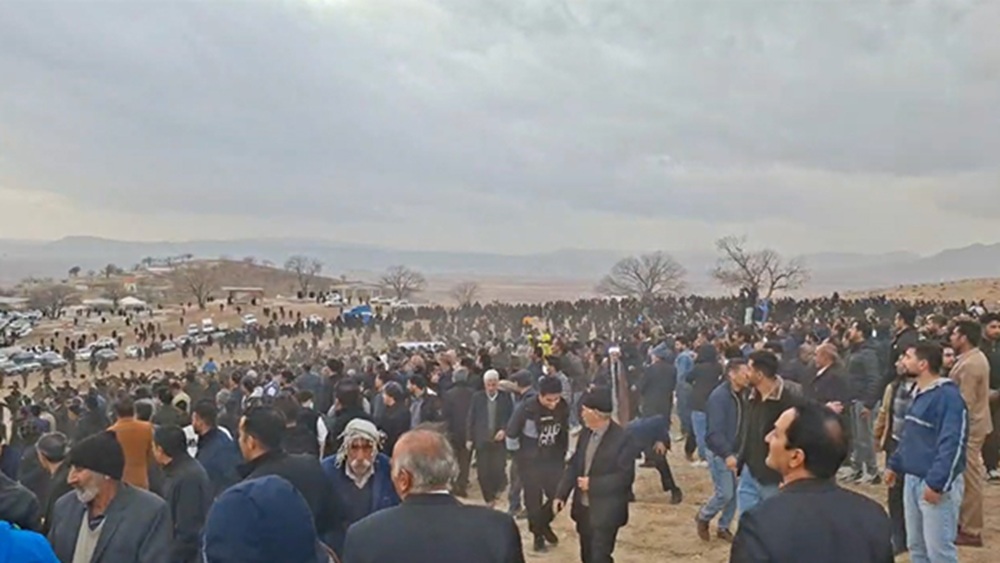 Funeral of Amirhesam Khodayari-Fard, protester murdered by the Iranian regime’s security forces— January 2, 2026
On January 2, 2026, the sixth consecutive day of nationwide protests in Iran, the dynamic of the unrest shifted significantly. What began earlier in the week as an economic outcry in Tehran’s Grand Bazaar, sparked by the collapse of the national currency and soaring inflation, has evolved into a volatile confrontation across the country’s residential sectors and provincial capitals.
Reports from the ground on January 2 indicate that the regime’s security apparatus is struggling to contain a movement that has transitioned from strikes in commercial centers to what witnesses are describing as widespread urban warfare. The unrest has been particularly intense in Lorestan and Fars provinces, where funeral ceremonies for protesters killed in previous days became the focal points for renewed anti-regime demonstrations.
Protests Expand to Neighborhoods in Tehran
In a development that signals a potential loss of control for the security forces in the capital, protests on Friday spread beyond the central market districts into major residential neighborhoods. Despite extensive measures by the regime to prevent assemblies, residents in Naziabad, Khaksefid, Narmak, and Tehranpars took to the streets.
Footage and reports from these areas show crowds chanting “Down with Khamenei” and “Death to the dictator.” The expansion into these densely populated districts suggests that the crackdown in the bazaar has failed to quell the momentum of the uprising, forcing security units to stretch their resources across the sprawling metropolis.
January 2—Tehran, Iran
The people of Naziabad held protest rallies, chanting, “Down with Khamenei!”#IranProtests #IranRevolution pic.twitter.com/XWAAJaKBnb
— People’s Mojahedin Organization of Iran (PMOI/MEK) (@Mojahedineng) January 2, 2026
Marvdasht: Police Station Under Siege
The intensity of the conflict was perhaps most visible in Marvdasht, Fars Province. On Friday, thousands gathered for the funeral of Khodadad Shirvani, a 33-year-old man who was shot and killed by security forces the previous day. The mourning ceremony quickly turned political, with the crowd chanting, “I will kill he who killed my brother.”
The situation escalated when protesters surrounded and attacked Police Station No. 11. Field reports indicate a violent standoff ensued, with regime operatives positioned on the rooftops of the police station and the nearby Bank Sepah firing live ammunition directly at the civilians below.
January 2—Kuhdasht, western Iran
The funeral of Amir Hesam Khodayarifard, 22, a youth murdered by security forces during anti-regime protests, turned into a rally against the regime. The people clashed with security forces and chanted anti-regime slogans.#IranProtests… pic.twitter.com/1djhe3WPWr
— People’s Mojahedin Organization of Iran (PMOI/MEK) (@Mojahedineng) January 2, 2026
In Kuhdasht, Lorestan Province, the funeral of Amirhesam Khodayari-Fard became a scene of direct resistance against state interference. Security forces reportedly attempted to seize the martyr’s body to prevent the burial from turning into a protest—a common tactic used by the regime to dampen public anger.
However, the large crowd present at the ceremony successfully resisted the agents and reclaimed the body to perform the burial themselves. In a significant blow to the regime’s propaganda efforts, the father of Amirhesam publicly addressed the crowd, stating that his son “had no connection with the Basij,” refuting state media narratives attempting to co-opt the victim as a pro-regime casualty.
Casualties Mount: Identification of Martyrs
As the crackdown intensifies, the human cost of the uprising is becoming clearer. On the afternoon of January 2, the Secretariat of the National Council of Resistance of Iran (NCRI) verified the identities of eight protesters killed by Revolutionary Guards and security forces between December 31, 2025, and January 1, 2026.
The victims, killed in the cities of Fuladshahr, Kuhdasht, Lordegan, Azna, and Marvdasht, include a minor. The identified martyrs are:
Mostafa, a 15-year-old boy from Azna (Lorestan).
Dariush Ansari Bakhtiarvand, 37, from Fuladshahr (Isfahan).
Amirhossein Khodayarifard, 26, from Kuhdasht (Lorestan).
Sajjad Valamanesh Zilaei, 28, from Lordegan.
Ahmad Jalil, 21, from Lordegan.
Shayan Asadollahi, 30, from Azna.
Vahab Ghaedi (Mousavi), from Azna.
Khodadad Shirvani, from Marvdasht.
In Fuladshahr, the funeral for Dariush Ansari, who was shot on December 31, also transformed into a protest, further fueling the cycle of mourning and resistance.
Regional Flashpoints: From Qom to Zahedan
The geographic scope of the unrest underscores the nationwide nature of the dissatisfaction. In Qom, traditionally the ideological stronghold of the clergy, protesters gathered at Towhid Square for the second consecutive night. Chants of “Death to Khamenei” echoed through the city, representing a profound challenge to the regime’s religious legitimacy.
January 2—Qom, central Iran
More footage of anti-regime protests. Demonstrators held a large rally and resisted against security forces dispatched to quell their protests.#IranProtests #IranRevolution pic.twitter.com/IuujWoZYyO
— People’s Mojahedin Organization of Iran (PMOI/MEK) (@Mojahedineng) January 2, 2026
In Yasuj, southwest Iran, security forces opened fire on demonstrators holding nightly rallies. Despite the use of lethal force, crowds refused to disperse, chanting, “This is the year of blood, Seyyed Ali [Khamenei] will be overthrown.”
In Hamedan, field reports describe the security apparatus as being “overwhelmed” by the sheer size of the crowds, failing to disperse marchers. Meanwhile, in Zahedan in the southeast, residents joined the nationwide movement following Friday prayers, with footage confirming chants of “Death to the dictator.”
January 2—Yasuj, southwest Iran
More footage of nightly anti-regime protests. Large crowd gathering and chanting, “This nation will not be a nation until the mullahs are gone” and “Down with the dictator”#IranProtests #IranRevolution pic.twitter.com/vE15Gd02XN
— People’s Mojahedin Organization of Iran (PMOI/MEK) (@Mojahedineng) January 2, 2026
A Unified Political Message
Parallel to the street protests, the uprising has articulated a clear political demand that rejects both the current theocracy and the past monarchy. Resistance Units affiliated with the People’s Mojahedin Organization of Iran (PMOI/MEK) have intensified activities in Tehran, Mashhad, and Isfahan. Placards and graffiti have appeared across these cities reading, “Down with the oppressor, be it the Shah or the Mullahs.”
January 1—Iran
In tandem with the nationwide uprising, PMOI Resistance Units across Iran carry out activities, reflecting the Iranian people’s desire to overthrow the regime and reject all forms of dictatorship, whether a religious tyranny or a despotic shah.#IranProtests… pic.twitter.com/ZeqsbWWwmM
— People’s Mojahedin Organization of Iran (PMOI/MEK) (@Mojahedineng) January 2, 2026
This sentiment was echoed by political prisoners. In a statement from Evin Prison, inmates declared that the regime is nearing the “dustbin of history,” drawing a parallel to the 1979 revolution. Simultaneously, prisoners on death row in Ghezel Hesar Prison sent a message to university students, stating, “The time has come to bury the dictatorship of the Sheikh and the Shah.”