
You’ve all heard the tune: America is soaring; Europe is falling behind. It’s the fashionable idea – in Brussels as in Washington. A recurring theme of Trump’s power, echoed even in the now famous national security strategy of the White House. “Western Europe,” it says, “has seen its share of global GDP decline, due in particular to the proliferation of regulations hindering innovation and productivity.”
European conservative parties are echoing this refrain to demand widespread deregulation: end the Green Deal, question the duty of vigilance for multinationals, and abandon the minimum tax on these companies. In Brussels, the US ambassador to the European Union also sang this tune, claiming that the poorest US states, such as Mississippi or West Virginia, now enjoy a higher standard of living than Germany.
All of this, however, is based on nothing.
The idea of European sclerosis in the face of a supposed American Eldorado, which is claimed as justification for the campaign of deregulation currently sweeping Europe, does not hold water. It is based on three myths, which we will deconstruct one by one.
First myth: soaring American growth
At first glance, statistics seem to support this hypothesis: the gross domestic product (GDP) of the United States – that is, the value of production carried out on American soil – appears to have been increasing faster than that of the European Union for the past 15 years. In reality, it’s primarily because the population is growing faster in America.
But above all, this growth is being wiped out by the explosion in the cost of living across the Atlantic. Once the differences in price levels are adjusted, there is no American miracle, any more than there is European stagnation.
GDP per capita, adjusted for differences in the cost of living, has increased by 70% in the United States since 1990, compared to 63% in the EU-27. This corresponds to an average annual growth of 1.6% in the United States, compared to 1.5% in the European Union.
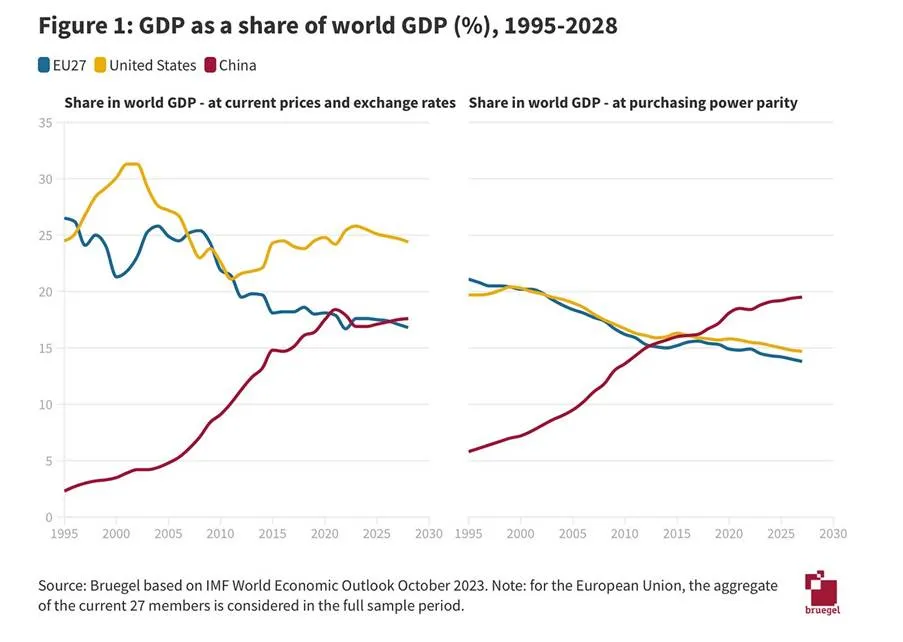
The United States has certainly performed better since the Covid crisis, but in the medium term there is hardly any significant divergence. The US national security strategy laments the decline in the share of European GDP in global GDP (left graph below).
Once differences in the cost of living between countries are corrected, we observe exactly the same decrease for the United States (right graph). The European Union, like the United States, has seen its share of global GDP fall from 20% in 1995 to 15% today.
Second myth: unproductive Europe
The United States (340 million inhabitants) is less populated than the European Union (450 million inhabitants), but weighs as heavily in global GDP. The US GDP per capita is therefore higher than that of the EU by approximately 35%.
But contrary to a persistent belief, this gap is not explained by a lack of productivity in Europe. The reason is quite different: Europeans have more free time – more vacation time and shorter weekly working hours.
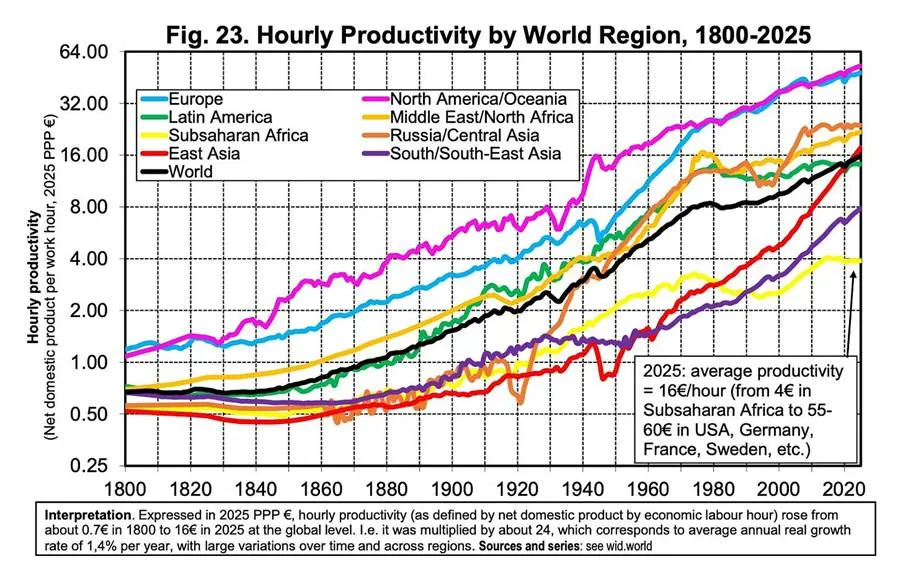
In terms of productivity, the European Union is almost on par with the United States. In the six “core” countries of the European Union (Germany, France, Italy, Spain, the Netherlands and Belgium), a hard core which includes 290 million inhabitants, barely less than the United States (340 million), productivity is almost identical to what is observed in America.
In both cases, workers produce an average of €60 per hour worked, according to the most recent data from the World Inequality Lab.
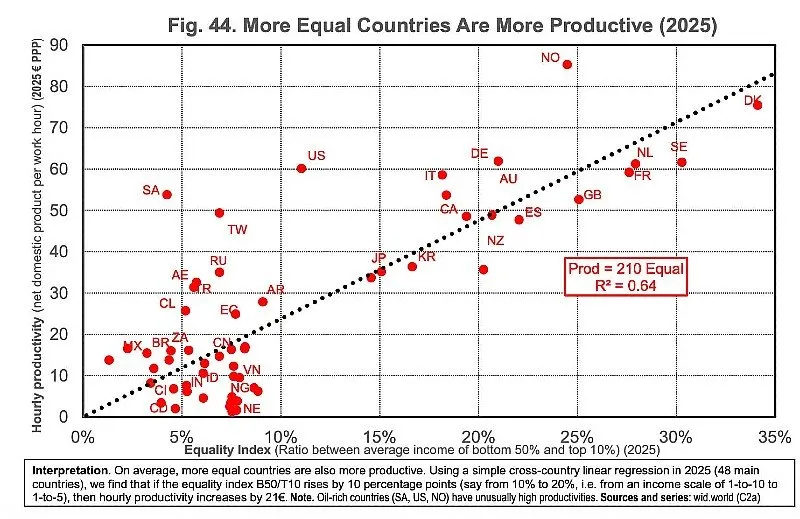 The greater the inequality in society, the less productive a country is.
If we broaden the analysis to the whole of the Union (450 million inhabitants), productivity is slightly lower than in the United States, due to lower productivity levels in Eastern Europe. The gap remains moderate, however.
According to statistics from the International Labour Organization, GDP per hour worked (the usual measure of productivity) amounts to $81.8 in the United States, $83 in Western Europe and $71.1 in the EU-27. And there is no European “sclerosis”: productivity is progressing at the same rate in Europe as in the United States.
Third myth: productivism
But above all, all these measures, which are limited to measuring the production of material goods and services, suffer from a perspective that is far too restrictive. Europeans enjoy more free time than Americans, a higher life expectancy and lower levels of inequality – all with roughly comparable productivity. Whichever way you look at it, this is a significantly superior economic performance.
Even if we limit ourselves to a narrow productivist perspective, the EU-27 probably does better than the United States, for one simple reason: its greater sobriety. The United States does indeed produce $81 of gross value per hour worked, but this comes at a particularly high environmental cost. The EU-27, on the other hand, produces $71 per hour, with significantly lower carbon emissions.
More leisure time, better health performance, less inequality and lower carbon emissions, all with broadly comparable productivity: Europeans can be proud of their development model, which is on the whole significantly more convincing.
This obviously does not mean that the EU does not need reform. But we must not fight the wrong battle.
The urgent need is not for deregulation, but for investment in education, universities, research, public infrastructure and the energy transition, which in the future, as in the past, will provide the key to our collective prosperity.
This article is republished with Gabriel Zuckan’s kind permission and translated from the original French by Google Translate. Read the original on his Substack here.
More from East Anglia Bylines

There has never been a greater need for grassroots journalism that investigates the stories that really matter, holds power to account and champions the voices of everyday citizens. We are proudly powered by volunteers but what we do isn’t free.
STAND WITH US for independent, citizen-led journalism that makes democracy stronger, and you will even get some exclusive benefits.