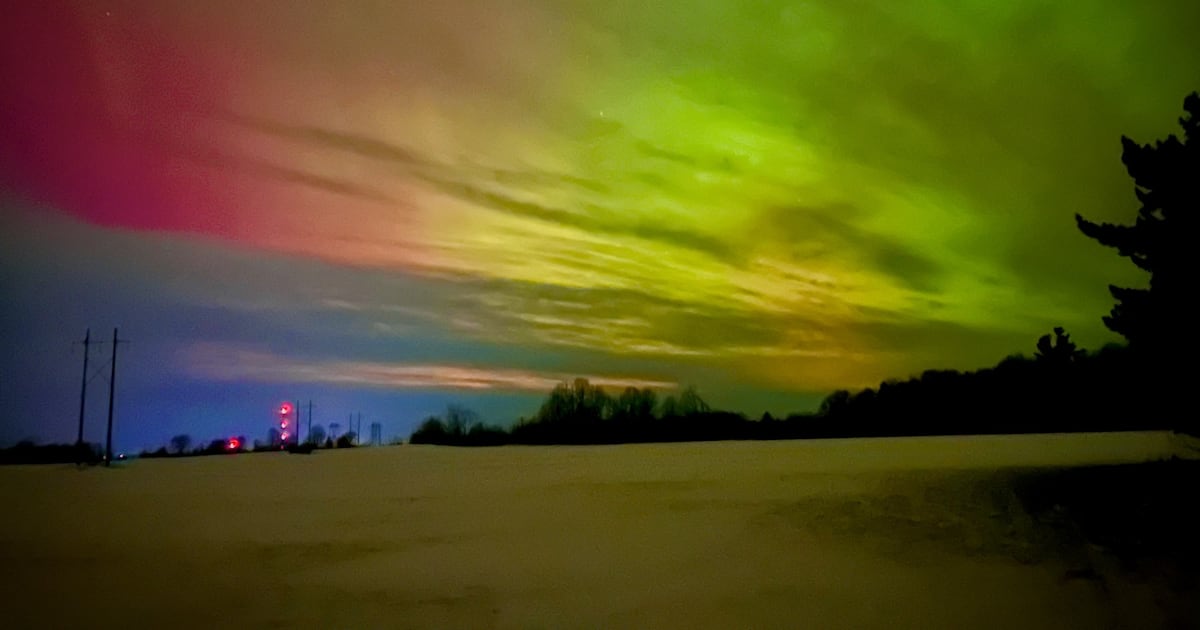
Most of Canada will be able to see the northern lights on Friday night, according to a U.S. weather agency.
Most of British Columbia, the Prairies, Alberta, northern Ontario and Quebec, and most of the territories have a relatively high likelihood of viewing the northern lights, also known as the aurora borealis.
The Atlantic provinces, Vancouver Island, and parts of the Arctic Archipelago have a lower likelihood of seeing the night sky phenomenon. Eastern Nova Scotia and the most southeastern corner of Newfoundland are the only parts of southern Canada that are outside the predicted viewing line.
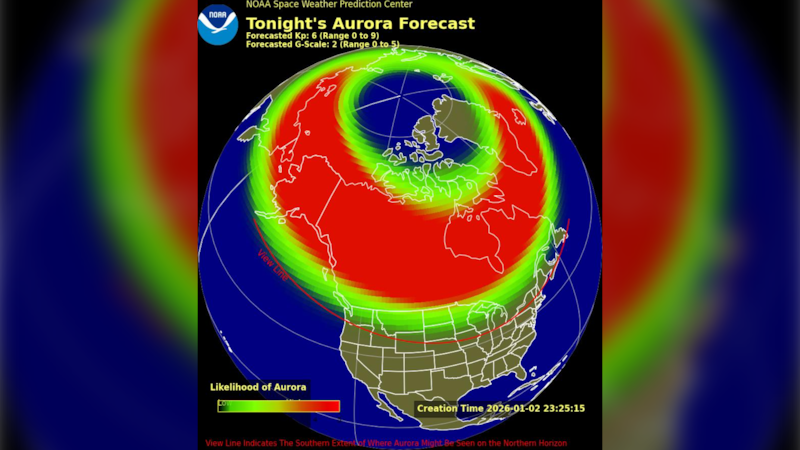 Aurora Borealis Jan 2 Where the Northern Lights are predicted to be visible.
According to the U.S. Space Weather Prediction Center, the best way to view the lights is to get away from urban light pollution and find an uninterrupted view of the northern horizon between 10 p.m. and 2 a.m.
The U.S. Space Weather Prediction Center forecasted the aurora borealis, posting a prediction for Friday and Saturday. Saturday night will have a significantly lower likelihood of appearing.
The effect occurs when electrons from space enter Earth’s atmosphere and collide with particles around the planet’s northern magnetic pole.
“The collisions produce light much like how electrons flowing through gas in a neon light collide with neon and other gasses to produce different colored light bulbs,” according to the U.S. space weather agency.
According to the Canadian Encyclopedia, the northern lights’ “average position in Canada is over Yellowknife, N.W.T., to the west, and Grande rivière de la Baleine, Que., to the east.”
The lights are usually green but can appear in reds, pinks, yellows, purples or blues according to the encyclopedia.