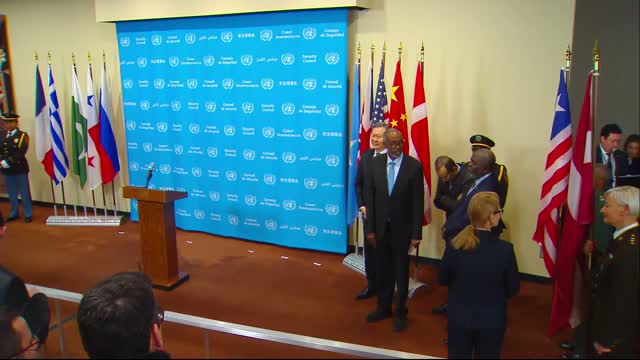
Kazakhstan’s permanent representative, Ambassador Kaira Tomarov, who proposed making the flag installation a visible ceremonial moment in 2018, said the practice has been embraced by successive presidencies and ‘‘seeks to strengthen the sense of collective responsibility that underpins the council’s work.’’ He noted the gathering marked the ninth such ceremony and said the event was formally recognized by an informal working group’s consensual decision and a note by the president of the Security Council on 2025‑12‑26.
Somalia’s permanent representative, introduced earlier as Abukar Dahir Osman and serving as Security Council president for January, thanked Kazakhstan for institutionalizing the practice and welcomed Bahrain, Colombia, the Democratic Republic of the Congo, Latvia and Liberia to the Council. ‘‘We reaffirm our commitment to the collective actions in service of peace, security, and human dignity,’’ he said.
Assistant Secretary‑General Khaled Hiyari, speaking on behalf of the Secretariat and the Secretary‑General, congratulated the new members and said the Secretariat will continue to provide reporting, briefings and advisory support to ensure ‘‘the full and effective discharge of your mandate.’’
Speakers from the five incoming members outlined their priorities. The permanent representative of Bahrain said the kingdom returns to the Council ‘‘with redoubled commitment to international peace and security’’ and listed priorities ranging from counterterrorism and cybersecurity to maritime security; she said ‘‘the Palestinian cause [is] our top priority during our membership.’’
Colombia’s representative, who noted this is Colombia’s eighth time on the Council and identified herself as the first indigenous woman to represent the country to the body, said Colombia ‘‘comes to the Security Council to speak about peace, not war’’ and pledged an agenda centered on inclusion, human rights and multilateralism.
The Democratic Republic of the Congo’s deputy minister said the DRC returns after 35 years and described two pillars for its term: peace and security, including discussion of the future of UN peacekeeping operations; and conflict prevention and resolution with emphasis on the link between natural resources, governance and conflict.
Latvia’s permanent representative, speaking on Latvia’s first time on the Security Council, pledged to serve ‘‘with integrity, consistency, and steadfast adherence to the principles of the United Nations Charter.’’
Liberia’s representative said Liberia returns after 65 years, noted the country’s democratic progress since the comprehensive peace agreement and that its election to the Council was supported by 181 member states; he framed Liberia’s presence as rooted in multilateralism and a commitment to dialogue and inclusion.
The national flags of Bahrain, Colombia, the Democratic Republic of the Congo, Latvia and Liberia were installed, delegates were invited for a group photograph, and the ceremony was closed by the master of ceremonies.
The ceremony included formal acknowledgments of outgoing members and repeated appeals that incoming members use their Council terms to advance diplomacy, cooperation and respect for the United Nations Charter.