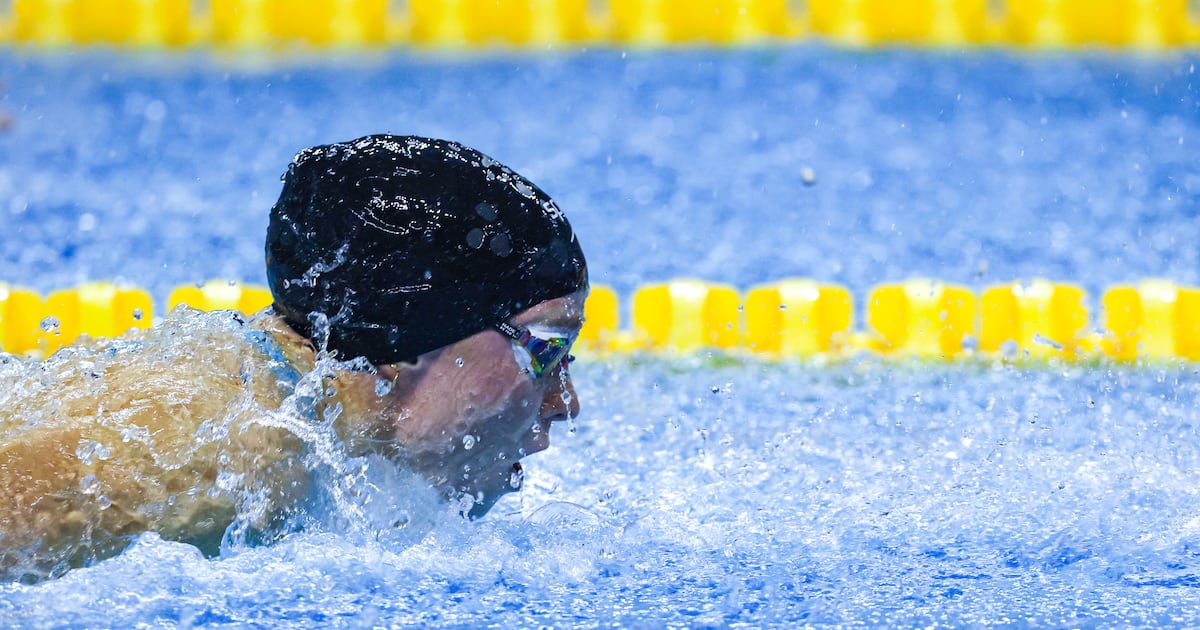
It’s been a wildly exciting time for Irish swimming. The squad that performed at the European Aquatics Short Course (this means racing in a 25 metre pool instead of a 50 metre one) Championships in early December brought back seven medals – Daniel Wiffen got three in the freestyle (bronze in the 400m and 800m, gold in the 1,500m); Ellen Walshe won gold in the 200m butterfly and silver in the 200m medley; John Shortt won gold in the 200m backstroke, and Evan Bailey won bronze in the 200m freestyle.
In addition to the medal-collectors were a group of greener swimmers, just broaching senior swimming, who performed impressively and stood up to the test of top-flight international competition. Absent was Olympic bronze-medallist Mona McSharry, who was busy winning a medal of each colour at the US Open in Texas. As Ian O’Riordan wrote in The Irish Times, these are “unprecedented times” in Irish swimming.
Like all swim fans, I was ecstatic, a reaction only slightly marred by two reports launched the same month: one, the Swimming Pool Gap Analysis Report from Swim Ireland, and the other, the HSE Public Health Strategy (2025-2030). The Swim Ireland report paints a bleak picture. The headline figures are bad: just one pool for every 81,053 people (compare with Scotland’s 1:14,047 and Iceland’s 1:2,500). As returning golden boy Daniel Wiffen remarked, “you can barely fit 100 people in a swimming pool, so, it’s eye-opening”.
Two thirds of swimming pools have a waiting list for lessons. Dig deeper and things worsen. Fifty seven per cent of pools in the Republic are hotel pools, which often offer no pay-as-you-go public swimming, restrict children’s access and lack accessibility accommodations. Only 28 per cent of hotel pools have hoists.
Swimming pools also have shelf lives (it varies but 50 years is an absolute upper end). Half of ours are over 25 and a quarter over 35. Pools take ages to build, so, even just to maintain our current, embarrassing level of supply, we urgently need to start building and refurbishing. Old also means unsustainable, environmentally speaking. More than half of the island’s pools are heated using gas.
[ ‘For me it’s not swimming’: Daniel Wiffen lashes out against Enhanced GamesOpens in new window ]
Espousing the benefits of swimming feels ridiculous and tautologous. Swimming is brilliant exercise for almost everyone. It is the second most popular exercise format in Ireland and the most popular among women and those with disabilities (this report represents yet more evidence of how those with additional needs are let down by public services). In pregnancy, it is low-risk and yet still fitness-enhancing. Swimming and aqua-aerobics are highly recommended for older people and those with arthritis. Done intensely, it burns a shedload of calories. Intentionally or not, it takes people away from screens; no surprise that it is associated with statistically significant improvements in mental health.
Wild and cold-water swimming are also popular here and the Irish legacy in these domains is significant. The Oceans Sevens, one of the big marathon swimming challenges attempted by long-distance swimmers, was first completed by a Corkonian, Stephen Redmond. Outdoor swimming brings its own benefits: it promotes connection and emotional investment in our natural resources and brings together intergenerational communities of those intrepid enough to climb into our chilly seas and freezing lakes. It’s also a public safety issue. Ours is an island nation and a surprisingly lake-y one to boot. We need to be able to swim to be safe here. The current barriers to participation should be seen for the safety issues they are.
The recent Public Health Strategy document included plenty to be optimistic about, including plans to “address health inequalities and diminish the burden of preventable illness in Ireland”. Another theme is stronger intersectoral partnerships between public health, healthcare services and the other entities that play often underappreciated roles in keeping the population well, like sports and cultural organisations.
It’s hard to summarise the impact swimming has had on my health. It kept me sane during my studies and fit in my pregnancies (when round ligaments and pelvic girdle pain meant I couldn’t walk for more than two minutes without pain). I swam 2.4km the day before I had my youngest child and I am convinced pregnant swimming was a key to quick recoveries after both births.
[ Planning to join a swimming pool this January? Read this firstOpens in new window ]
Having become more enthusiastic about distance swimming this year, I’m back training with a club and loving it – including the humbling that comes from having circles swum round me by people in my club with decades on me. I’m also looking around at people older and fitter than I am, thinking “this can be me in the future”. That’s a powerful feeling.
I look at other domains in which the scope of my goals is shrinking against the background of ageing, motherhood and career, but swimming is the exception. I am making plans to swim a 10k in the next five years, a commitment to my health as much as anything.
Beyond all the very legitimate excitement about the national talent in competitive swimming lies an urgent need. Bringing our pitiful provision of public swimming access in line with our neighbours’ should be seen for the vital public health objective it is. We cannot tolerate another instance of infrastructural necrosis in this area. If we are at all serious about prevention and early intervention in public health, or in respecting the rights of those with additional needs to exercise, generously funding activities as obviously beneficial to the whole population as swimming is a no-brainer.
Dr Clare Moriarty is a research fellow at TCD’s Long Room Hub