
NEW DELHI: 2025 is likely to rank third-warmest on record in most of the six global temperature datasets tracked by the World Meteorological Organisation, and only marginally below the level seen in 2023, as HT reported on January 1. Since the January-November period averaged 1.42°C warming across the six datasets in both 2025 and 2023, it can be expected that the six datasets will average approximately 1.4°C when December data are factored in. This would make 2025 the third consecutive year in which global warming exceeds 1.4°C.
 At more than 5,800 meters above sea level, an international team of scientists is drilling deep into the Pamir glaciers of Tajikistan to extract the region’s first-ever deep ice cores to preserve the Earth’s climatic memory before global warming erases it forever. (AFP)
Will this continue in 2026? There are very few such global forecasts, but they suggest this is probable, although much will depend on how rapidly surface temperatures in the Pacific change this year. Here is what these forecasts say.
The only forecast for global warming for 2026 by an organisation that also produces a global temperature dataset is from the United Kingdom’s Met Office. On December 18, it predicted warming in the range of 1.34°C-1.58°C in 2026. The midpoint of this range is 1.46°C. This means that the year is more likely than not to exceed 1.4°C, according to this early forecast.
Another indicative forecast is available from James E. Hansen, a former NASA scientist who heads the Climate Science, Awareness and Solutions Program at the Columbia Climate School. While he hasn’t given a direct forecast for 2026, his predictions are helpful in understanding what to expect in the year and why.
Hansen expects the 12-month average to first fall to around 1.4°C in the first half of 2026. This isn’t surprising. Hansen’s analysis is based on the GISTEMP dataset produced by NASA. The 12-month average in November – the latest available data in GISTEMP – was 1.48°C. This average is largely driven by the first three months of the year, during which average warming was 1.65°C. The warming in the six-month June-November period was relatively small, at 1.39°C, indicating that the 12-month average for the first half of 2026 can still be 1.4°C, even with a few months above 1.5°C.
After the fall, however, Hansen expects warming to reach 1.7°C in 2027. The rationale explains what may happen in 2026.
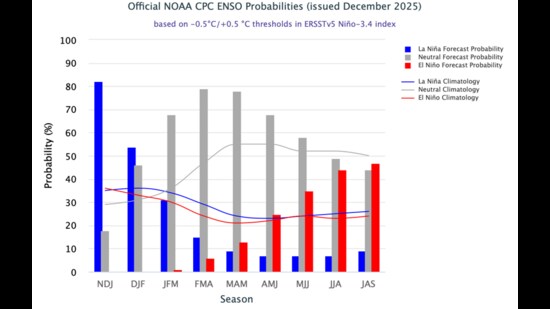
The high forecast for 2027 is based on an expected El Nino, a cyclical warming of the equatorial Pacific Ocean and a significant factor in short-term year-on-year variations in global temperature. This El Nino, as per forecasts made in December, is expected to arrive in the July-September period. Since El Nino affects global temperatures the most with a 2-4 months lag (more on this here), the chances of 2026 averaging more than 1.5°C are not like those in 2024, which was impacted by the 2023-24 El Nino.
However, it also means that the favourable conditions seen in 2025 are coming to an end. 2025 was affected by two periods of La Niña-like temperatures in the Pacific, which is the opposite of an El Nino and has a cooling effect on global temperatures.
To be sure, 2026 is likely to begin with somewhat favourable conditions. A La Nina started in late September 2025 in the Pacific. This La Nina is expected to last until the December-February season, which implies an effect on temperatures possibly up to June.
 GFX
GFX
Moreover, the forecast for El Nino is conservative as of now. The probability for El Nino is only marginally above that of neutral conditions. The first three-month period when El Nino is expected, in July-September, is also the last of the nine overlapping such periods for which the forecast is made. As forecast accuracy decreases at longer lead times, it is possible that updates to the forecast are warranted. If that update shows the El Nino starting later than currently forecast, its impact would wipe some of the inter-year cooling from La Nina. If that update shows the El Nino arriving earlier, one can expect a warming spike for a longer part of 2026’s tail.