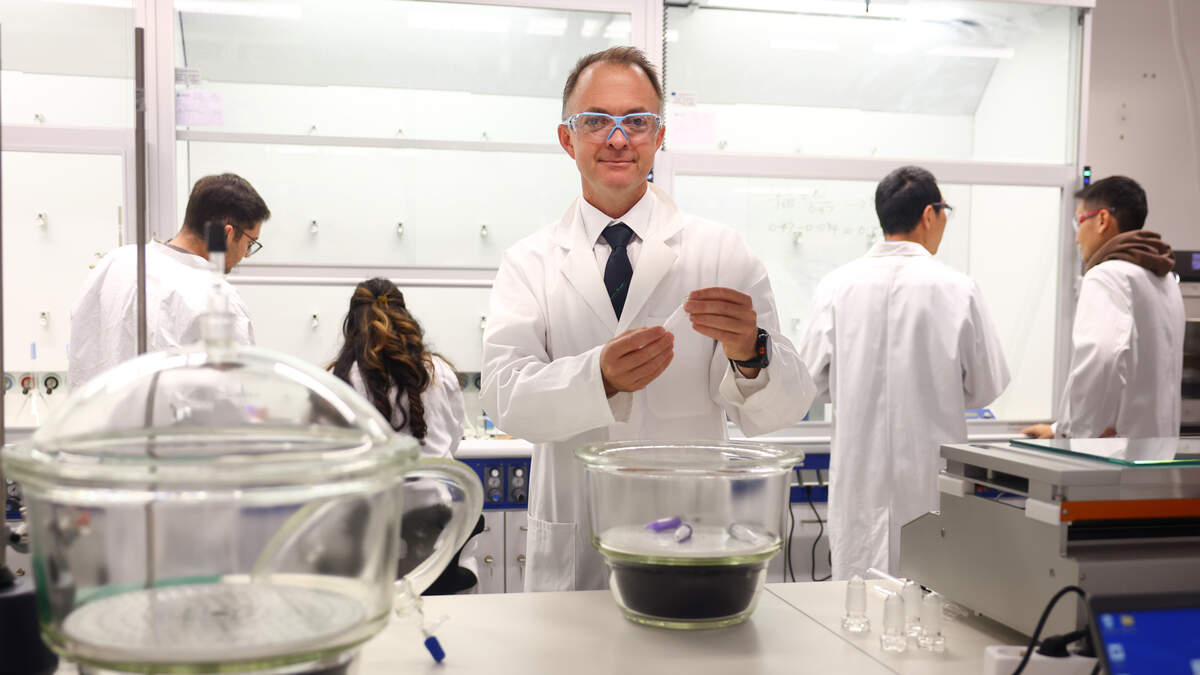
Luxembourg Hydrogen Valley will direct the local energy shift in a sustainable direction… as long as it can fail successfully, says its coordinator at the University of Luxembourg and vice dean of the Faculty of Science, Technology and Medicine, Professor Bradley Ladewig.
What is a hydrogen valley?
In one location you bring together the elements of the value chain: from production of renewable energy (sometimes that’s brought in from outside) to the production of renewable hydrogen using an electrolyser. Then you need to compress it, take it up to a much higher pressure, you need to store it on site to some extent, and you need to transport it to where you’re going to use it.
In our case, those transport distances are very, very short. Our main mobility off-taker, Sales-Lentz, is literally located adjacent to where we will produce the green hydrogen. They’ll refuel buses directly at the production site. And we have a major industrial off-taker, Ceratizit, that has two production sites within about 10-12km.
 €8 million from Brussels, plus a very substantial amount of funding from the national government, means the project will now almost certainly go ahead in Bascharage.
We are on the right track
Bradley Ladewig
Paul Wurth Chair of Energy Process Engineering
I understand green hydrogen is up to six-times more expensive than hydrogen from natural gas.
I would challenge the multiplier of six. It’s extremely location dependent. If you are a refinery working in one of the major northwestern European ports, you have access to natural gas and if you try and replace that with renewable hydrogen made by electrolysis, maybe it would be three, four, five times more expensive.
But we’re here in Luxembourg. There’s no refinery here, there’s no large-scale producer, there’s no producer of any type of hydrogen here. You have to bring it in from outside and pay very high transport costs to do so.
Fossil hydrogen appears cheaper only if you don’t fully calculate the cost of the CO2 emissions that are associated with it. This is changing rapidly in Europe. We have an emissions trading scheme just about to be expanded in a second phase, which will mean a lot more elements of the economy will be incorporated. Decarbonisation doesn’t come for free: we have to sometimes accept that there will be higher costs because we’re moving to something better.
The renewable hydrogen revolution has been envisaged since the 1970s. How can we nudge it along?
At a very rough breakdown, the electricity alone accounts for 70-80% of the cost of renewable hydrogen, so all that’s really required to have a massive reduction in the production cost is to go to the places in the world that have very low renewable energy costs.
Proposed large scale renewable hydrogen projects in Europe are typically in the far north where we have large reserves of hydroelectricity, or they’re in the far south, typically in Spain, where we have very good solar resources. In those places, the economics of making hydrogen are far more attractive than in cloudy, rainy Luxembourg or Germany. Even better is to go to Brazil, Australia, Morocco, Algeria, Saudi Arabia.
The challenge is transport, because in those locations where you can produce it very cheaply, there’s often not a big demand for the hydrogen. In Brazil, they are building green ammonia plants. They make green hydrogen, combine it with nitrogen from the atmosphere to make ammonia, which can be much more easily transported. But whether you convert that ammonia back to hydrogen or you directly use the ammonia in a chemical or industrial process is not quite clear yet.
Bradley Ladewig, Paul Wurth Chair of Energy Process Engineering and vice dean of the Faculty of Science, Technology and Medicine © Photo credit: Gerry Huberty
Also read:Luxembourg’s future hydrogen network moves step closer with Creos in charge
Converting electricity into hydrogen, then into ammonia, and potentially back again likely involves significant efficiency losses?
There’s a lot of losses along the way, but there’s also a lot of benefits to trying to work with ammonia. At the moment, ammonia is produced on a massive scale all around the world using natural gas and it’s quite an emissions-intensive industry.
Even if we don’t find any new applications for ammonia than the biggest one today, fertilisers, if we just converted all current consumption to green ammonia, this itself would lead to a massive global reduction in CO2 emissions. That alone is worth doing.
Ammonia is NH3, so hydrogen does have to be in ammonia. You cannot go from water and atmospheric nitrogen to ammonia. You have to first create the hydrogen and then combine it.
It sounds like renewable hydrogen could be central to the green transition. Do you have advice for politicians?
I actually believe we are on the right track. Recently, the national government awarded funding for two pilot scale hydrogen projects. In the longer term, Luxembourgish industry and the national government are working on pipelines. At European level, some of the first big industries that will use renewable hydrogen is low-carbon steel.
This industry is not taking off as fast as some people would like, but I think the important elements are in place. One important one is the Carbon Border Adjustment Mechanism, CBAM. The fundamental principle is that if you produce in Europe, operating under our emissions trading schemes and meeting our requirements, you shouldn’t be subject to unfair competition from imports produced in another region. Steel will be one of the first products regulated with respect to CBAM.
We have to sometimes accept that there will be higher costs
Bradley Ladewig
Paul Wurth Chair of Energy Process Engineering
Do we need a steel industry in Europe? The answer is absolutely yes, because a lot of manufacturing that occurs with steel as a main input material happens within a small area around a steel producer. I see it as fundamental to the future of society, of our economy, industries, the stability of our nations and our defence, that we have a sustainable manufacturing industry, and especially things like the steel industry. It’s not optional.
One of the biggest hydrogen valley disappointments to date was in Australia. What advice do you have for Luxembourg to succeed?
I know people that worked on one hydrogen project in Australia that was planning to export to Singapore and Japan and recently shut down. I knew quite a lot about the technical aspects of that project, and it was relatively viable. At the end of the day, they went from no real industrial renewable hydrogen projects, to – in one step – try and go to multi-gigawatt scale. That is a very ambitious thing to do.
That project was planning to ship hydrogen to markets in East Asia using ships that haven’t been built yet. But we are producing for end users in our neighbourhood. We are going from zero to five megawatts, eventually to make 500 tonnes per year, which in the grand scheme of hydrogen production facilities is not large.
Every first-of-a-kind project has things you didn’t expect and have to solve. When those things come up in a multi-gigawatt scale project, they can cost you such enormous sums that you lose the whole project.
If everything goes well here, one day it could organically grow huge anyway?
I can tell with a lot of confidence what the long-term picture here will be: our hydrogen valley, to use a mixed metaphor, is a bridge. It’s a valley that’s a bridge.
The bridge goes from today, where we have no local production and no pipelines, to a future where we have pipelines. It might take ten years or more until we have those pipelines.
If you only start the decarbonisation when the pipeline is here, we may have already lost some of those industries because they couldn’t decarbonise the way they needed to. We bridge from where we are today through a decarbonisation pathway to a future point where ten, a hundred, a thousand-times more hydrogen will be available through these pipelines than we can produce, and at a lower cost.
We have to get us to that point. If our facility only runs for ten years, that will be okay because we’ve fulfilled our task: we bridged the gap between the present and a future where larger scale low-cost renewable hydrogen by pipeline exists for Luxembourg.
This interview has been edited for length and clarity. It was first published in the autumn 2025 edition of the Luxembourg Times magazine.