WESTERN BUREAU:
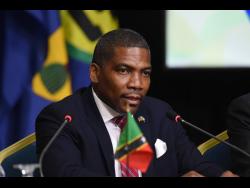
Incoming Caribbean Community (CARICOM) Chairman Dr Terrance Drew is warning that rising geopolitical pressures and external policy shifts affecting Caribbean nationals are testing the cohesion of the regional bloc, even as he calls for stronger coordination and a unified regional voice.
“Recent international developments, including geopolitical tensions in our region and external policy decisions affecting Caribbean nationals, remind us of a fundamental truth, none will come to save us. We must save ourselves,” Drew, who is prime minister of St Kitts and Nevis, said in a New Year address to citizens and residents of the Caribbean Community.
His comments come amid heightened global instability, growing competition among major powers, and renewed scrutiny of Caribbean states over foreign-policy alignment, security cooperation, migration, and economic relations. Within CARICOM itself, recent public disagreements among member states on international issues have drawn regional and international attention, raising concerns about the bloc’s ability to act cohesively on the global stage.
“Recent public discussions among member states, reflecting differing national perspectives, have unfolded in a way that has attracted regional and international attention,” Drew acknowledged.
The new CARICOM chairman’s comments come after the Antigua and Barbuda government recently disputed comments by Trinidad and Tobago Prime Minister Kamla Persad-Bissessar that the 15-member regional integration grouping, “is not a reliable partner at this time”. Persad-Bissessar had also argued that CARICOM cannot continue to operate in “this dysfunctional and self-destructive manner, as it is a grave disservice to the people of the Caribbean”.
LOST ITS WAY
In her statement last month, Persad-Bissessar said “an organisation that chooses to disparage our greatest ally, the United States, but lends support to the Maduro narco-government headed by a dictator who has imprisoned and killed thousands of civilians and opposition members, as well as threatened two CARICOM members, is one that has clearly lost its way”.
She also distanced her country from a statement issued by the CARICOM Bureau with regard to the US’s decision to fully restrict nationals from Dominica and Antigua and Barbuda from entering the North American country.
While stressing that diversity of views is natural, Drew cautioned that such differences must be carefully managed.
“They remind us of the importance of managing our dialogue with care, mutual respect and a resolute sense of regional responsibility,” he said.
Drew underscored that CARICOM was never designed to eliminate disagreement, but to provide a framework for resolving differences constructively.
“CARICOM was never conceived as a space free of disagreement. It was created as a forum where differences could be addressed constructively, internally, and with the shared understanding that our collective strength is greater than any single issue before us,” he said.
DEMANDS DEEPER INTEGRATION
The St Kitts and Nevis prime minister assumed the chairmanship of CARICOM on January 1, with his term running through to June 30. He replaced Jamaica’s Prime Minister Dr Andrew Holness, who led the regional heads of government from July 1 to December 31 and last year argued that the current moment demands not withdrawal, but deeper integration.
“This reality does not call for isolation, but for stronger coordination, clearer purpose and a deeper solidarity,” Drew said, urging regional leaders to “speak with one voice where our shared interests are concerned, and to act with strategic maturity on the global stage”.
The CARICOM chair also pointed to Haiti as a critical geopolitical and humanitarian concern requiring sustained regional engagement. He described Haiti as “the world’s first free Black republic and the first independent nation in our region,” and said the Community will continue to support stabilisation efforts as the country prepares for general elections in 2026 under UN Security Council Resolution 2793.
Drew said strengthening institutions and consultation mechanisms will be key as CARICOM navigates an increasingly complex international environment.
“Differences and all, we are one Caribbean people … heirs to a civilisation that transforms suffering into strength and adversity into achievement,” he said, framing unity as essential to safeguarding the region’s sovereignty, security, and future development.