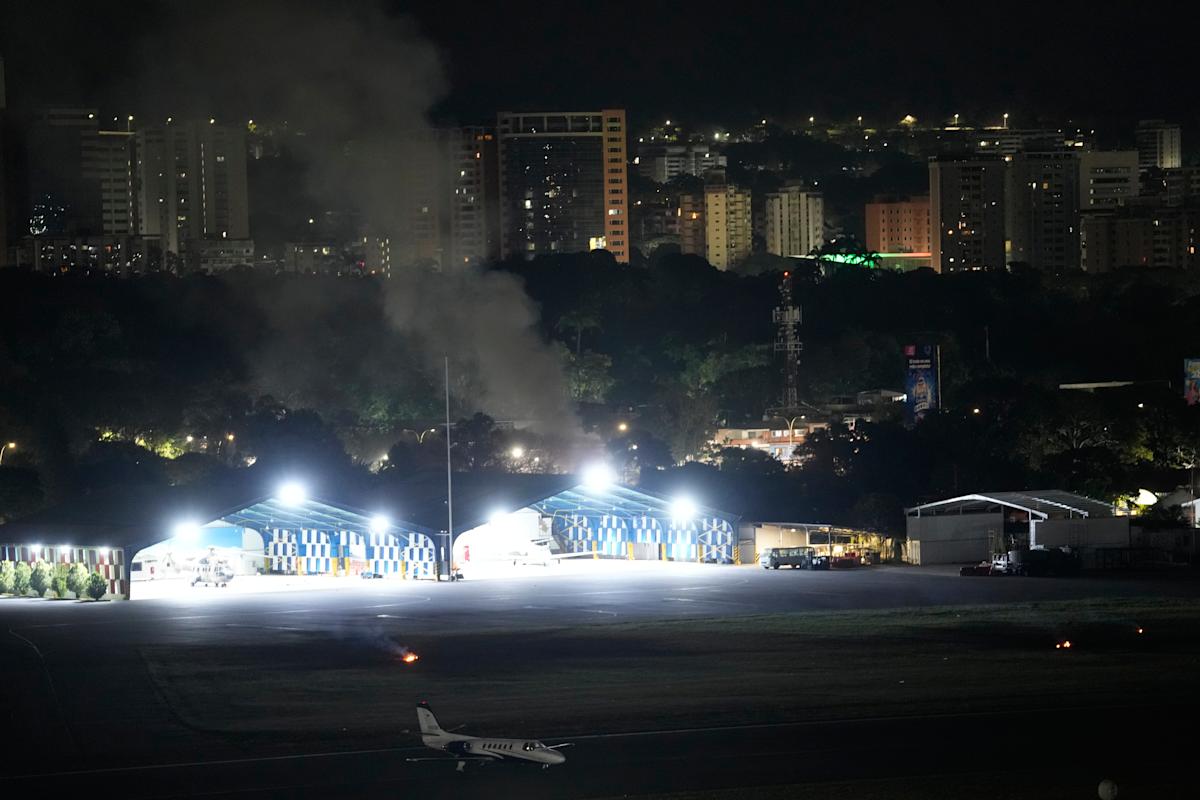
The US military throughout the night of Jan. 2 and early morning of Jan. 3 captured and extracted Venezuelan leader Nicolás Maduro from Caracas, who President Trump called an “outlaw dictator” at a press conference on Saturday.

The move opened up a ream of questions on what will become of Venezuela’s massive oil reserves.

Oil contracts don’t trade on Saturdays, but when the market opens on Sunday at 6 p.m. ET, traders will be watching for any swings as chances for a reopening of the Venezuelan oil market or a more drastic shuttering are priced in.

While there may be an initial spike on Brent crude (BZ=F), the international pricing benchmark, and US benchmark West Texas Intermediate (WTI) crude oil (CL=F), the longer-tail impact will depend on what Venezuela’s post-Maduro landscape looks like, Jorge León, the head of geopolitical analysis for industry intelligence firm Rystad Energy, told Yahoo Finance.

If the country quickly stabilizes around a more democratic leader such as opposition figure María Corina Machado, foreign investment flows in, and US and other international oil companies see a decreased risk profile — such as what happened in Syria after Bashar Al-Assad was removed from power — a more open Venezuela is likely to be bearish for oil prices as more supply is added to the market over the coming years.

If, however, Venezuela looks more like Libya after the toppling of Muammar Gaddafi, where the country remained in disarray and foreign capital was loath to enter, a further constriction of the Venezuelan oil market would almost certainly provide some degree of bullish support to global prices.

At least in the shorter term, León said, he expects Venezuela is likely to look more like post-Gaddafi Libya, owing to remaining support for Maduro’s Chavismo movement inside the county, and multiple opposition leaders in exile who are all likely to vie for power.

“If that is the case, then we are likely to see a slightly bullish increase in geopolitical risk and slightly bullish [impact] on pricing in the short term,” León said.

President Trump during a press conference at Mar-a-Lago on Saturday that the US will “run the country” until the US government can architect a “just” transition to a more democratic leader in Venezuela, opening up questions about what leadership in the country will look like.

President Donald Trump speaks at his Mar-a-Lago club, Saturday, Jan. 3, 2026, in Palm Beach, Fla., as Defense Secretary Pete Hegseth listens. (AP Photo/Alex Brandon)

President Donald Trump speaks at his Mar-a-Lago club, Saturday, Jan. 3, 2026, in Palm Beach, Fla., as Defense Secretary Pete Hegseth listens. (AP Photo/Alex Brandon) · ASSOCIATED PRESS

Whatever way the situation goes, the impact on global prices is likely not to be extreme.

Despite sitting on the largest proved oil reserves in the world, the South American nation has been relegated to only a minor player on the world exporting stage since its petroleum industry was fully nationalized under Hugo Chavez’s leadership in the early 2000s.

Thirty years ago, Venezuela was pumping more than 3 million barrels per day, and a decade ago, the country was pumping more than 2.5 million barrels per day. Today, Venezuela produces less than 1 million barrels per day, accounting for less than 1% of all global supply.

There just isn’t enough supply at risk, adding to León’s predictions that any impact is, at least in the short term, likely to be muted.

Even if Venezuela were to quickly stabilize and open up, any bearish impact would likely be small as well, at least in the short term, León said.

Venezuela’s oil infrastructure has faced chronic underinvestment since it was nationalized under Chavez, and the country has suffered significant brain drain as oil experts have left the country to work in more stable regions around the world.

New leadership would also have to convince international oil operators that country is indeed safe and stable enough for them to reestablish operations. Chevron (CVX) is the only remaining US oil company operating in Venezuela, after most international companies were pushed out or left the country under Chavez, and it operates under a very limited sanctions exemption granted by the US Treasury Department.

Chevron told Yahoo Finance in a statement that the company “remains focused on the safety and wellbeing of our employees, as well as the integrity of our assets” and “continue[s] to operate in full compliance with all relevant laws and regulations.”

Of Venezuela’s exports, Chevron ships roughly 120,000 to 150,000 barrels per day of crude oil to US refiners, making up such a tiny share of US imports so as to be effectively zeroed. For that reason, León said, US consumers are likely to notice little to no difference at the gas pump, where crude oil pricing makes up roughly half of the per-barrel price of gas.

“I don’t think it’s a matter of a few months,” León told Yahoo Finance. “I think we’re talking about years, three to five years, before we see Venezuela exporting, let’s say, 2 million barrels per day.”

El petrolero con bandera de Guinea MT Bandra, que se encuentra bajo sanciones, se ve parcialmente junto a otro buque en la terminal El Palito, cerca de Puerto Cabello, Venezuela, el 29 de diciembre de 2025. REUTERS/Juan Carlos Hernandez

The El Palito terminal near Puerto Cabello, Venezuela, on December 29, 2025. (REUTERS/Juan Carlos Hernandez) · Reuters / Reuters

President Trump said Saturday that the US, as part of its “running” of Venezuela, would “rebuild the oil infrastructure” and that the oil industry would pay for the effort.

Adding to the limited impact, Venezuelan crude is a heavy, sour grade of oil, useful for industrial products such as diesel and jet fuel, but not of the quality used for gasoline. The US’ WTI oil, on the other hand, is a light, sweet grade of crude that works well for refinement into gasoline.

“Unless there’s a very smooth transition, which I don’t think is likely to happen, we’re probably going to see an increase in prices of less than $5 per barrel, let’s say $2 to $3 per barrel, on Monday and next week,” León said.

“That would probably have a very, very marginal impact on US consumers at the end of the day.”

The move by the US military to extract Maduro to face charges stateside also comes at a moment where the global oil market is already facing a downturn.

Brent and WTI spent 2025 sliding downward, shedding nearly 20% each over the course of the year. The dominant narrative in 2025’s oil market was and continues to be one of a coming wave of oversupply that is depressing prices globally, now expected to reach an overhang of more than 3 million barrels per day.

The OPEC+ cartel, which counts Venezuela as a founding member, spent April through December unwinding production cuts and adding an increasing amount of supply to the global market as cartel leader Saudi Arabia looks to regain market share. US shale producers and other oil exporters in the Americas also spent the year maintaining or raising production levels.

The cartel is set to gather Sunday in a regularly scheduled monthly meeting to discuss the oil market, where the member countries are likely to confirm a previously decided pause on production rate changes through the first quarter of 2026.

The largest buyer of Venezuelan crude by a large margin is China, which spent 2025 heavily stockpiling oil far beyond its domestic need, helping to buoy global crude prices. China buys roughly 80% of the oil exports from Venezuela, where Chinese refiners are able to the barrels at steep discounts, due to the geopolitical risk premium applied to them by the market.

While China would likely be frustrated to lose the barrels, if that supply is to be choked off, “it’s not the end of the world” for China, León said, where the bigger risk for Beijing would be to risk escalating geopolitical tensions with the US.

An Chinese oil tanker that has been transporting Venezuelan crude to China for the last five years and was heading for Venezuela, diverted and set course for Nigeria, and there are four other tankers bound for Venezuela that are sitting idle at sea, said Ben Emons, the managing director of Highline Wealth Partners.

President Trump said at Mar-a-Lago on Saturday that the US blockade of sanctioned oil tankers moving in and out of Venezuela remains in place.

The Trump Administration’s timing for the move against Maduro, León said, may actually be serendipitous for the oil industry. If Venezuela remains unstable and prices are elevated on higher risk and a slightly lowered global supply, those dynamics may actually help to somewhat offset this coming wave of oversupply.

But going forward, much of the impact on the oil market will depend on how the situation in Venezuela evolves over the next few months, León told Yahoo Finance.

“[It’s not] a problem of below-ground factors,” Leon said. “It is the above-ground factors.”

Jake Conley is a breaking news reporter covering US equities for Yahoo Finance. Follow him on X at @byjakeconley or email him at jake.conley@yahooinc.com.