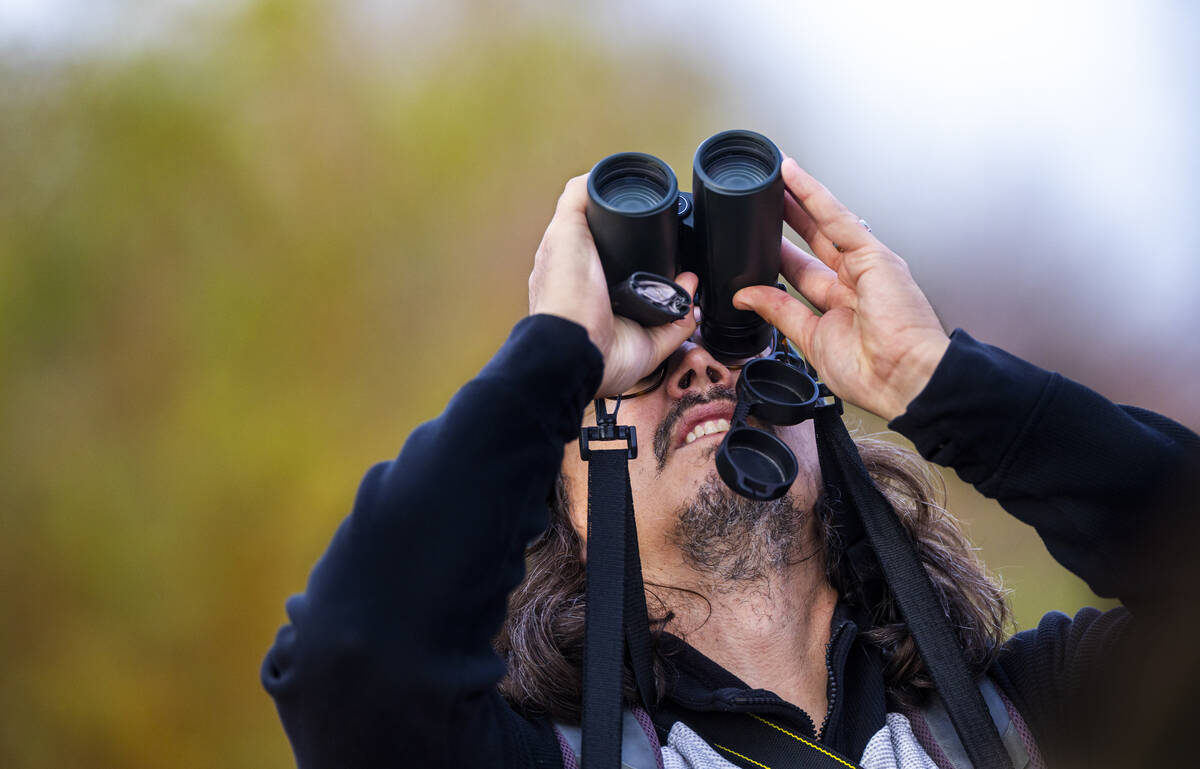
Eight pairs of eyes scanned the desert brush through binoculars for signs of life. Without notice, a flash of bright yellow quickly materialized, seizing attention — and raising eyebrows.
This mixed-age group of voracious birders had stumbled upon something people don’t ever see at Clark County Wetlands Park: a Cape May warbler, hundreds of miles away from its normal habitat boundary.
According to historical patterns, the closest that Cape May warblers get to the American West is North and South Dakota or Alberta, Canada.
“We see warblers hanging out in the winter that never would have been here before,” said Justin Streit, an environmental consultant who volunteers with the Red Rock Audubon Society. “It’s likely in response to warmer temperatures, which means vegetation keeps its leaves. … It’s changing where resources are available to these species.”
Streit and his crew were assigned to the park and a nearby trail for the annual Christmas Bird Count, a National Audubon Society effort to document bird populations throughout North America. It’s the oldest citizen science project in the world, dating back to 1900, when an ornithologist presented it as an alternative to traditional Christmas bird hunts.
Throughout December and into early January, Las Vegas’ Red Rock Audubon Society welcomed birders of all skill levels to create a point-in-time count of migratory birds throughout Southern Nevada, said Morrigan DeVito, who will begin her post as the group’s education and outreach director next week.
“Nowadays, we’re confronted with so much climate despair and bad news that it’s really easy to feel powerless, especially if you’re not from a science background,” DeVito said. “This is a way you can help and be involved.”
Catch of the day
At 6:30 a.m. Friday, a few dozen sleepy-eyed and bundled-up volunteers divided into groups to conquer the count in the East Las Vegas and Henderson areas.
One of them was Deanne King, a first-time bird count participant who said she moved from the Lake Tahoe area to Las Vegas in 1991 to attend UNLV. King got to add a particularly exciting entry to her “life bird list” — a digital archive of every bird she’s logged.
She had heard the call of a sora before but saw the small waterbird in person for the first time. King, a resident of Desert Shores in northwest Las Vegas, said she’s new to the hobby, only beginning to take birding seriously last year.
“I came down here, and I thought it was so barren,” she said.
When King stayed the night at Floyd Lamb Park at Tule Springs with her son’s troop, she said, she found herself awestruck at an owl sighting and decided it was worth giving birding in Las Vegas a shot.
King has become the resident naturalist among the parents in her 11-year-old son’s Boy Scouts troop, even becoming a “merit badge counselor” for bird study, meaning she guides scouts through mastering the skill and awards them badges.
And when her son’s troop heads out into the wilderness, she comes along — and turns the trips into her personal birding adventures courtesy of the teardrop trailer she attaches to her SUV.
“There have been birds all around me, and I never even noticed,” King said.
‘New perspective’
Friday marked UNLV Birding Club President Franklin Ung’s third year participating in the bird count. Ung, a 20-year-old biology student, grew up in Southern Nevada but didn’t catch the birding itch until attending the club as an undergraduate.
“Revisiting these places in Las Vegas with this new perspective of birding and being a naturalist really helps me appreciate what we have around us,” Ung said.
This past year, Ung said, the club has been collecting data of how many birds die crashing into campus windows, in hopes that UNLV leadership will consider ways to bird-proof them.
Ung, who wants to conduct more academic research on birds in the future, said the bird count is a critical data-gathering exercise that could help document the effects of climate change over time.
“There’s only so much you can do if there’s a single data set,” Ung said. “It’s so important to see how ranges are changing.”
Contact Alan Halaly at ahalaly@reviewjournal.com. Follow @AlanHalaly on X.