The 2025/2026 La Liga season marks a pivotal phase in Spanish football, shaped not only by strict economic control regulations and Financial Fair Play policies, but also by their growing influence on the league’s on-pitch product.
While these financial frameworks were introduced to safeguard long-term sustainability and curb excessive spending, their impact has been felt most acutely by clubs operating outside the traditional ‘Top Three’.
This La Liga data analysis shifts the focus from financial balance sheets to the technical and tactical consequences of these regulations, examining how economic constraints have translated into measurable changes in performance on the pitch.
Particular attention is given to the challenges faced by coaches, who are increasingly required to implement complex tactical ideas with reduced squad depth and declining individual quality.
By combining market value data with in-game performance metrics, this analysis provides a data-driven assessment of how Economic Fair Play is reshaping not only squad construction but also the technical level and tactical ceiling of La Liga beyond its elite clubs.
La Liga Market Value Disparities & Tactical Implications
In evaluating how Financial Fair Play (FFP) and La Liga’s economic regulations have shaped the 2025/2026 market, it is crucial to examine the stark differences in club market values and their on-pitch repercussions.
La Liga 2025/2026 – Market Value Distribution
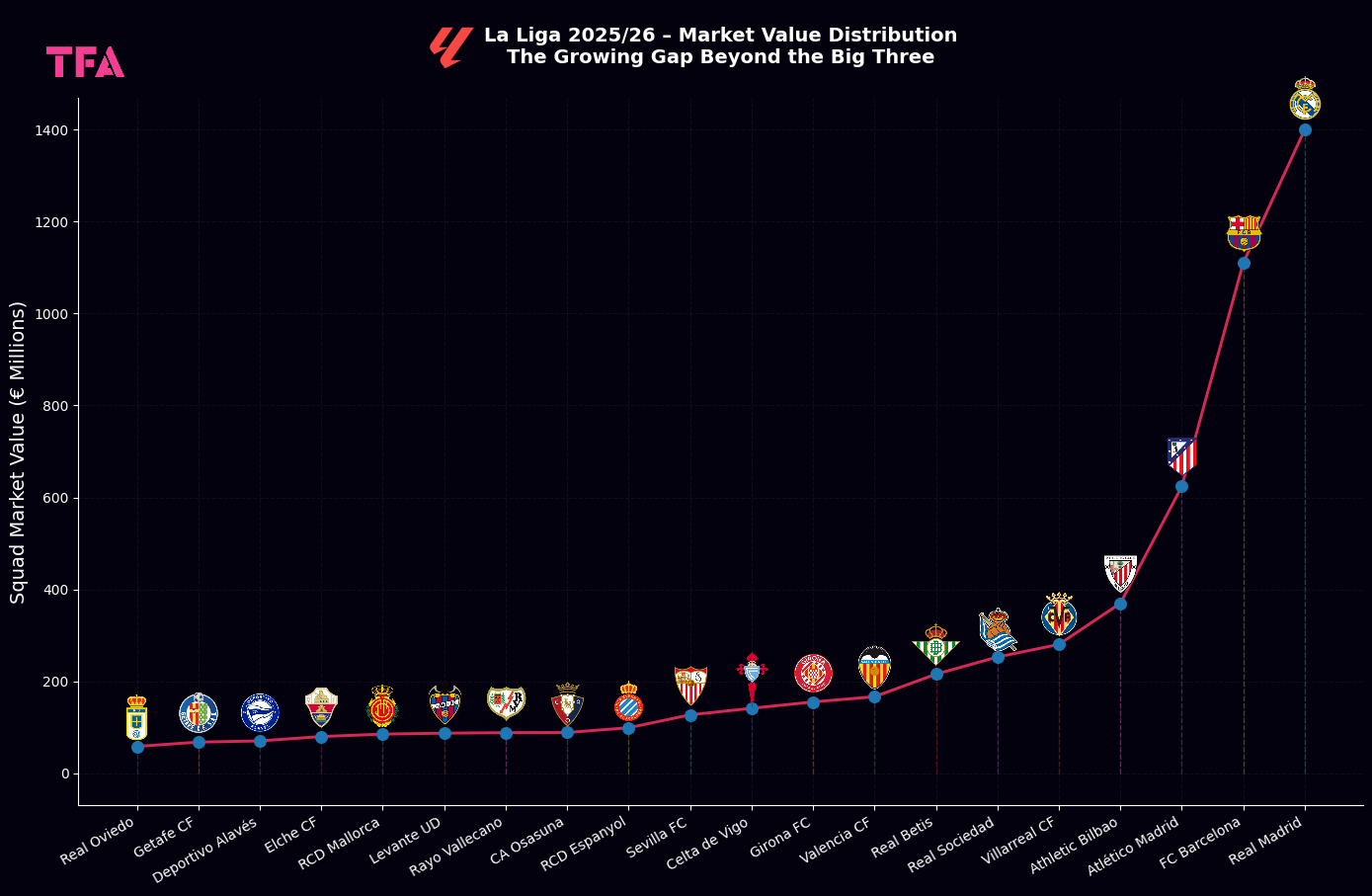 La Liga 2025/2026 – Market Value Distribution
Collectively, La Liga clubs possess a total squad market value exceeding €5.23bn, with valuations spanning from the elite giants to mid- and lower-tier sides.
Real Madrid leads with an impressive €1.4bn, closely followed by FC Barcelona at €1.11bn, while Atlético Madrid holds €623.8bn, Athletic Bilbao, Villarreal CF, and Real Sociedad occupy the mid-tier range.
Full Access To TFA Articles
New Content 7 Days
Expert Insights
TFA Podcast Access
7 Day Free Trial
Money Back Guarantee