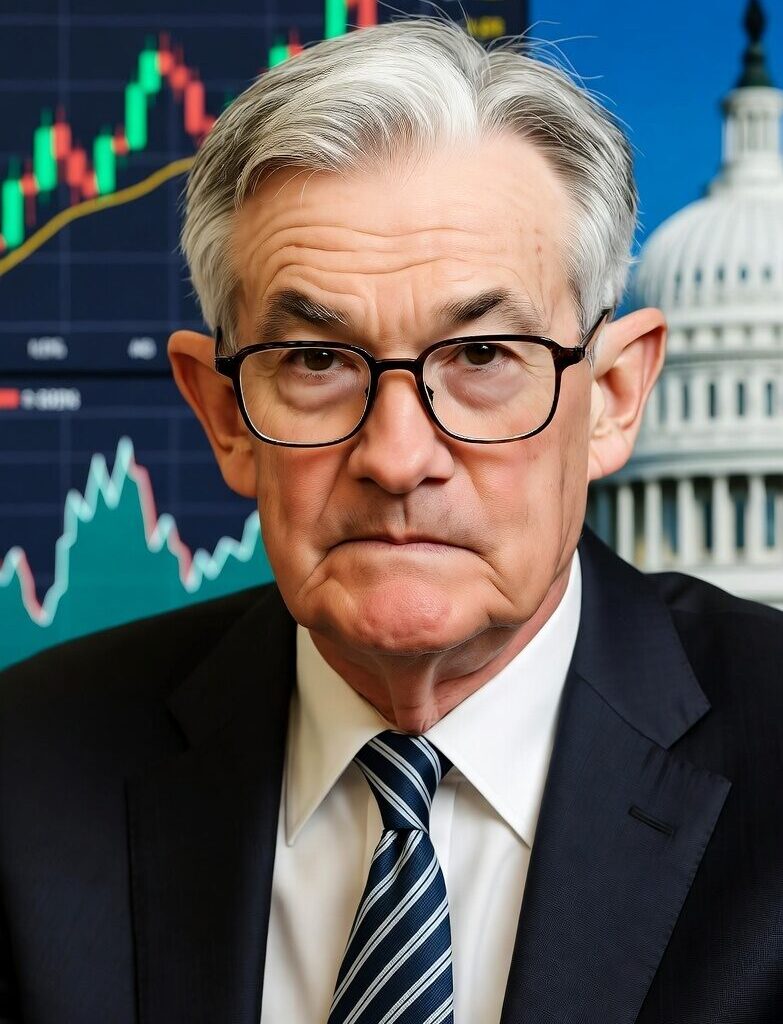
 US Federal Reserve Chair Jerome Powell
A growing belief in financial markets is that US monetary policy will become more accommodative in 2026, not because inflation is defeated, but because the internal dynamics of the Federal Reserve are shifting. As voting rights rotate among regional Federal Reserve Bank presidents and leadership at the top approaches a transition, investors are increasingly pricing a softer policy stance into the outlook.
At the centre of this expectation is the approaching end of Jerome Powell’s tenure as Federal Reserve Chair. Powell will preside over his final Federal Open Market Committee meeting in late April before stepping down in May, completing his second four-year term. With his departure now in sight, markets have begun to treat the Chair as a diminishing force in shaping forward guidance, even though he retains formal authority until the end.
Dr Komal Sri-Kumar, President of Sri-Kumar Global Strategies and a long-time adviser to multinational investors and sovereign wealth funds, notes that Powell risks becoming a lame duck in his final months, formally in charge but no longer setting expectations. As attention shifts toward his successor, the centre of gravity in monetary policy may already be moving.
That shift is being reinforced by explicit political signalling. President Donald Trump has stated repeatedly that he wants a Federal Reserve Chair who will cut interest rates aggressively. Investors have taken that message seriously. The three rate cuts delivered toward the end of 2025 are now widely seen as the beginning of a longer easing cycle rather than its conclusion. Expectations for further cuts in 2026 are being driven less by near-term data and more by leadership change, institutional incentives, and political pressure.
 Dr Komal Sri-Kumar, President of Sri-Kumar Global Strategies
Yet Sri-Kumar cautions that the narrative of an inevitably dovish Fed deserves closer scrutiny. Even a more accommodative Committee and a growth-friendly Chair will remain constrained by inflation credibility and financial stability risks. The direction of policy may be clear, but the pace and scale of easing could still disappoint markets that are expecting rapid relief.
Part of the dovish expectation stems from changes in the FOMC’s voting roster. Two regional bank presidents who favoured holding rates steady last month, Austan Goolsbee of Chicago and Jeffrey Schmid of Kansas City, will not be voters in 2026. That rotation has been interpreted as removing resistance to further cuts. But the picture is more nuanced.
Goolsbee, for example, voted to cut rates at both the September and October meetings, supporting a pause in December only to wait for clearer data. Sri-Kumar has consistently argued that such caution reflects prudence rather than hawkishness. Rotation alone does not guarantee a more accommodative Committee.
Powell has frequently invoked the legacy of Paul Volcker, the Fed Chair who restored inflation discipline in the early 1980s at significant short-term cost. Whether his final months resemble that legacy, or instead echo the politically constrained tenure of Arthur Burns, will become clear soon enough
Nor are incoming voters uniformly dovish. While outgoing voters Susan Collins and Alberto Musalem are often characterised as leaning hawkish, their successors are not unequivocally supportive of near-term easing. Beth Hammack and Lorie Logan, both voting members in 2026, have expressed reservations about further rate cuts in the current environment, highlighting how finely balanced the Committee remains.
That balance places greater weight on two pivotal figures in the months ahead: Powell himself and John Williams, President of the New York Fed and a permanent voter who has historically aligned closely with the Chair. Whether the two support further easing at meetings early next year could shape the rate path well into 2026.
This raises a deeper question about Powell’s motivations as his tenure draws to a close. With inflation having failed to meet the Federal Reserve’s 2 per cent target since early 2021, Sri-Kumar argues that the Chair may use his final votes to reassert the centrality of price stability rather than accommodate political pressure. The passage of the Big Beautiful Bill, which is expected to widen fiscal deficits in pursuit of growth and employment, strengthens the case for restraint rather than renewed stimulus.
There is also historical memory at play. The policy response to the pandemic combined aggressive fiscal expansion with extraordinary monetary easing, a mix that later contributed to persistent inflation. Repeating that approach while inflation credibility remains fragile would risk repeating a costly error.
Powell has frequently invoked the legacy of Paul Volcker, the Fed Chair who restored inflation discipline in the early 1980s at significant short-term cost. Whether his final months resemble that legacy, or instead echo the politically constrained tenure of Arthur Burns, will become clear soon enough.
What is already clear is that expectations of an effortlessly dovish Federal Reserve in 2026 may prove overly optimistic. Institutional change matters, but credibility, inflation, and market confidence still impose limits that even a reshaped Fed cannot easily escape.
Post Views: 6
Dear Reader,
The Indian Sun is an independent organisation committed to community journalism. We have, through the years, been able to reach a wide audience especially with the growth of social media, where we also have a strong presence. With platforms such as YouTube videos, we have been able to engage in different forms of storytelling. However, the past few years, like many media organisations around the world, it has not been an easy path. We have a greater challenge. We believe community journalism is very important for a multicultural country like Australia. We’re not able to do everything, but we aim for some of the most interesting stories and journalism of quality. We call upon readers like you to support us and make any contribution. Do make a DONATION NOW so we can continue with the volume and quality journalism that we are able to practice.
Thank you for your support.
Best wishes,
Team The Indian Sun
