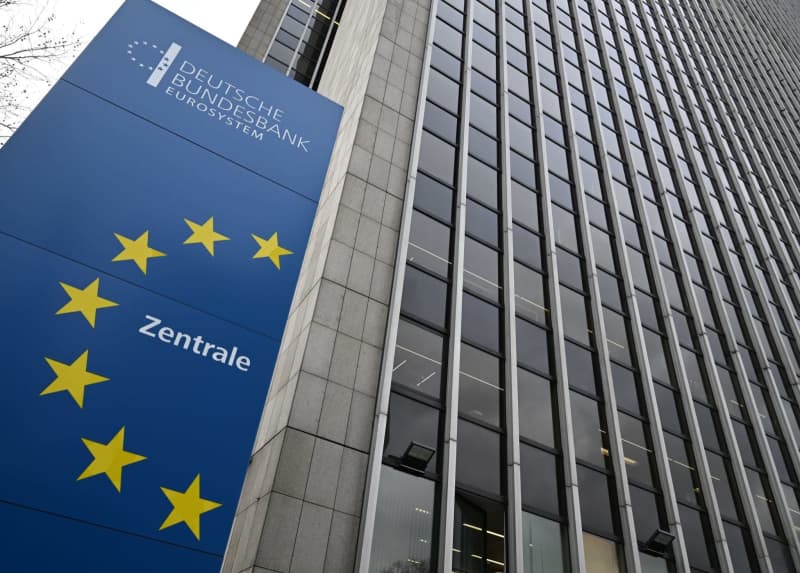

A stele with the inscription “Deutsche Bundesbank Eurosystem” stands in front of the Bundesbank headquarters. Arne Dedert/dpa
The Bundesbank expects a gradual revival of the German economy over the course of the coming year, forecasting 0.6% growth for 2026 after three years of weak performance, the central bank said on Friday.
The projection, released in its monthly report for December, is slightly more pessimistic than in June, when it predicted a calendar-adjusted 0.7% increase in real gross domestic product (GDP) for next year.
Several other economic forecasts have also been revised down recently.
Taking into account the additional working days in the coming year, the Bundesbank’s projection is somewhat more optimistic. The current year is likely to deliver mini-growth of 0.2%, the central bank said.
“The German economy will make headway again in 2026: While progress will be subdued initially, it will then slowly pick up,” Bundesbank President Joachim Nagel said in presenting the Bundesbank’s new Forecast for Germany.
“Starting in the second quarter of 2026, economic growth will strengthen markedly, driven mainly by government spending and a resurgence in exports,” he explained.
For the first quarter of 2026, the Bundesbank expects an increase of 0.1% on the previous quarter, as in the final quarter of 2025.
The upswing is set to gain significant momentum in 2027, the Bundesbank said. It expects 1.3% growth then, which is 0.1 percentage points more than estimated in June.
In 2028, Europe’s largest economy is forecast to expand by 1.1%, according to the Bundesbank. Increasingly, momentum should come from multibillion-euro government spending on infrastructure such as roads and rail and from investment in defence.