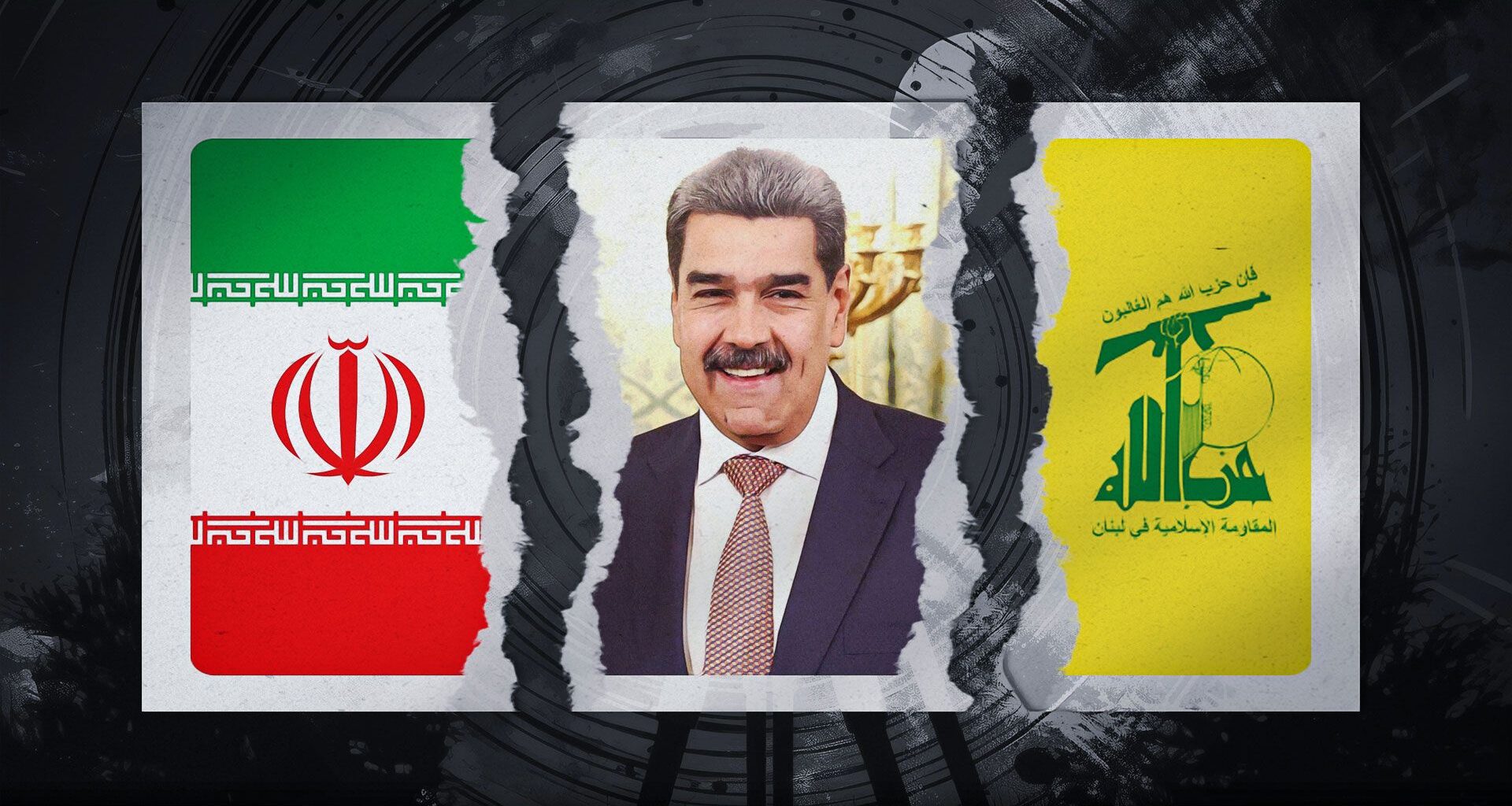
Key Takeaways:
Nicolás Maduro’s capture by the U.S. weakens a key global hub for narcotics trafficking and corruption — and disrupts one of Iran’s closest strategic partnerships outside the Middle East.
For years, Venezuela has served as an IRGC-linked outpost, enabling Iran and Hezbollah to launder money, smuggle gold and oil, traffic drugs, and finance terrorism — including through Venezuela-based operatives.
Removing Maduro threatens Iran’s financial pipelines and Hezbollah’s criminal networks across South America, potentially limiting Tehran’s ability to project power and fund terror globally.
On Saturday, January 3, the U.S. undertook a military operation in Venezuela, resulting in the capture of the Venezuelan President Nicolás Maduro and his transfer to New York, where he faces drug trafficking charges.
While the primary driver behind Maduro’s arrest appears to be the systemic corruption and narcotics trafficking under his rule, contributing directly to the surge of cocaine entering the United States, the implications extend far beyond U.S.-Venezuela relations. Maduro’s removal has the potential to reshape regional power dynamics in the Middle East and disrupt transnational criminal and terror-linked networks with reach well beyond North and South America.
Venezuela and the Iranian Regime
Iran and Venezuela have maintained a relationship since the 1950s. However, the strength and direction of the relationship increased significantly in 2005. The strategic partnership encompassed the realms of politics, military, and economics. In 2007, then-Iranian President Mahmoud Ahmadinejad and Venezuelan President Hugo Chávez signed a formal “anti-imperialist” alliance, alluding to the U.S.
By 2020, a military company directly tied to the Islamic Revolutionary Guard Corps (IRGC) established itself in Venezuela. Then, in 2022, amid U.S. oil sanctions, Venezuela and Iran signed a 20-year agreement, whereby Iran transferred oil to Venezuela. The two countries have coordinated the exchange of gasoline and gold, providing both regimes with sanctions-evasion mechanisms and alternative revenue streams. The partnership allowed Iran to establish a growing presence in Venezuela while diverting some of the profits it makes in Venezuela to its terror network in the Middle East.
In the years leading up to the U.S. military operation, Venezuela began developing drones using Iranian-trained experts overseen by the Islamic Republic, reflecting a deepening military collaboration. Beyond that, Venezuela’s state-owned airline, Conviasa Airlines, has been involved in the Iranian regime’s global illicit arms network.
In effect, Venezuela became not merely an economic partner but a strategic outpost for Iran, extending Tehran’s influence closer to U.S. borders while reinforcing its global network of illicit trade and terror financing.
After the U.S. operation, Qatar issued a statement of disapproval, knowing that ultimately, the capture of Maduro would have profound impacts on Qatar as well, which is also linked to Iran’s terror network.
Breaking: Qatar is pissed over Trump’s capture of narco-terrorist warlord Nicolás Maduro. The reason is twofold:
1. Both Venezuela and Qatar maintain deep ties with Iran. Taking Maduro off the board directly damages Tehran’s regional and financial networks.
2. More… pic.twitter.com/00Eb1X3vKa
— Eitan Fischberger (@EFischberger) January 3, 2026
Venezuela and Hezbollah
Iran has exploited this connection with Venezuela to expand its terror and criminal networks across South America. Hezbollah, in particular, has leveraged the region as a hub for narcotics trafficking, money laundering, and illicit finance, with Hezbollah-affiliated operatives based in Venezuela playing a documented role in these schemes. Through drug trafficking corridors, Hezbollah has generated significant revenue used to finance its terrorist activities abroad.
Hezbollah’s vast terror network includes clans based in Venezuela and other South American countries that assist in the movement of funds through different banks in order to finance Hezbollah’s terror activities. One major operation in 2011 exposed the scale of this network, resulting in the arrest of approximately 130 individuals and the seizure of roughly $23 million in illicit funds.
Hezbollah’s involvement in narcotics and organized crime led the U.S. government in 2018 to designate the group as one of the world’s top five transnational criminal organizations, placing it alongside major drug cartels. This designation underscored the critical reality that Hezbollah is not solely a terrorist organization driven by ideology, but a sophisticated hybrid entity that fuses terrorism with large-scale criminal enterprise, exploiting weak states and corrupt regimes like Venezuela to fund and sustain its global operations.
Venezuela has also bypassed U.S. sanctions by using Hezbollah to smuggle gold, whereby the IRGC facilitated the sale of Iranian oil and accepted gold as a form of payment, which was directed toward Hezbollah terrorists.
Venezuelan opposition leader: “Some people talk about invasion in Venezuela. And I answered: Venezuela has been already invaded. We have the Russian agents, we have the Iranian agents. We have terrorist groups such as Hezbollah, Hamas, operating freely in accordance with the… https://t.co/gUpSDZMlRh
— UN Watch (@UNWatch) January 3, 2026
Venezuela, ruled by Maduro, played an undeniable role in increasing the reach of the Iranian regime and its terrorist proxies. While South America may be geographically distant from Israel, the capture of Maduro is likely to have a significant impact that extends well beyond Venezuela and the U.S.
Maduro’s removal threatens to sever one of the Iranian regime’s most valuable strategic partnerships, disrupting financial pipelines and logistical routes that the Iranian regime relied upon to sustain its proxies. Especially now, as the Iranian regime faces growing internal pressure, the loss of Venezuela as a partner further constrains its ability to project power abroad.
Maduro’s downfall is not only a turning point for Venezuela, but a development with direct implications for Middle Eastern security, weakening Iran’s global infrastructure and limiting the reach of the terror networks it supports.
Liked this article? Follow HonestReporting on Twitter, Facebook, Instagram and TikTok to see even more posts and videos debunking news bias and smears, as well as other content explaining what’s really going on in Israel and the region. Get updates direct to your phone. Join our WhatsApp and Telegram channels!