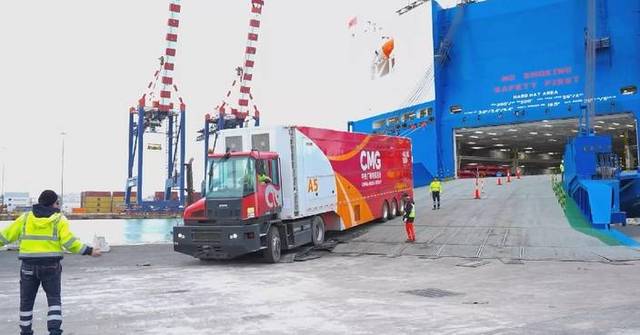
China Media Group’s (CMG) “China Red” 4K/8K ultra-high-definition broadcast vehicle fleet arrived at the Port of Livorno, Italy on Sunday ahead of the Milano-Cortina 2026 Winter Olympic Games.
Following the successful fulfillment of the broadcast mission of the Paris 2024 Olympic Games, the “China Red” fleet has once again set out overseas and will undertake the production of 8K international public signals for the opening and closing ceremonies and multiple events of the 2026 Winter Olympic Games scheduled for February.
The broadcast vehicles were transported aboard the carrier Yuan Hai Kou, which departed from the Taicang Port in east China’s Jiangsu Province on December 1, 2025.
The carrier sailed through the South China Sea, the Indian Ocean, the Red Sea and the Suez Canal, making a brief stopover at the Port of Piraeus in Greece on December 26 before proceeding to Italy.
Throughout the entire journey, the CMG ultra-high-definition broadcast vehicles were provided with comprehensive security and logistical support.
The “China Red” broadcast fleet consists of two 4K/8K ultra-high-definition broadcast vans and two supporting vehicles.
The 4K/8K broadcast vans are independently designed and integrated by the CMG — China’s flagship broadcaster. Each vehicle is 17 meters long, accommodates up to 34 workstations across five operational areas, and is capable of processing up to 80 channels of 4K signals, representing the cutting edge of international ultra-high-definition live production technology.
After completing customs clearance, the fleet will leave Livorno for Milan and is scheduled to officially move into the San Siro Stadium on January 13, where it will begin preliminary preparations for the Milano-Cortina 2026 Winter Olympic broadcast operations.
The 2026 Winter Games will open on February 6, 2026, at Milan’s San Siro Olympic Stadium, with around 2,900 athletes expected to take part. It will be Italy’s first Winter Olympics in 20 years since Turin 2006, and 70 years after Cortina d’Ampezzo hosted the 1956 edition.
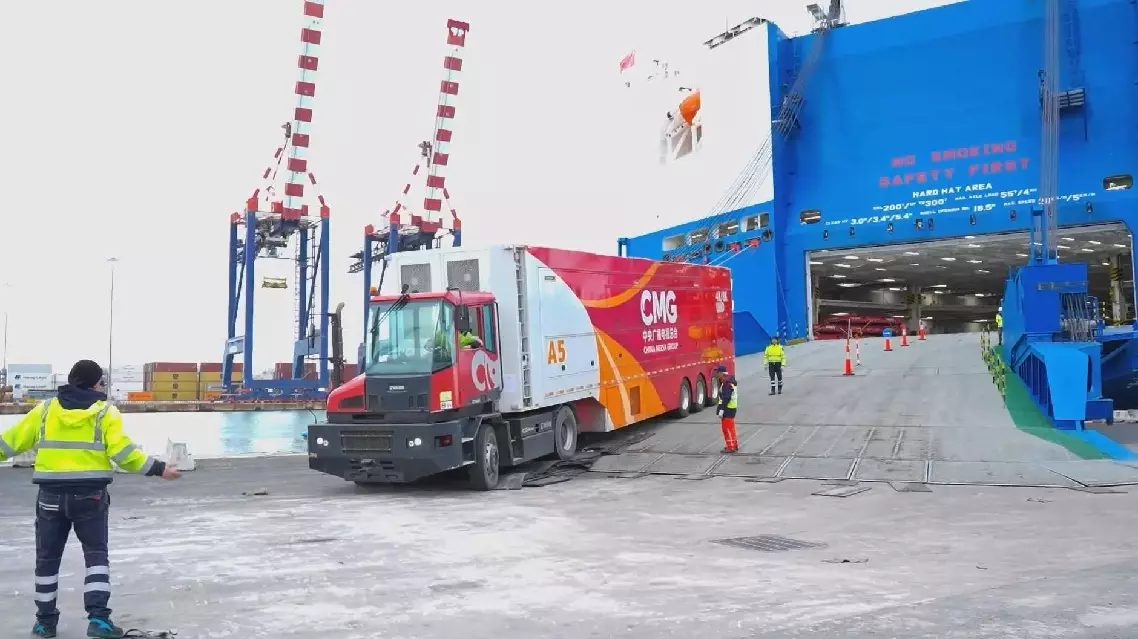
CMG broadcast vehicles arrive in Italy for 2026 Winter Olympics coverage
The United States cannot legitimize an operation that attacked Venezuela and captured its president, a Chinese scholar said Sunday.
On Saturday, the United States launched a large-scale strike on Venezuela, during which Venezuelan President Nicolas Maduro and his wife were ‘captured and flown out of Venezuela’ according to a post by U.S. President Donald Trump on his Truth Social account.
Teng Jianqun, director of the Center for Diplomatic Studies at Hunan Normal University, said in an interview with China Global Television Network (CGTN) that the aim of this operation is to take full control of Venezuela’s natural resources.
“I don’t think the United States can legitimize this operation to take custody of the president of Venezuela. And also I don’t think the United States can legitimize its any action in taking the oil reserves of that country. This is actually a very dangerous game played by the Trump administration. And of course, the United States would like to take full control of that country and to take full control of the natural resources, especially the large reserve of oil in Venezuela,” said Teng.
Teng said Venezuela is not an isolated case but a common practice by the United States. The United States launched an invasion of Panama on Dec. 20, 1989, which continued until January 1990, with the stated objective of capturing Panamanian strongman Manuel Noriega on charges of drug trafficking and organized crime.
“We still remember the so-called sentence of the former president of Panama in the late 1980s. And this time, the president of Venezuela will be under some judicial condition (judicial proceedings) for the so-called drug trafficking and some other crimes. So I think this is not a single case for the Venezuela country, but also this is actually a practice by the United States — to use force, to use so-called justice under law against any leaders in Latin America and the Caribbean waters,” he said.
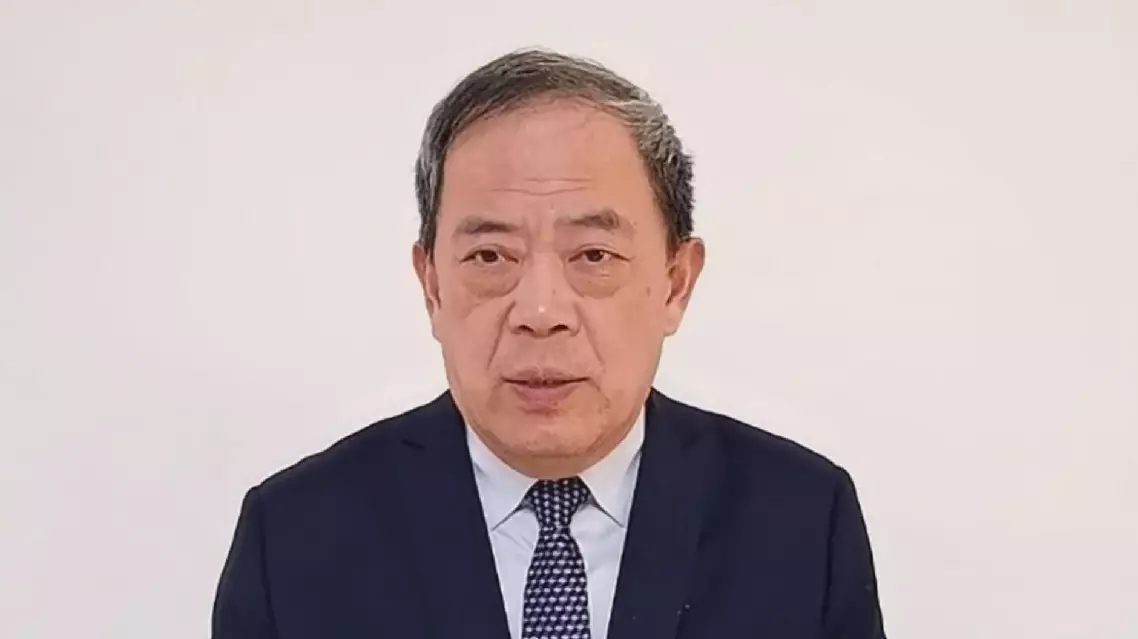
US cannot legitimize operation against Venezuela: Chinese scholar