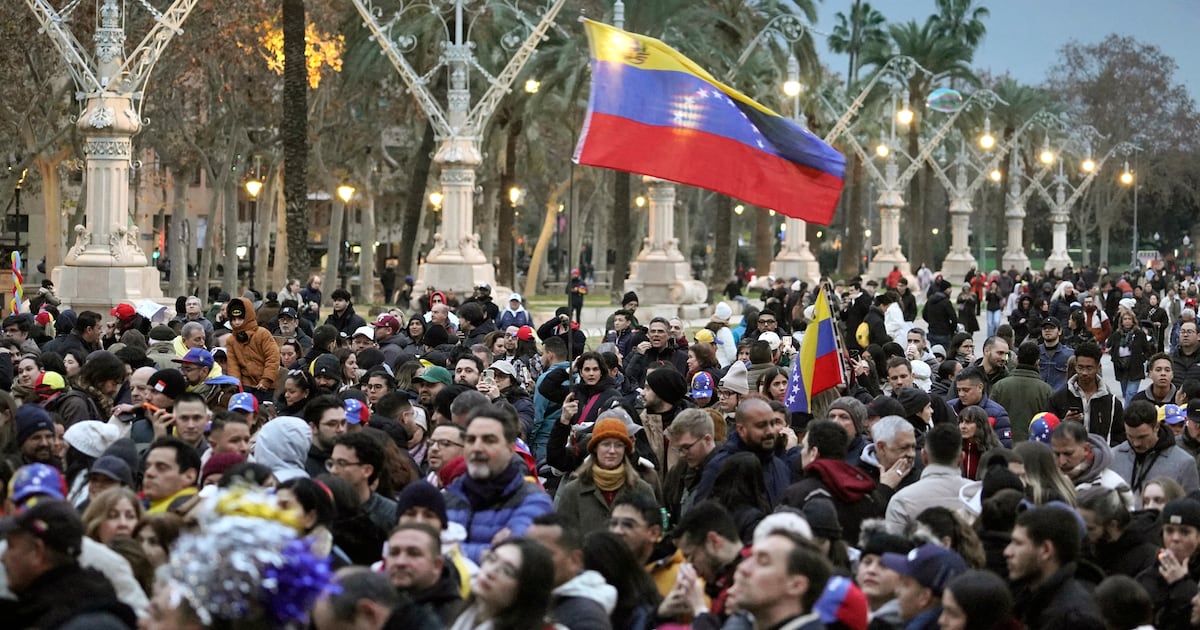
Most EU leaders sought to tread carefully in their response to the US attack on the regime of Nicolás Maduro in Venezuela over the weekend, fearful, officials say, of the consequences for Ukraine of antagonising the Trump administration.
The US action shocked governments around the world but many were cautious in their comments, emphasising the need to uphold international law, rather than explicitly condemning the Trump administration’s actions.
This was especially evident in Europe, where leaders, wary of undermining US support for Ukraine, were circumspect in their comments about the US action. Senior Irish officials confirmed there had been extensive behind-the-scenes contacts between EU leaders on the issue on Saturday in the hours after news of the attack first broke early that day.
One person with knowledge of the issue said that EU leaders were trying to perform a “delicate balancing act”, in advance of a meeting of the so-called “coalition of the willing”, a group of EU and western countries committed to helping Ukraine resist the Russian invasion.
EU foreign policy chief Kaja Kallas said that the bloc was “closely monitoring the situation in Venezuela”.
“Under all circumstances, the principles of international law and the UN Charter must be respected. We call for restraint,” she said.
The Irish Government, in a statement issued by Minister for Foreign Affairs Helen McEntee, echoed the EU line. “Ireland, together with our EU partners, underlines the absolute necessity of full respect for international law and the principles of the UN Charter,” she said. “While we have been clear that president Maduro does not have any democratic legitimacy, we have consistently called for a peaceful and negotiated transition in Venezuela, and have supported all international efforts to that end.”
Similar statements, using similar language, were issued by several EU governments. However, others issued more robust responses.
[ Why has US attacked Caracas and captured Venezuela’s president?Opens in new window ]
Spanish prime minister Pedro Sánchez said that Spain will not recognise any intervention in Venezuela that violates international law.
“Spain did not recognise the Maduro regime. But neither will it recognise an intervention that violates international law and pushes the region toward a horizon of uncertainty and belligerence,” Mr Sánchez said in a statement.
At home, Opposition parties were critical of the Government’s failure to condemn the US action.
Sinn Féin spokesperson on foreign affairs Donnchadh Ó Laoghaire described the US action as “a naked power grab to gain control of Venezuelan oil” and added that “world leaders must demand immediate de-escalation to avoid a full-blown conflict in the region”.
While the EU refused to recognise Mr Maduro’s regime, assessing that the elections were not free and fair, members of Sinn Féin travelled to his inauguration in 2019 and have, along with other left-wing parties in the Dáil, condemned the EU’s stance.
A small group of protesters gathered in Dublin to condemn the US action over the weekend. Organiser Céile Varley said she was “horrified” by the bombing of the capital, Caracas, and capture of Mr Maduro.
“As a lawyer and a believer in international law, what the US is doing is in complete contradiction to everything I ever learned and everything the world should do,” she said.
Ms Varley was a key campaign aide of President Catherine Connolly during the recent election.
Meanwhile, Eamon Gilmore, the former tánaiste and Labour leader who has served as an EU envoy in the region, said that Mr Maduro ran “a very repressive regime”, imprisoning most of his opponents.
“But there is such a thing as international law,” he said. “There has to be respect for territorial integrity and sovereignty … It’s not legal for a country to swoop into another country and replace its government. That’s a matter for the people of Venezuela.”