![[Peace In Your View] Preserving Nuclear Test Records as a Legacy for Peace](https://www.europesays.com/wp-content/uploads/2026/01/https3A2F2Fsubstack-post-media.s3.amazonaws.com2Fpublic2Fimages2F337e9913-338a-468c-8543-60df1.jpeg)
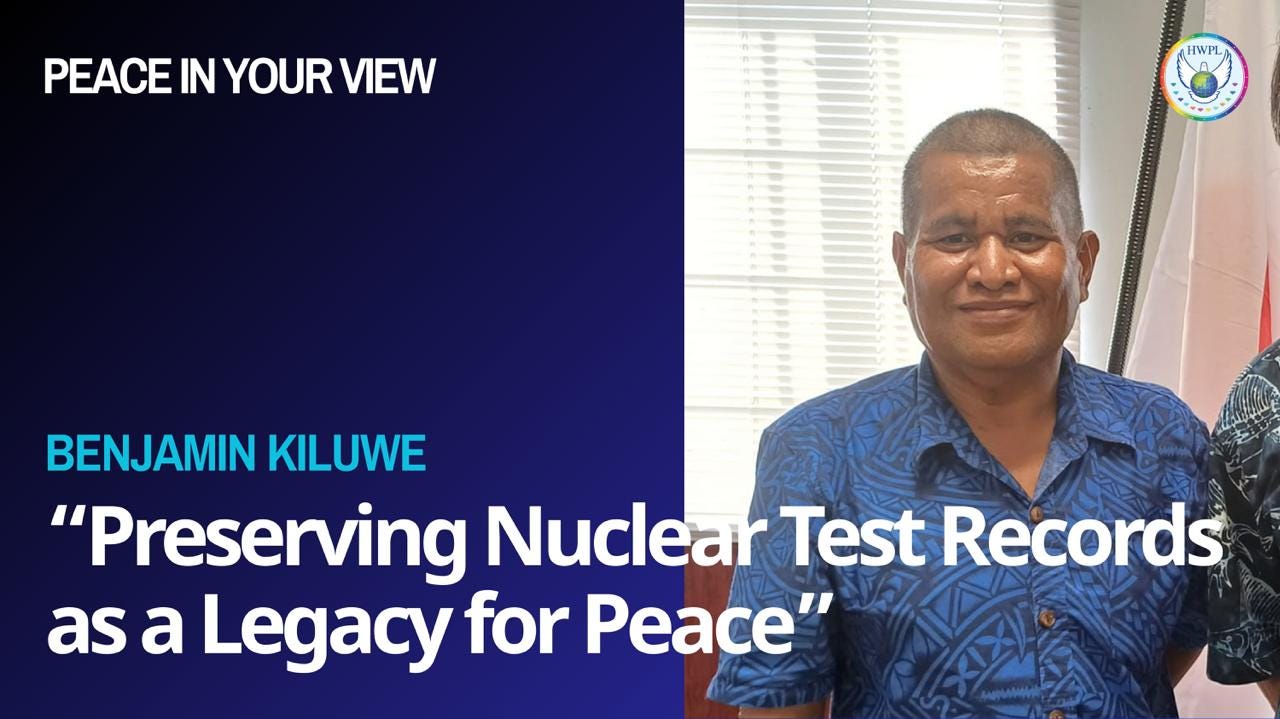
Exclusive interview withMr. Benjamin Kiluwe of the Marshall Islands Ministry of Culture & Internal Affairs on “Preserving Nuclear Test Records as a Legacy for Peace”.
Peace In Your View is an initiative developed under HWPL’s efforts to realize Article 10, Spreading a Culture of Peace, of the Declaration of Peace and Cessation of War (DPCW).
By conducting in-depth interviews with individuals actively contributing to peace, the project seeks to illuminate diverse perspectives, experiences, and philosophies.
Through stories shared by leaders, practitioners, and community members from various backgrounds, Peace in Your View aims to inspire readers to reflect on how they can promote peace, inclusion, and social cohesion in their own communities.
The Republic of the Marshall Islands bears one of the most painful legacies of nuclear testing in human history. Between 1946 and 1958, nuclear tests conducted at Bikini Atoll and other sites displaced communities, devastated the environment, and left long-lasting human suffering.
In this interview, Mr. Benjamin Kiluwe, an official at the Marshall Islands Ministry of Culture & Internal Affairs (MoCIA), shares his perspective on why preserving nuclear testing records is essential—not only for Marshallese society, but for the global community. He reflects on the enduring human, environmental, and historical impacts of nuclear testing, and emphasizes the role of documentary records in safeguarding truth, memory, and intergenerational accountability as foundations for justice and peace.
Q. Why is it important for Marshallese society—especially younger generations—to remember the history of nuclear testing at Bikini and Enewetak Atolls?
It is crucial for our society to fully understand the suffering and losses our people endured as a result of nuclear testing. Entire communities were displaced, and many Marshallese lost not only their homes, but also their cultural heritage, as they were never able to return to their ancestral lands.
For younger generations, remembering this history is especially important. They need to understand how deeply nuclear testing devastated our society—socially, culturally, environmentally, and spiritually. More importantly, this understanding helps explain why the issue of justice remains unresolved for many Marshallese families even today.
Memory is not about dwelling on pain; it is about ensuring that the truth is carried forward so that similar tragedies are never repeated.
Q. You have collaborated with HWPL over the years and previously visited Korea for the HWPL World Peace Summit. Could you share your experience and how your understanding of HWPL’s peace work has evolved over time?
I had the opportunity to visit Korea in 2014 and 2015 to participate in the HWPL World Peace Summit, during the early stages of HWPL’s global peace activities. At that time, I was deeply impressed by how people from diverse nations, cultures, and backgrounds came together with a shared desire for peace.
Since then, HWPL has continued to develop its peace initiatives in a consistent and principled way. In particular, after the Declaration of Peace and Cessation of War (DPCW) was proclaimed in 2016, I observed how HWPL began grounding its activities in a clear normative framework for peace.
What stood out to me most was Article 10 of the DPCW, which emphasizes spreading a culture of peace through public awareness, education, and remembrance. I was especially moved by how HWPL applies this principle in practice—transforming painful histories, such as nuclear testing in the Marshall Islands, into peace initiatives that educate, commemorate, and promote accountability.
Seeing efforts that seek not to erase suffering, but to preserve memory and transform a nuclear legacy into a peace legacy, left a strong impression on me. It reflects a sincere commitment to ensuring that such tragedies are not repeated.
Q. HWPL conducts its peace activities based on the Declaration of Peace and Cessation of War (DPCW). How do you see the relevance of this framework—especially Article 10—to the historical experience of the Marshall Islands?
The Marshall Islands represents a very real example of why a culture of peace is necessary. The nuclear testing carried out at Bikini and Enewetak Atolls demonstrates how militarization and war-related decisions can continue to harm people, communities, and the environment long after conflicts have officially ended.
Article 10 speaks directly to this reality. By emphasizing public awareness, remembrance, and education, it recognizes that peace is not sustained only through political agreements, but through collective memory and shared understanding.
From this perspective, preserving nuclear testing records is not simply about documenting the past. It is about ensuring that future generations inherit lessons for peace, rather than a legacy of violence. This approach closely reflects the lived experience of the Marshallese people.
Q. When we talk about preserving the memory of nuclear testing, what kinds of records or materials are most important?
The documentary records related to nuclear testing are essential because they provide concrete evidence of historical truth, responsibility, and accountability. In particular, the legal decisions and case records produced by the Nuclear Claims Tribunal (NCT) are extremely significant.
These records clearly document the extent of personal injury, displacement, environmental damage, and long-term suffering experienced by the affected communities. Many of the people represented in these documents are still seeking justice today.
Such records speak for those whose voices were ignored for decades. Preserving them ensures that the human impact of nuclear weapons is neither minimized nor forgotten.
Q. Why do you believe the Marshall Islands—especially Bikini and Enewetak Atolls—are relevant to global peace discussions today?
For me, the history of Bikini and Enewetak Atolls is not only a national tragedy—it is a global lesson. What happened here reflects the broader consequences of weapons of mass destruction on humanity and our shared environment.
When these experiences are remembered and shared internationally, they help people understand the true cost of nuclear weapons beyond military or political narratives. Preserving these records allows the world to confront uncomfortable truths and acknowledge historical responsibility.
Transforming what was once a nuclear testing ground into a source of peace education and remembrance is not only meaningful—it is necessary. This is how painful history can contribute to building a safer and more peaceful future for all.
Preserving nuclear testing records is not simply an act of archiving history. It is an act of justice, remembrance, and peacebuilding.
Through memory, education, and international solidarity, the suffering of the Marshallese people can become a lasting reminder of why peace must be actively protected—and why humanity must never repeat the same mistakes.