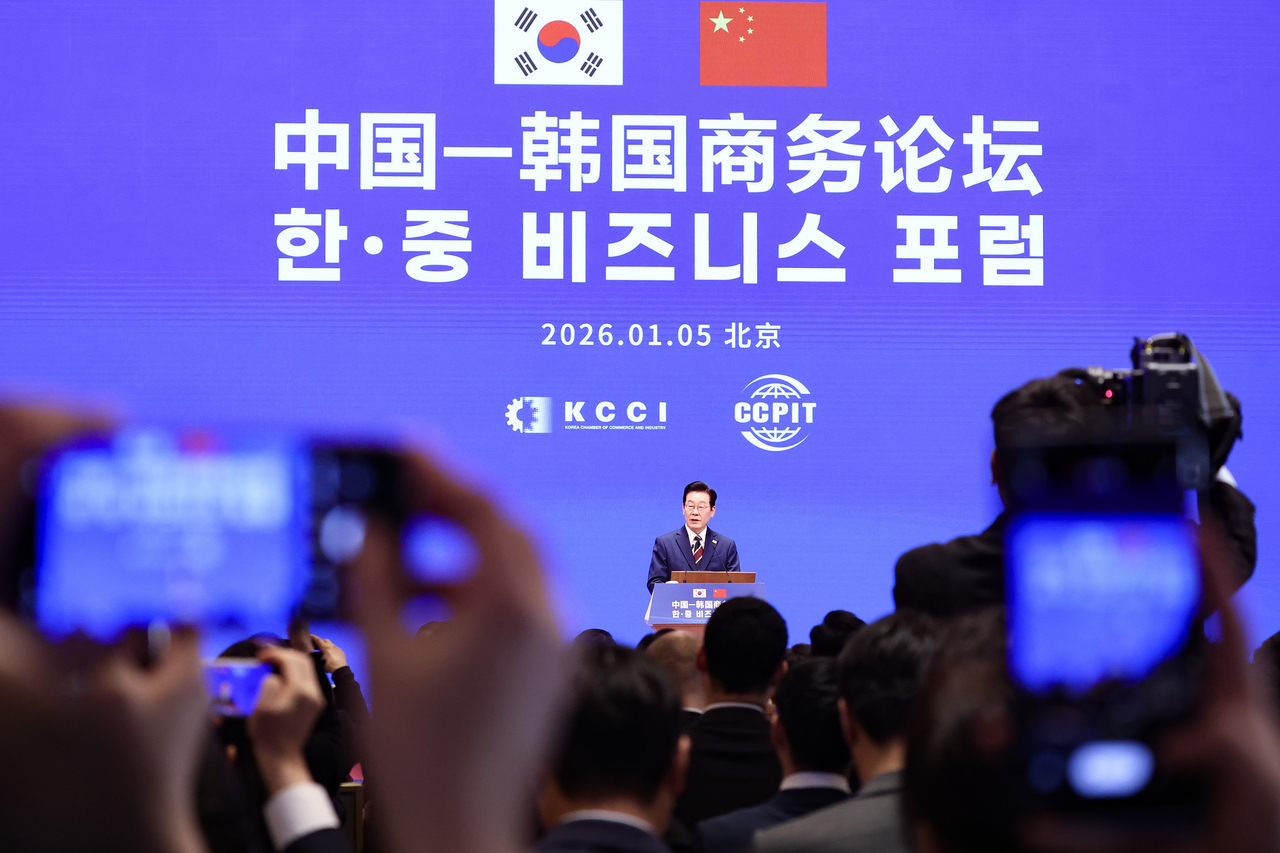
 President Lee Jae Myung speaks during a Korea-China Business Forum held at Diaoyutai State Guesthouse in Beijing on Monday. (Yonhap)
 BEIJING, China — President Lee Jae Myung on Monday called for Seoul and Beijing to “open a new route” for economic and industrial cooperation, to jump-start stagnant trade ties amid rapid technological shifts and growing supply-chain uncertainty.
During a meeting with top business leaders from South Korea and China, Lee underscored that the next phase should pair high-tech areas such as artificial intelligence with everyday industries spanning consumer goods to cultural business.
The president also noted Seoul and Beijing have pursued their own technological advances and economic growth while bound by tightly linked industrial supply chains that have helped lift both economies.
Lee cautioned that a new approach may be needed following changes to the global economic and trade landscape.
“Technology is changing direction at speed, and supply chains have become as difficult to predict as shifting tides. If we rely only on past momentum, we risk missing critical turning points,” Lee said during the meeting at Diaoyutai State Guesthouse in Beijing that took place before the Korea-China business forum.
“Now is the time to set course for a new route. Hesitation is natural, but without changing direction, we may never discover a new path at all.”
Lee highlighted the trajectory of Korea-China trade as proof that the economic partnership needs fresh momentum. Bilateral trade between Seoul, which had climbed steadily since 2015, peaked at around $310.3 billion in 2022 before slipping into a downturn from 2023.
“Korea-China trade has plateaued at around the $300 billion level, which is precisely why charting new routes — and opening new markets — has become imperative,” Lee said.
“The two countries share cultural values rooted in geographic proximity and historical ties. At the same time, future technologies such as artificial intelligence make a new level of cooperation not only possible, but necessary,” Lee added.
Coupling AI with bread-and-butter consumer sectors and cultural content could create a synergy strong enough to generate new growth engines and widen economic cooperation, according to Lee.
“Consumer goods, including daily necessities, beauty products and food, as well as cultural content such as film, music, gaming and sports, can serve as new engines of growth. … Artificial intelligence, in turn, can broaden and deepen cooperation across manufacturing, services and other sectors.”
이재명 대통령, 한·중 비즈니스 포럼 참석
South Korean President Lee Jae Myung and Chinese Vice Premier He Lifeng join a group photo session during a forum between businesspeople of South Korea and China at the Diaoyutai State Guesthouse in Beijing on Monday. (Yonhap)
Heavyweights pack Korea-China biz forum
The business forum, held on the sidelines of Lee’s state visit, was co-hosted by the Korea Chamber of Commerce and Industry and the China Council for the Promotion of International Trade.
It drew a heavyweight lineup, including the heads of South Korea’s four largest conglomerates — Samsung, SK, Hyundai Motor Group and LG — alongside executives from the fashion, entertainment and gaming industries.
The roster underscored the breadth of the two countries’ industrial overlap. South Korean participants ranged from the semiconductor, battery and auto industries; home appliances, steel, energy, food and biotechnology; and fashion, entertainment and gaming.
Chinese attendees, meanwhile, spanned trade and investment promotion; petrochemicals and energy infrastructure; finance; consumer electronics and displays; electric vehicles; cultural content and telecommunications equipment.
On the South Korean side, the delegation featured Chey Tae-won, chair of SK and the Korea Chamber of Commerce and Industry, as well as Samsung Electronics Chair Lee Jae-yong, Hyundai Motor Group Executive Chair Chung Euisun and LG Group Chair Koo Kwang-mo.
Posco Group Chair Chang In-hwa, GS Group Chair Huh Tae-soo, CJ Group Chair Sohn Kyung-Shik, LS Group Chair Koo Ja-eun and Fashion Group Hyungji Chair Choi Byung-oh also attended, as well as SM Entertainment CEO Jang Cheol-hyuk and gaming giant Krafton CEO Kim Chang-han.
Chinese companies were represented by their chairs, with the exception of Tencent, which was represented by a vice president. This included chairs from the China Council for the Promotion of International Trade, Sinopec Group, China Energy Engineering Corp. Ltd., Industrial and Commercial Bank of China, TCL Technology, Contemporary Amperex Technology Co., Jiangsu Yueda Group, SERES Group, Lancy, and ZTE Corporation.
Lee’s state visit also brought a business delegation comprising roughly 200 members. It was the first KCCI-led delegation to China since December 2019, when a similar trip was organized on the occasion of the trilateral summit between Korea, China and Japan.
한·중 비즈니스 포럼, 발언하는 허리펑 중국 부총리
Chinese Vice Premier He Lifeng speaks during a forum between businesspeople of South Korea and China at the Diaoyutai State Guesthouse in Beijing on Monday. (Yonhap)
High stakes for Korea-China summit
The Korea-China business forum took place hours before a second summit between Lee and Chinese President Xi Jinping, expected about two months after their first meeting on Nov. 1 on the sidelines of the 2025 APEC summit in Gyeongju, North Gyeongsang Province.
Chinese Vice Premier He Lifeng on Monday noted that Lee was set to hold “an important meeting” later in the day.
“I hope the summit between the two leaders will help guide bilateral relations toward a path of trust and development through shared understanding,” He said while attending Lee’s meeting with business tycoons.
After the summit, Seoul and Beijing were set to sign about 15 memorandums of understanding spanning the economy and industry, climate and the environment, and transportation.
Lee has framed his four-day state visit, which began Sunday and includes Beijing and Shanghai, around two priorities.
One is to encourage China to play a constructive role in maintaining peace and stability on the Korean Peninsula, including by helping revive long-stalled dialogue with North Korea.
The other is to deepen economic cooperation in areas central to today’s supply chains, including semiconductors and batteries, while expanding into future-oriented fields such as artificial intelligence, biotechnology and renewable energy based on the two countries’ respective comparative advantages.
“This return visit will serve as an important marker in charting the next 30 years of our relationship, building on more than three decades of diplomatic ties,” Lee said Sunday at a meeting with South Koreans living in China at the Wanda Vista Hotel in Beijing.
dagyumji@heraldcorp.com