Scholarly evidence now attributes a three-page section of the play Sir Thomas More (1591-93) to William Shakespeare. If true, its safe to say the Elizabethan poet was a fierce defender of immigrant rights; or, at the very least, had empathy for so-called “strangers” seeking a better life, in a new place. I Was A Stranger, a five-part, neorealist drama set during the height of the Syrian civil war, in 2015, begins with Shakespeare’s impassioned speech to a group of braying rioters, demanding the bigots see themselves in the shoes of the stranger with “babies at their backs and their poor luggage.” Do you imagine you’d be treated any differently, Shakespeare seems to ask, if you were a stranger in another land?
Writer-director Brandt Andersen has his heart in the right place, but the inclusion of Shakespeare’s forgotten words is an unfortunate harbinger for a film whose western gaze is apparent from the get. Fractured as it is in Pulp Fiction-like chronology, and at only 97 minutes, I Was a Stranger is packaged and sold with a festival audience in mind.
It’s an odd approach. In some ways, I Was a Stranger is reminiscent of Agnieszka Holland’s Green Border, which depicted, in raw detail, the experience of Ukrainian refugees at the Polish border. But Holland’s film more or less sticks with one storyline, giving us intimate access to the on-the-ground challenges of leaving one place in haste and, perhaps, even more challenging, being accepted somewhere new. Because Andersen doesn’t let us sit with any one perspective for longer than about fifteen minutes, we are stuck at arm’s length.
I Was a Stranger Too Often Feels Like an Action Epic
Told in reverse chronological order, the film starts in Chicago in April 2023 with a conspicuous crane shot approaching Trump Tower. But Andersen brings into a hospital where Doctor Amira Homsi (Yasmine Al Massri, who gives a star turn in Palestine ’36) is clocking in and is, seemingly, shocked to realize it is her birthday. The film immediately flashes back to 2015, when Amira is desperately trying to hold down an ER in Aleppo, treating a bleeding-out teenager and a gunshot-wounded soldier at the same time; the latter threatens her at gunpoint to stop treating “the enemy.” At the same time, bombs rain down relentlessly mere feet away.
Nonetheless, Amira gets out of her shift in one piece and heads home for a family birthday celebration, right before a bomb tears through the living room ceiling. Amira and her daughter Rasha (Massa Daoud) survive, but the rest of the family does not, and the two of them find themselves in the trunk of a car in a mad dash to be smuggled out of the conflict. The film then cuts to Mustafa’s POV (Yahya Nagayni), the soldier who had told Amira in the ER waiting room that treating the enemy makes her the enemy.
It turns out Mustafa is the son of an infamous resistance fighter, though how he became a loyal soldier for Bashar al-Assad is as yet unclear. Mustafa seems like a pretty unflappable fellow until he witnesses his superior make several decisions to murder children at point-blank range, and is faced with a quandary to either help Amira escape or else shoot his boss. But, like every preceding segment, Andersen cuts before the decisive moment.
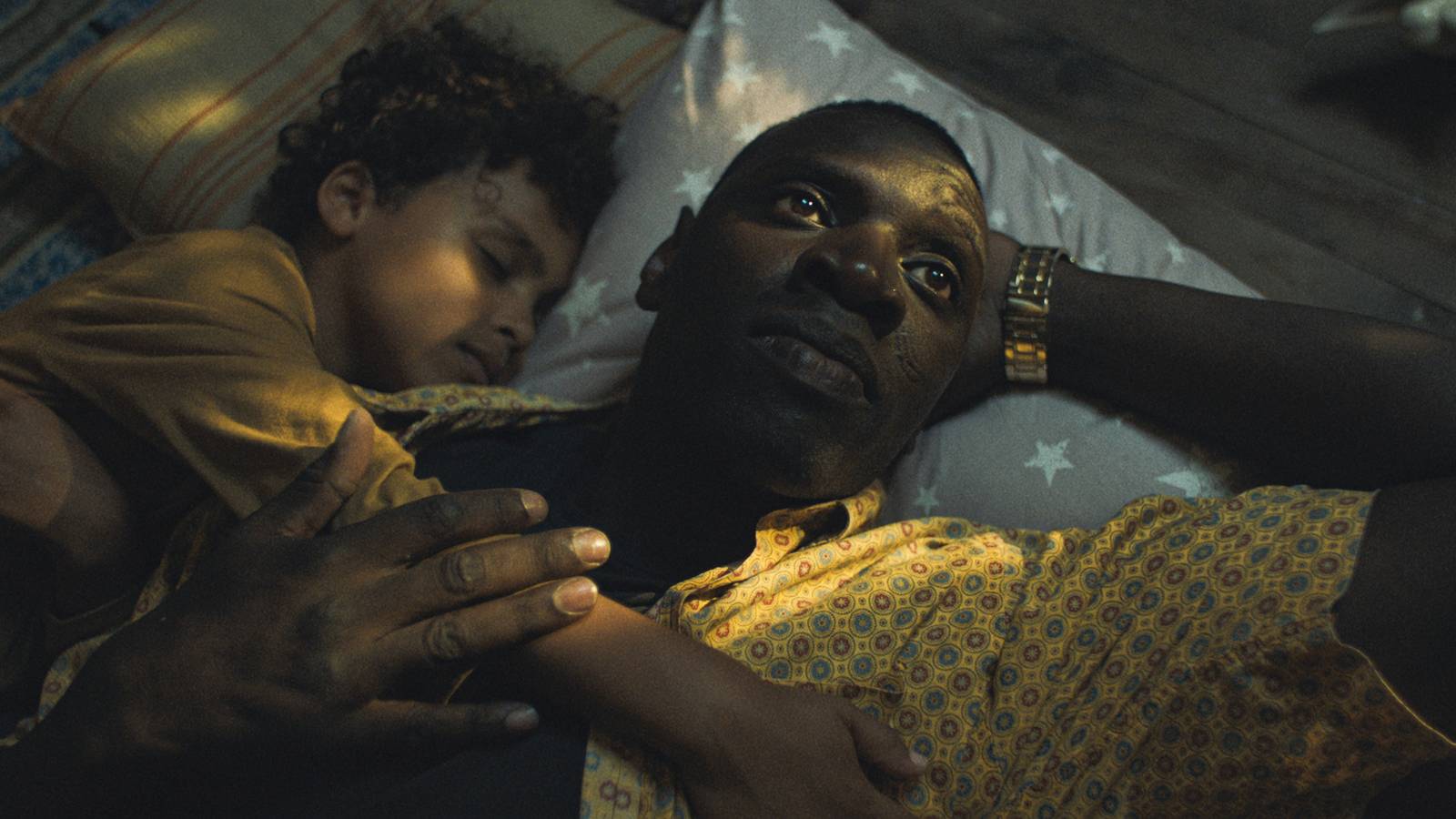
Next up is Omar Sy (Netflix’s Lupin), who plays Marwan, the film’s most bizarrely confusing character. Sy may be the film’s most recognizable face, but he is cartoonishly evil here in some scenes and then cartoonishly sweet in others. A smuggler in Turkey taking reprehensible levels of advantage over enthusiastic would-be migrants, Marwan also cares for his ill child Yusuf (Baeyen Hoffman) with tenderness as they both fantasize about eating deep dish pizza in Chicago. Everyone is complicated, I guess, but Marwan doesn’t make a ton of sense, especially since he and his son are both French, yet speak in English while living in Turkey.
Andersen then shows us the brief journey of Fathi (Ziad Bakri), Amira’s brother, who is caught on the lifeboat that Marwan has organized, in the film’s shortest and, oddly, most expendable section. Nothing is learned here, really, and then Andersen brings us to Greece, where battle-weary Captain Stavros (Constantine Markoulakis) struggles to keep up spirits while on an unceasing mission to save as many migrants as he can. In the film’s most morally dubious scene, Stavros, his colleagues and family put on airs of false humility while scoreboarding the total number of lives he has saved. White saviorism in real time.
Andersen has long been a passionate activist for immigrant rights; he has personally flown aid packages over Gaza, has run filmmaking camps for displaced people all over the world, and operates a foundation called REEL which helps immigrants use art as an outlet. Despite him being white and American, it isn’t as if he comes to this material with inexperienced eyes and ears, yet still, the movie feels hollow. The characters’ one dimensionality is one thing, but its also frustrating that the film makes no attempt to contextualize this moment, a decision which just characterizes middle eastern conflict as generalized and othered.
At its best, I Was a Stranger dramatizes the desperation of migrancy in ways that complicate right-wing narratives of cheapskate criminality, but most of the time the movie dips into trauma porn. It isn’t difficult to imagine the wealthy cinema-goer that otherwise spends little time thinking of immigrants, now able to walk out of the theater patting themselves on the back for having a heart. But the movie doesn’t interrogate the actual perpetrators of violence nor the systems that have lit the powder keg for the migrant crisis to exist, nor does it do much to help us understand these people on any real, vulnerable level. As an action movie, it works alright — but I’m sure Andersen would agree his subject deserves more value than as entertainment.
I Was a Stranger releases theatrically on January 9th, 2026.
Release Date
January 9, 2026
Runtime
97 minutes
Director
Brandt Andersen
Writers
Brandt Andersen
Producers
Ossama Bawardi, Charlie Endean, Brandt Andersen, Ryan Busse

Yasmine Al Massri
Amira Homsi