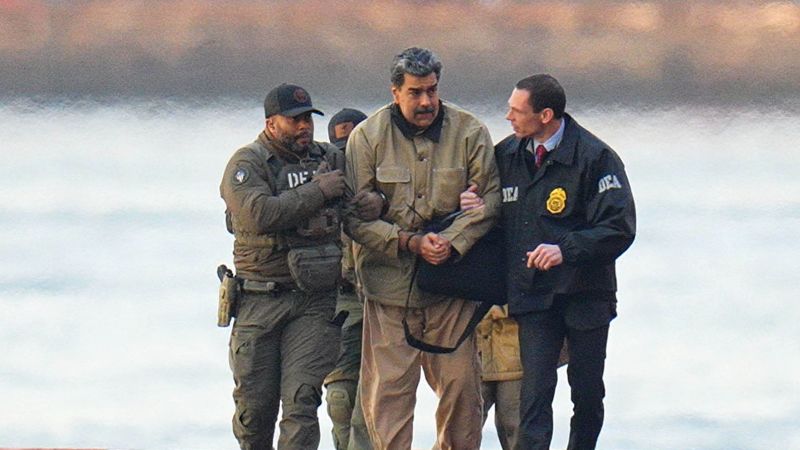
President Donald Trump’s second term entered a new phase over the weekend, with the administration launching a successful operation in Venezuela that captured its leader, Nicolás Maduro.
The legally dubious mission is Trump’s most significant foreign policy move to date and appears to preview a new effort by the president to throw his weight and US military might around on the global stage and, more specifically, in the Western Hemisphere.
Trump is already making threats to several other countries that he suggests could be targeted next.
As for the politics of the Venezuela strike? Here’s what we can say at this early juncture.
The first quality poll on the operation — released by The Washington Post on Monday — suggests Republicans have rallied to Trump’s side. But that doesn’t mean this is popular.
The poll shows 40% of Americans approved of the administration sending the military to capture Maduro, compared with 42% who opposed it.
So that’s about evenly split.
But there’s some key context here.
For one, those numbers appear better than we might have expected. Polling before the operation showed Americans overwhelmingly opposed military action in Venezuela — to the tune of 63%-25% in a Quinnipiac University poll and 70%-30% in a CBS News-YouGov poll.
So why the discrepancy?
One likely reason is that the action was more limited than a full-scale invasion, at least for now. (Trump has suggested the mission could go beyond that, including with a “second strike” if Venezuela’s remaining leaders don’t do what he wants.)
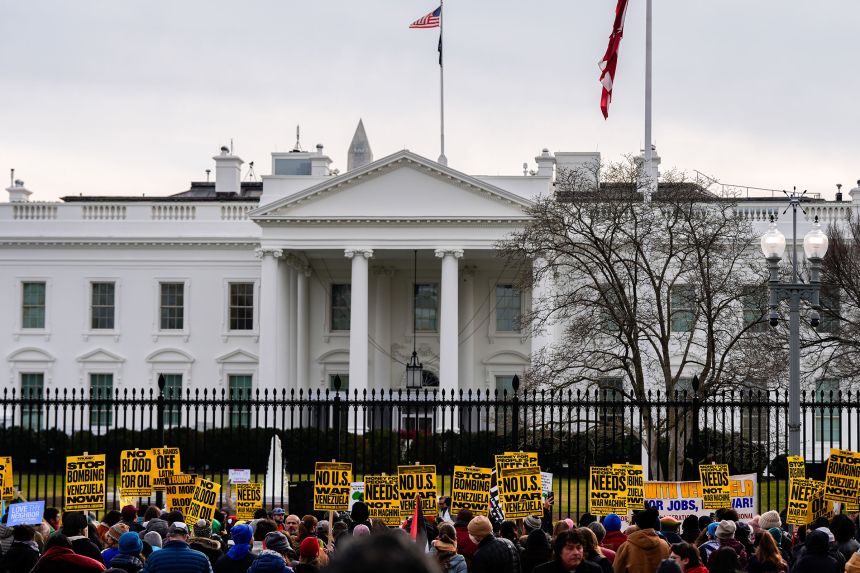
It seems logical that people might be more in favor of just capturing Maduro, an unsympathetic strongman.
But still another could be partisanship. We saw after Trump’s Iran strikes last summer that many Republicans who were skeptical ultimately came around when Trump launched them.
While GOP support for military action before the Venezuela operation was 52% and 58% in the Quinnipiac and CBS polls, respectively, it was at 74% in the post-strike Washington Post poll.
Independents moved less in Trump’s favor, going from 19% and 22% supporting military action on the pre-strike polls to 34% in the Post poll.
It’s also not normal for an operation like this to be unpopular initially.
The mission to capture Maduro bears many similarities to the operation to capture then-Panamanian strongman Manuel Noriega in 1989 and early 1990. But back then, the Post’s polling showed 8 in 10 Americans approved of the mission.
Americans also leaned in favor of the invasion of Grenada in 1983, and they overwhelmingly favored the invasions of Afghanistan in 2001 of Iraq in 2003.
These invasions tend to lose popularity as time goes on and the complexity of the situation comes into focus. But usually, Americans are on board at the start.
So it would seem inauspicious for Trump that even a highly successful military operation that secured Maduro, wrapped up quickly and didn’t cost any American lives would have only middling popularity.
Trump’s focus on running Venezuela and taking its oil — controversial steps, to say the least — could also hurt those approval numbers moving forward.
It’s not just that Americans were skeptical of this mission, specifically. It’s that they seem to care a lot less about foreign policy than Trump does, and they want him to focus on matters at home — things like inflation.
Perhaps the most striking evidence of that came a few months ago when Trump struck a ceasefire deal in Gaza and took a high-profile victory lap.
It was a huge moment. But polls showed Americans basically shrugged. Some polls even showed Trump remained underwater on the Gaza issue.
But the evidence of Americans’ disinterest in foreign adventurism goes beyond that.
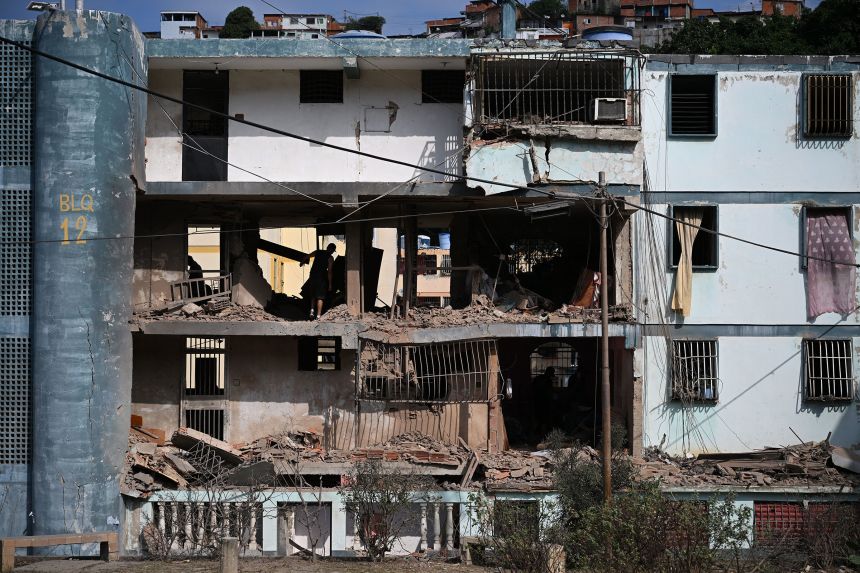
Recent polling from the Chicago Council on Global Affairs shows the percentage of Americans who want the US to “stay out” of world affairs is hovering around a decades-high of 40% (including 40% of Republicans).
A Reuters-Ipsos poll in June showed majorities of Republicans, Democrats and independents all said it was “better” for the US if it “stays out of the affairs of other nations.”
And a recent AP-NORC poll asked Americans to name five political priorities for 2026. Just 26% named something having to do with foreign policy. That put it in last place — far lower than the economy (71%), immigration (44%), health care (41%) and personal financial issues (43%).
Which brings us back to the new Washington Post poll. Yes, three-quarters of Republicans approved of Trump’s Venezuela operation. But just 45% said they approved of it “strongly.”
The numbers were remarkably similar in a CNN poll after Trump’s Iran strikes: Eighty-two percent of Republicans supported the action, but just 44% did so strongly.
If even Trump’s base can’t get too excited about these strikes, maybe that’s a sign.
Trump is clearly chasing the domination of the Western Hemisphere and a Nobel Peace Prize. But those aren’t Americans’ — or even Republicans’ — priorities right now.
It remains to be seen how this plays out in the court of public opinion. But on a more practical level, Trump is starting to get what he wants out of his increasingly militaristic and outwardly focused second term — and is apparently building the legacy that he cares about.
With his quip this weekend about the “Donroe Doctrine” and the administration’s recently published national security strategy, Trump has made it clear his goal is to dominate the Western Hemisphere through threats, coercion and even military force.
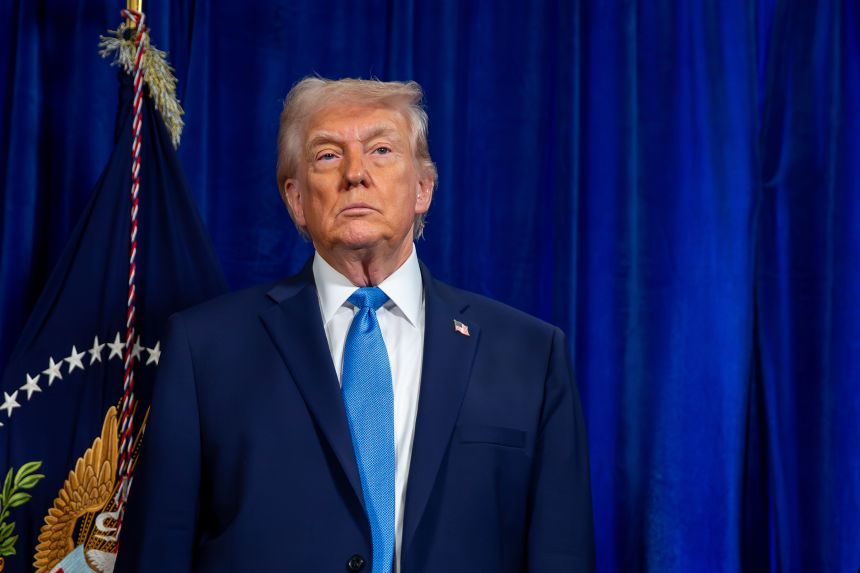
(The Trump War Room social media account helpfully illustrated this for us on Saturday, depicting Trump standing defiantly over a map of North and South America with a baseball bat labeled “Donroe Doctrine.”)
Trump likes nothing better than to apply pressure on people to bend to his will. And as CNN’s Nick Paton Walsh wrote this weekend, there are few signs of strength like deposing a foreign leader who didn’t play along. That surely sends a message to others.
There is plenty to play out yet in Venezuela, and history suggests the situation there could quickly become a problem for the administration.
But when it comes to Trump’s broader foreign campaign, this was a significant show of force that should enable the rest of the project.
While it doesn’t appear Trump’s base is turning against him over this strike, it does risk exacerbating some emerging fissures in the MAGA movement.
Trump is practically daring the noninterventionists to desert him.
Those noninterventionists largely looked the other way after the Iran strikes. But what do they do now that Trump has deposed a foreign leader and is threatening Colombia, Cuba, Greenland, Iran and Mexico?
For now, few have weighed in, and Trump’s MAGA allies appear mostly in line. We’ve seen strong criticism from frequent Trump adversary Rep. Thomas Massie of Kentucky and outgoing Rep. Marjorie Taylor Greene of Georgia. We’ve also seen cautious statements warning about how this was handled and about what happens next from Sens. Rand Paul of Kentucky and Lisa Murkowski and Dan Sullivan of Alaska, among others.
On the MAGA influencer side of things, Candace Owens savaged the strike as a “hostile takeover” by globalists, while Steve Bannon wondered aloud whether Trump was getting talked into this by the “neocons.”
A big question now is what Tucker Carlson does. He softened his early skepticism of the Iran strikes, but he cautioned strongly against invading Venezuela.
At some point, these people might have to reckon with the idea that Trump’s version of “America First” has become very different from their own — and that giving the president a pass on things like Iran emboldens him to go further in places like Venezuela.
And that’s especially the case if Trump remains intent on effectively running Venezuela and taking its oil.
That’s something that even many Republicans who praised the strike seemed to warn Trump against this weekend. They can apparently see a possible quagmire coming, even if Trump doesn’t.