Why I had to write a second piece — and what Lakritz Stangen have to do with Venezuelan oil
I want to start by saying something plainly.
I wrote this as a second article because it undermines a key assumption behind the first one. And I think it matters to say that out loud.
In the earlier piece, I treated the idea of “taking Venezuelan oil” as if it referred to something concrete — a real, extractable prize that could plausibly be seized, controlled, and monetised. That assumption gave weight to my suspicion that justice was being mixed with appropriation.
Then I looked more closely at the oil itself.
And that’s where the argument began to fall apart.
The moment of clarity came from an unexpected place: a conversation relayed to me about a Dutch petroleum engineer who has worked extensively with heavy oil. Not a politician. Not a commentator. Someone who has actually dealt with this material in the real world.
He laughed and said something simple.
“Venezuelan oil? It’s like Lakritz Stangen.”
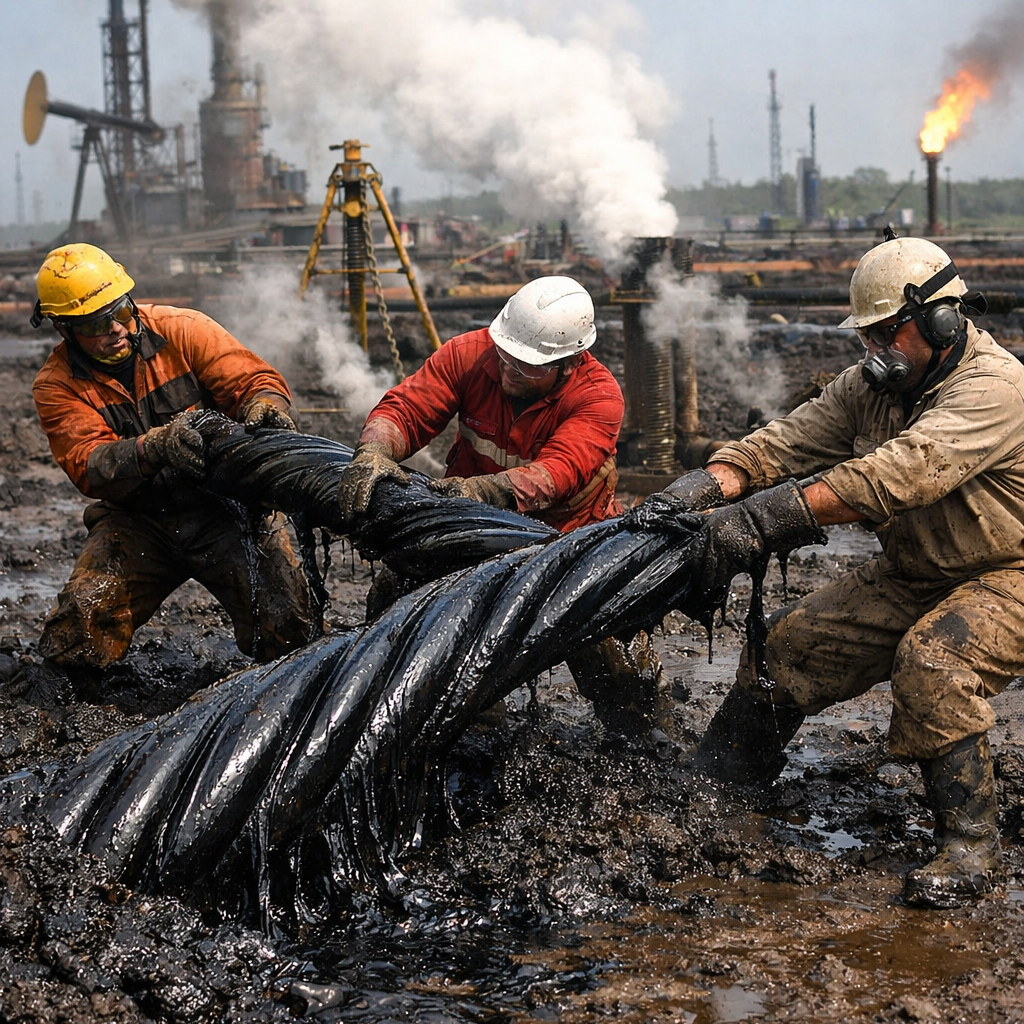
Hard liquorice sticks. The kind you don’t pour or sip, but pull, stretch, and wrestle with before they give you anything at all.
At first, it sounded almost playful. Then it clicked. Because it was one of the most accurate descriptions I’d heard.
The problem with Venezuelan oil is not primarily political.
It’s not even primarily moral.
It’s physical.
Most of what people mean when they talk about “Venezuelan oil” comes from the Orinoco Oil Belt. And that oil does not behave like oil in the ordinary sense. It doesn’t flow. It doesn’t gush. It doesn’t obediently rise to the surface when you drill a hole.
It sits there. Thick. Resistant. Almost solid.
Like liquorice.
If you leave a Lakritz Stange on a table, nothing happens. Gravity won’t help you. You have to grab it, apply force, maybe warm it up, keep pulling steadily. Even then, it resists. It only moves because you keep working at it.
That is Venezuelan oil.
And here is the part that tends to disappear in political talk.
To make that oil move at scale requires tens of billions of dollars in upfront investment: massive steam-generation plants, continuous energy supply, specialised infrastructure, and years of development before a single barrel becomes profitable. It also requires highly trained engineers, operators, chemists, and maintenance teams — people with rare expertise.
That work is not done by armies.
It is not done by presidents.
And it is not done by states acting alone.
It is done, if at all, by private companies operating under strict economic logic. And those companies ask very simple questions: Is the legal framework stable? Is the political risk manageable? Will the numbers work over 20 or 30 years?
Right now, the answers in Venezuela are obvious.
No serious private firm is lining up to invest tens of billions there. Not because of ideology, but because the risk–return equation does not close. Without those firms, without that capital, without that expertise, the oil stays where it is — underground, stubborn, unmoved.
Which is why phrases like “taking the oil” start to sound hollow once you understand the reality. You don’t “take” Lakritz Stangen. You don’t seize them and walk away. You commit to them, long-term, at enormous cost — or you leave them alone.
And that’s the point where my earlier argument weakens.
If the oil cannot realistically be taken in the way the rhetoric suggests, then the idea of a simple material “booty” collapses. The language may still be crude. It may still reveal a certain mindset. But it no longer describes a viable plan of appropriation.
What remains, then, is something else: performative political communication. A statement designed to project power, signal dominance, and speak to an audience — not to outline an executable economic project.
That doesn’t settle the moral question I raised before. The discomfort about unilateral action, sovereignty, and precedent remains. But it does force a correction.
This article exists because I think it matters to adjust one’s thinking when the facts demand it — even when doing so complicates a position that initially felt clear.
Sometimes the most honest thing you can say is:
I thought I was dealing with liquid gold. It turns out it was liquorice.
And that changes the whole picture.
Dr. Yosef B. Moran is a writer and philosopher based in Antwerp, Belgium. He explores transcendence, human dignity, and the balance between inner growth, action, and the hidden structures of power. He is the author of Weekly Parashah, a series bringing Torah to life through existential and ethical reflection.