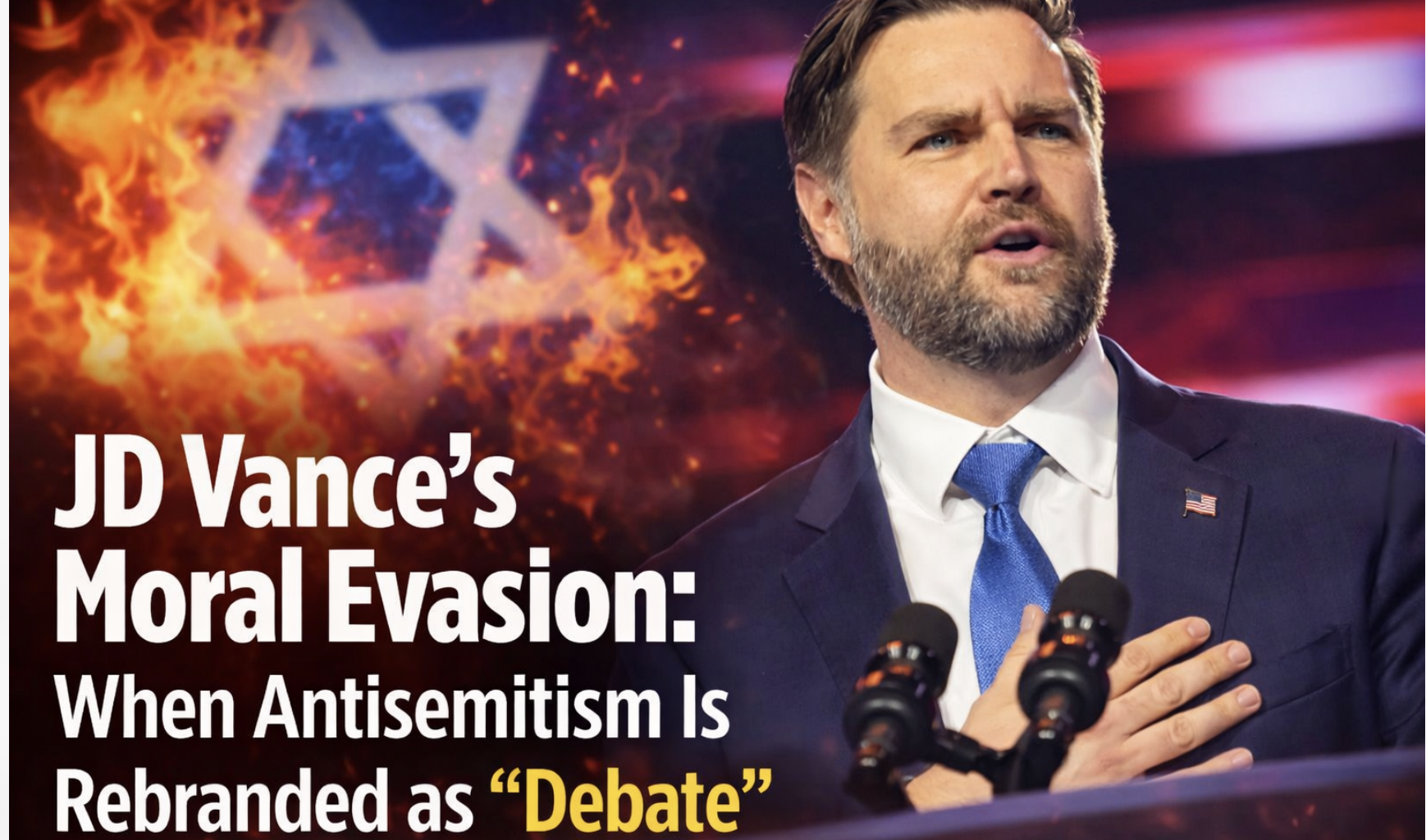
The times of Israel publish a Live Blog titled Vance claims antisemitism in US a ‘real backlash’ to American foreign policy that record JD Vance’s troubling remarking about Israel. Not only are Vance’s comments at Turning Point USA wrong, they also hurt the cause. Vance’s effort to recast antisemitism as a “real backlash” to U.S. foreign policy is a common but risky one: he turns hate into criticism and bias into perspective.
This is not a deep thought. It looks smart because of a mistake in how we think.
Vance’s assertion—that the majority of Americans are not antisemitic, and that the current sentiment reflects frustration with a foreign policy “consensus” regarding Israel—relies on two deceptive maneuvers. First, he makes up numbers without giving any proof, as if confidence alone can stand in for proof. Second, and more dangerously, he sees antisemitism as an epiphenomenon: not a belief system with its own logic, but a side effect of disagreement over policy.
That framing doesn’t hold up well when looked at closely. Even if most people don’t believe in it, antisemitism can still work. It needs to be allowed. It does well when powerful people say that being hostile to Jews is normal, understandable, or a result of something else, like imperialism, Zionism, or globalism. Vance’s rhetoric gives that exact permission structure while still being able to deny it.
This is even more dangerous because of the way things are right now. We aren’t talking about general trends in polling. Jews are getting more and more scared in public places, on college campuses, and online. People often do this in the name of politics that are against Israel. It’s not a misunderstanding of the debate when chants can easily go from “end the occupation” to “from the river to the sea.” It is the end of a moral line.
Even though he is breaking it down, Vance acts like the line is still there. He is implicitly saying that Jews who speak out against antisemitism are not targets of abuse, but enemies of discourse, by telling us not to “shut down” the conversation. This isn’t leading; it’s turning things upside down.
This position is not new or brave. When it’s not politically convenient to openly condemn antisemitism, it is rebranded as dissent. Jews are told to put up with it for the sake of a higher argument when they are in danger. The idea here is not new; it’s dangerously old.
A serious politician would say the obvious: bigotry is never okay, and when criticism of Israel turns into harassment of Jews, it is no longer criticism; it is antisemitism. JD Vance won’t say that because it would mean being honest instead of using rhetorical triangulation.
The test is simple right now. Do you draw lines or do you make them fuzzy? Vance has made the decision to blur.
Tim Orr is a religious studies scholar who has been teaching and doing research for almost 20 years. He focuses on Shia Islam and working with people of other faiths. He has six degrees, including an M.A. in Islamic Studies from the Islamic College in London. He is also working on a Ph.D. in Interreligious Studies at Hartford International University. He served as a Research Associate with both Hartford International University and the Center for Religion and American Culture, and has spoken widely in Shia institutions in the UK.