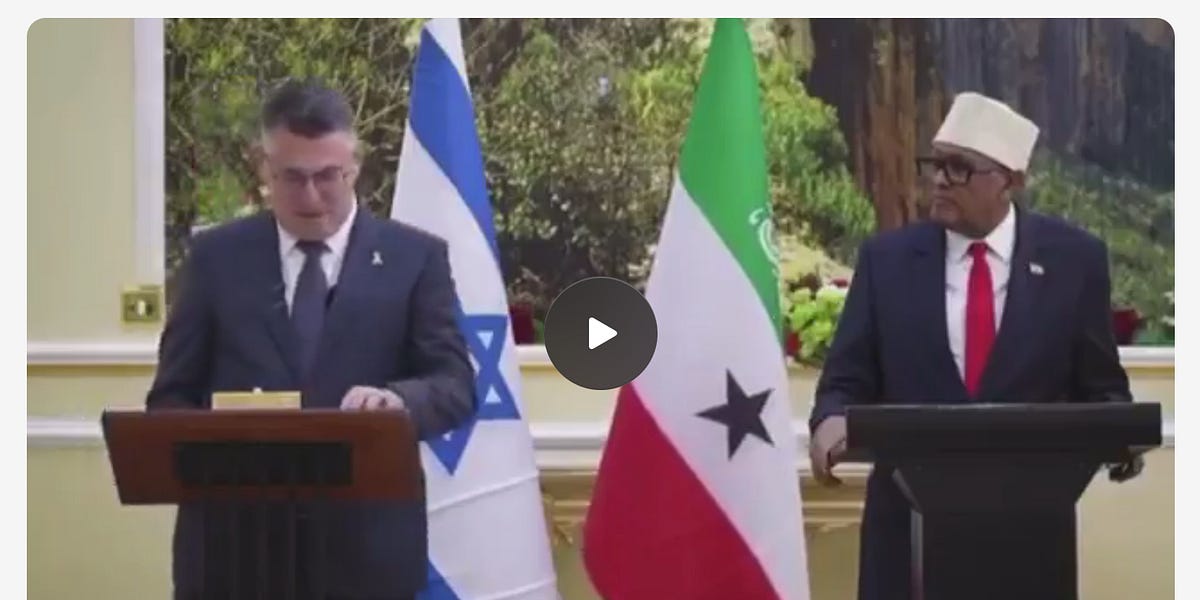
Watch that video please. Israel’s foreign minister is standing in Somaliland—fresh off Israel becoming the first and only country on earth to “recognize” it—and he says this with a straight face:
“Unlike ‘Palestine,’ Somaliland is not a virtual state.”
That sentence is despicable. It is also revealing. Because it’s not only an insult to Palestinians. It’s a confession about how Israel sees the world: some people are allowed to exist, and some people are meant to be erased.
Before I go any further, I want to ask you from the heart to click here to become a member and click here to join as a monthly, annual, or founding member. I keep this work free for the world—for readers in Gaza, for students in public schools, for families living in deep poverty, for elders on fixed incomes—because a smaller circle of people who can afford it chooses to carry the cost. Your support keeps this work free for them, and even for you when you can’t afford to pay.
Now let’s talk about what Israel is doing—and what it means for Palestinians, Somalia, and the whole region.
Earlier today, Israeli Foreign Minister Gideon Saar arrived in Somaliland and declared, “Unlike ‘Palestine,’ Somaliland is not a virtual state.” He also described Somaliland as “pro-western and friendly to Israel,” and talked about partnerships in medical, defense, education, and water. He said Somaliland’s president accepted an invitation to visit Israel.
That phrase—“virtual state”—is not accidental. It’s not casual. It’s one of the most cynical forms of propaganda Israel has used for decades: treat Palestinian nationhood like a fantasy, like a rumor, like an online idea—anything other than what it is: a real people on real land living under real occupation.
Palestine is not “virtual.”
Tell that to the families in Gaza burying children.
Tell that to the farmers in the West Bank being cut off from their orchards.
Tell that to Palestinians in East Jerusalem watching bulldozers erase homes.
Tell that to the Christian clergy being spat on.
Tell that to the refugees whose entire lives have been shaped by a single word: displacement.
If Palestine is “virtual,” why does it take a genocide to keep it from living? Why does it take siege, starvation, checkpoints, demolitions, assassinations, settler violence, and military courts to keep a “virtual” people in their place?
There is nothing virtual about being trapped.
Saar’s insult is also designed to do something else: to make the world feel like Palestinian statehood is optional, like it’s a nice idea that can be deferred forever. That’s how the occupation survives. If you can convince the world Palestinians are not “real” in the legal and political sense, you can treat their rights like a suggestion.
But international law doesn’t work like that—at least it isn’t supposed to.
Under international law, Palestinians have the right to self-determination. Gaza, the West Bank, and East Jerusalem are not imaginary. They are territory. They are people. They are lives. The world knows this. That’s why Israel has had to spend decades bullying courts, pressuring governments, and smearing anyone who says the obvious.
Saar didn’t just insult Palestine. He tried to erase it on the same day he was helping Israel expand its strategic footprint into the Horn of Africa.
That’s the connective tissue. Humiliation and expansion.
Now let’s talk about Somaliland—not as a punchline, but as a battlefield of geopolitics.
Somaliland is a self-declared breakaway region of Somalia. It has operated with its own government structures for decades, but the core international norm has held: Somalia’s territorial integrity matters, and unilateral recognition can destabilize the region. That’s why Israel’s decision to recognize Somaliland—alone—triggered global outcry and emergency-level diplomatic response, including at the United Nations.
Israel knows this. That’s the point. Israel has always understood how to turn recognition into a weapon.
If you want the simplest definition of imperialism, it’s this: a powerful state using force, coercion, or economic control to dominate weaker peoples and reshape regions for its own benefit. If you want the simplest definition of colonialism, it’s this: taking control of land, resources, and political futures as if they belong to you.
Israel is exporting that mindset here—by taking a disputed geopolitical fault line and turning it into a lever: a lever over Somalia, a lever over the Gulf of Aden, a lever over the Red Sea corridor, a lever over Yemen, and a lever for future military infrastructure.
Gideon Saar is expected to visit Berbera, a port that already hosts an Emirati base and is being considered by Israel for a similar purpose. That is not charity. That is not “shared values.” That is a military footprint. Israel is partnered with this land because they want to use it to bomb Yemen and control the Red Sea. Period.
Berbera matters because the Gulf of Aden and the Red Sea are not small waterways. Roughly a third of global shipping moves through this corridor. Whoever controls logistics and bases in this zone is not merely “protecting trade.” They are shaping power.
And let’s be honest: after over two years of genocide in Gaza, the Red Sea became more militarized, more volatile, and more contested. Israel’s confrontation with Yemen’s Houthis over shipping is part of that. So a base in Somaliland is not just a handshake. It’s a platform.
There is also something else that should make every Somali and every African leader furious: Somaliland has reportedly discussed hosting bases and offering access to mineral resources—including lithium—as part of a strategy to win international recognition. That’s the exchange: recognition for strategic access.
It’s the same story everywhere: powerful states and wealthy allies promise “investment,” then demand sovereignty as payment. A base, a corridor, a resource concession, a political realignment.
That’s why this is not just “Somaliland politics.” It’s the next chapter in a broader story: the reshaping of regions through the same playbook Israel has used in Palestine—create facts, create leverage, force the world to adapt.
If you’re wondering why I’m connecting Somaliland to Gaza, here’s why: everything Israel is doing right now is part of a larger architecture of impunity and expansion.
The genocide in Gaza didn’t just destroy buildings. It exposed the global system. It exposed who will fund atrocities. Who will shield them. Who will look away. Who will sell “security” while children starve.
Now Israel is using the same moment of global confusion and institutional weakness to make a move that destabilizes the Horn of Africa.
And the arrogance is breathtaking: while Palestinians are being erased by siege and war, Israel’s foreign minister is traveling to a new outpost of recognition and declaring Palestine “virtual.”
That’s not just cruelty. That’s strategy: erase Palestinian legitimacy while building Israel’s strategic depth elsewhere.
Because if Palestinians become “virtual” in the world’s mind, then the world’s sympathy becomes optional. Accountability becomes optional. The right to land becomes optional. The right to return becomes optional. The right to live becomes conditional.
That is exactly how a genocide continues for years.
Somalia’s foreign ministry condemned the Israeli visit to Somaliland as a violation of Somalia’s sovereignty and territorial integrity.
That’s not political theater. That’s an alarm bell.
Because if powerful states normalize recognition games and base-building inside contested or fragile regions, they don’t create stability. They create permanent tension—and then they justify militarization as the cure for the problem they helped create.
This is how regions get trapped in “tailspin.” And yes, it’s the same pattern the Middle East has been living under for decades: endless crises, endless escalation, endless “security partnerships,” endless extraction of resources and control of strategic corridors.
And through it all, ordinary people—Palestinians, Yemenis, Somalis—pay the price.
Family, I’m not sharing this clip because I want more outrage for its own sake. I’m sharing it because Saar’s sentence is the kind of sentence that reveals a worldview we can no longer pretend is hidden.
When a foreign minister calls Palestine “virtual,” he is telling you he does not recognize Palestinian humanity as fully real. And when that same government starts staking new claims in the Horn of Africa—through recognition, bases, and “strategic partnership”—it’s telling you this isn’t about coexistence. It’s about dominance.
And dominance always requires someone else to be diminished.
That’s why this matters.
If you want me to keep doing this work—reading the documents, watching the clips, connecting the dots, and writing in a way that’s clear enough for a teenager and grounded enough for a historian—I need you with me. Please click here to become a member and click here to join as a monthly, annual, or founding member.
Love and appreciate each of you.
Your friend and brother,
Shaun
