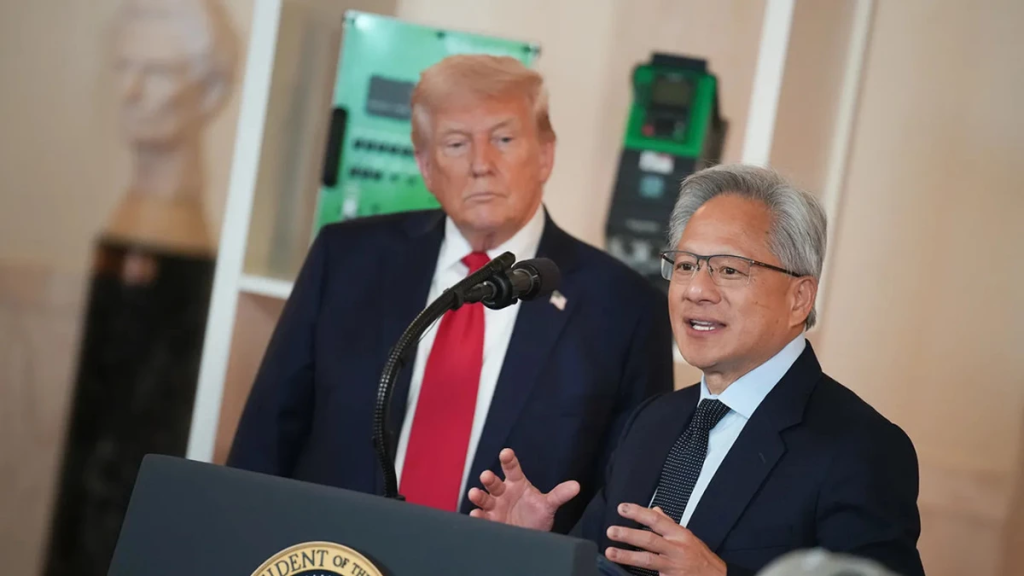
At the 2026 Consumer Electronics Show in Las Vegas, Nvidia’s CEO Jensen Huang delivered a rare mix of optimism and calculated restraint about his company’s role in one of the tech industry’s most geopolitically charged markets: China.
Huang said demand in China for Nvidia’s H200 artificial intelligence (AI) data-center chips is “quite high,” but he also signaled that sales will take shape quietly through orders rather than grand official announcements — underscoring the regulatory balancing act facing both U.S. policymakers and the world’s dominant AI hardware supplier.
A Delicate Opening to China’s Lucrative Market
Nvidia’s advanced AI chips were effectively barred from China during part of 2025 as the U.S. government tightened export controls amid concerns about national security and strategic technology transfer. But late last year, the Trump administration reversed that stance and agreed to allow certain high-end chips like the H200 to be sold into China under strict licensing and conditions — including a requirement that Nvidia share a percentage of China sales revenue with the U.S. government.
That shift has created a potential $2–5 billion quarterly market for Nvidia in China, according to estimates shared by industry executives and analysts present at CES 2026. The catch? Final export licenses are still pending, and Beijing’s own regulatory response remains cautious and opaque.
Rather than issuing an official proclamation on import approval, Huang said the real signal will be “purchase orders coming in” from Chinese firms — a quiet but clear market indicator.
Why China Matters — and Why It’s Complicated
China ranks as the world’s second-largest AI market behind the United States, with both private tech giants and state sectors investing heavily in cloud computing and AI development. Local companies such as Alibaba, ByteDance and others are said to be placing very large orders for Nvidia H200 chips in anticipation of regulatory clearance.
Meanwhile, the global AI hardware industry is already under strain: intense demand for high-bandwidth memory and other key components has pushed suppliers like Samsung and SK Hynix to raise prices and accelerate next-generation memory production — evidence that AI compute demand is outpacing supply itself.
Yet geopolitical realities loom large. Advanced AI chips have been a flashpoint in U.S.–China technology competition for years, and export controls are a major strategic tool in Washington’s broader effort to maintain an edge in high-end compute and artificial intelligence.
Tech Race, Not Just Chip Sales
Chinese technology firms and semiconductor producers are also accelerating their own AI chip development — with mixed success. While domestic chips generally lag Nvidia’s top offerings, research suggests China’s market will need exponentially more compute power as AI models scale, making foreign hardware — where legally allowed — highly desirable.
Some analysts argue that improving domestic options is a long-term strategy, but in the near term, Chinese cloud and AI infrastructure developers are still heavily reliant on high-performance accelerators like the Nvidia H200. That presents a rare intersection where business demand collides with geopolitical friction.
Balancing Act: Supply Chain and Strategic Policy
Nvidia isn’t just waiting on licensing. The company has already ramped up production of H200 chips and is collaborating with contract manufacturers (including TSMC) to expand capacity — in part because its existing inventory falls far short of the magnitude of anticipated orders from China.
At the same time, Nvidia is introducing its next generation of AI microarchitectures, including the emerging Vera Rubin line — expected to power even more advanced systems later in 2026 — signaling that demand isn’t a China-only phenomenon but a global AI boom.
Financially, the stakes are enormous. Nvidia projects up to $500 billion in combined sales from its current and upcoming AI computing platforms by year-end, and analysts believe this figure may climb further as global compute demand continues its exponential rise.

The Tightrope Between Business and Strategy
For Washington, the choice to permit controlled exports of H200 chips reflects a shifting calculation. On the one hand, policymakers want to slow the transfer of cutting-edge compute capability that could someday power sophisticated military or surveillance AI systems. On the other, blocking access to a market worth billions jeopardizes the international competitiveness of American semiconductor companies.
In China, the response has been equally nuanced — a mix of regulatory caution, strategic ambiguity, and home-grown innovation incentives that attempt to balance national priorities with commercial necessity.
What Comes Next?
Whether Nvidia’s China gambit ultimately pays off depends on several interlinked outcomes: the timing and scope of export license approvals, Beijing’s formal regulatory posture, the speed at which Nvidia and TSMC can scale production, and China’s own progress toward indigenous AI chip leadership.
If recent years have taught the tech industry anything, it’s that AI compute demand can move faster than policy — and that hardware supply chains are now as much about geopolitics as they are about silicon. As Nvidia navigates that cross-current, the world is watching closely.