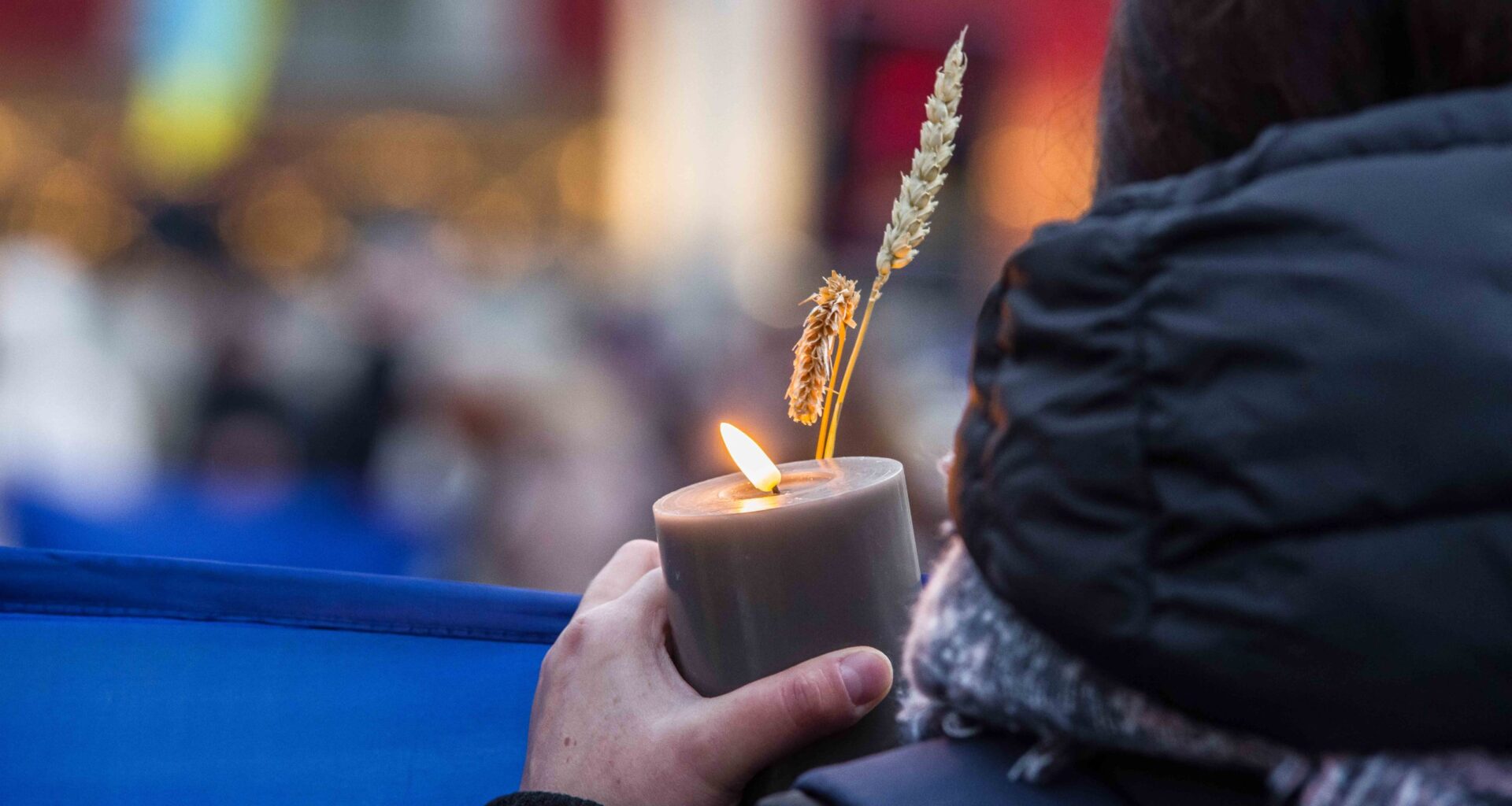
The screen went black just as my Zoom call to Kyiv was about to begin.
From my desk in Maryland, I could hear voices from inside Ukraine’s National War Museum, but there were no images. The building’s electricity had been cut. Less than a minute later, a dim picture appeared, and psychologist Iryna Uzhakova was barely visible, lit by a butane camping lantern. Deputy Director Dmytro Hainetdinov, in a darker wing of the museum, joined with only audio.
Encounters like this have become routine in Ukraine. Power cuts, air raid alerts, and unstable connections — all courtesy of Russia — are now part of daily life. What made this moment different was its location, inside a national institution charged with preserving evidence and healing the damage from a war that is still underway.
The National War Museum is an institution unlike any other. Its work offers a rare example of scalable, low-resource psychological intervention embedded in a national institution rather than delivered episodically by outsiders. What makes the model even more distinctive is that this mental health work is occurring alongside real-time recording of war crimes.
Before our call, I had visited the museum in person. I saw how it sends multidisciplinary teams, including historians, archivists, photographers, videographers, psychologists, and local field specialists, to liberated areas, often within hours of the guns going quiet. Speed is essential.
“After a few days, the evidence is gone, cleared, buried, burned, or blown away,” Hainetdinov explained during my visit.
Museum teams have now worked in more than 35 regions. They document bombed homes, destroyed villages, and religious sites reduced to shells. Hainetdinov described a 19th-century wooden church burned down to its frame, with only blackened crosses remaining.
“The Russians claim they are protecting religion; in reality, they target churches,” he said. “We have records of 1,000 that have been destroyed or damaged.”
The Museum also collects testimony from individual survivors. Visitors can see the stories of families hiding for weeks in basements and read accounts of hunger, thirst, fear, and cold. Exhibits include elderly residents who refused to abandon ruined homes and civilians who escaped through minefields.
These accounts are not just treated as memoir. They are gathered as evidence, material likely to be important for future investigations into war crimes.
But the obstacles are vast. At one point during our call, Hainetdinov paused. “I wanted to show you photographs,” he said. “But the outage cut off access to my files.”
Get the Latest
Sign up to receive regular emails and stay informed about CEPA’s work.
What distinguishes the National War Museum is not only that it documents a war in progress, but that it houses psychologists who offer tailored support to civilians, veterans, minors, and people released from captivity.
Since July, the Museum’s psychological service has worked with more than 700 people, Uzhakova said. These included children, wounded soldiers and their families, former prisoners freed from Russia, veterans, and civilians from frontline and near-frontline areas.
This is not a temporary pilot or a parallel program run by an outside organization, but a standing function of a national institution operating under wartime constraints. The psychological services are modest in scale, low-tech, and resource-constrained, yet continuous. For policymakers concerned with resilience, institutional capacity, and postwar recovery, that distinction is significant.
One typical program is a five-session workshop for children aged eight to 13 in which each child produces a short animated video.
At first, the drawings are strikingly consistent: tanks, drones, explosions, and shattered buildings predominate as war dominates the imagery.
By the final session, the tone almost always shifts. Bicycles, family pets, and clear skies appear. In one animation shared by Uzhakova, a small paper rabbit climbs into a boat and drifts across a crayon-blue sea.
It’s not that the war has disappeared from the children’s awareness, but what has returned is their capacity to imagine moments of safety and continuity. “That change,” Uzhakova said, “is healing.”
Just before the call ended, when her laptop battery failed, she held one last drawing up to the screen. The paper rabbit appeared again, this time beneath a bright yellow sun.
For policymakers focused on war crimes documentation, reconstruction, and institutional resilience, the museum offers a concrete case study. It shows that trauma care need not wait for peace, nor depend entirely on outsiders.
Embedding basic psychological support in national institutions during conflict may reduce long-term social costs, strengthen civilian trust, and improve recovery outcomes.
As Ukraine plans its reconstruction, and as other countries study how to prepare for prolonged conflict, the lesson is clear: Preserving evidence and preserving people are not competing priorities. Addressing psychological harm during war is not only a humanitarian imperative, but it is also a strategic investment in postwar stability.
Mitzi Perdue is a journalist reporting from and about Ukraine. She is the co-founder of Mental Help Global, a philanthropy that uses artificial intelligence to provide immediate, free, 24/7 mental health support in Ukraine.
Europe’s Edge is CEPA’s online journal covering critical topics on the foreign policy docket across Europe and North America. All opinions expressed on Europe’s Edge are those of the author alone and may not represent those of the institutions they represent or the Center for European Policy Analysis. CEPA maintains a strict intellectual independence policy across all its projects and publications.
Europe’s Edge
CEPA’s online journal covering critical topics on the foreign policy docket across Europe and North America.