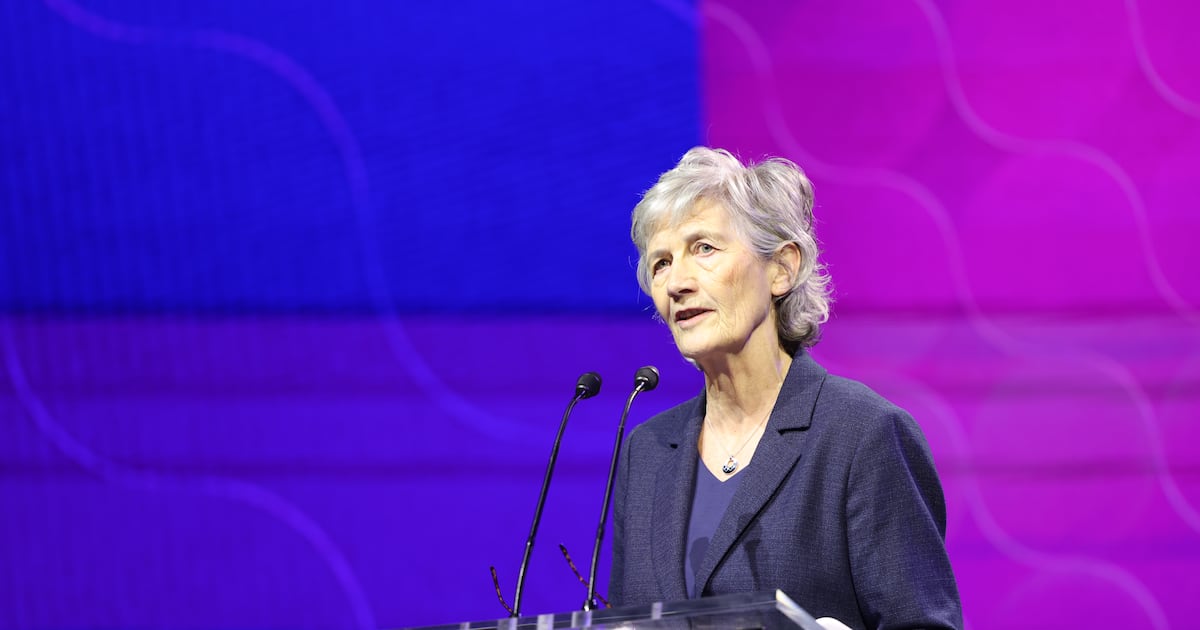
President Catherine Connolly has described the recent loss of life in Venezuela as “appalling” and said international law must be upheld.
Ms Connolly did not make explicit reference to the actions of the United States in removing Venezuelan president Nicolás Maduro from power or the attacks on Venezuelan ships that preceded the intervention.
However, she spoke in the context of what she called the “tremendous challenges” facing the world.
“As the United Nations general secretary has said, there must be full respect for international law including the United Nations charter,” she said.
“And the recent loss of lives in Venezuela – it’s appalling and it’s often overlooked in the debate.”
Ms Connolly was speaking at the opening of the Stripe Young Scientist and Technology Exhibition where she said the young people taking part gave her hope for the future despite the world’s many problems.
She described the exhibition’s 550 projects as the “wonderful end” to the rigorous application of scientific methods to a wide range of issues, and the creativity and dedication that required.
[ AI gets put to real-life test at Young Scientist ExhibitionOpens in new window ]
However, she said it was important that the event served as an opportunity “to put science and technology themselves under the microscope”.
She said there should be discussion about “what questions are being asked, what data is being collected, the nature of the analysis carried out and the conclusions that are being drawn and will be drawn – for what purpose and for whose benefit”.
“There needs to be an open and honest debate on these issues so that science and technology can be a part and essential part of the transformative change required to meet the interconnected challenges of our time – irreversible climate change, biodiversity loss, the normalisation of war, forced displacement, global hunger and poverty.
“Transformative change cannot be achieved, much and all as we like to believe it can, with science and technology alone.”
Climate change was a case in point, she said. It was less a scientific problem than a problem of injustice in societies and economies.
She said the same problem was resulting in “the concentration of wealth and power among more and more unaccountable interests and that are increasingly posing a serious challenge to our democratic processes throughout the world”.
“I absolutely believe that science and technology have the greatest potential to serve the common good, but it is important to remember that they are not neutral in their purpose or application.
“That is why the decisions you make as young people regarding the areas that you pursue for further study, investigation and exploration are critically important.”
Ms Connolly said she was looking forward to meeting the students and seeing their projects. However, she was suffering from a bug that she joked could not be cured by anything more scientific than bed rest, and had to cancel her intended walkabout.
No scientific solution came to the rescue of the other guest speaker of the day either.
Patrick Collison, co-founder of sponsors Stripe, and the 2005 overall winner of the competition, was due to be on stage but his flight was delayed by bad weather across mainland Europe.
Speaking by video link, he promised to hold a questions-and-answers session with the students when he arrived at the venue.
In the meantime, he had words of encouragement for those hoping to follow in his footsteps and those of his brother and Stripe co-founder John Collison, who won a category award at the competition the same year.
He said school was great but students needed to look outside the curriculum to find their own passions.
“Follow your curiosity,” he said. “Teenagers can do great things. Set your sights high.”