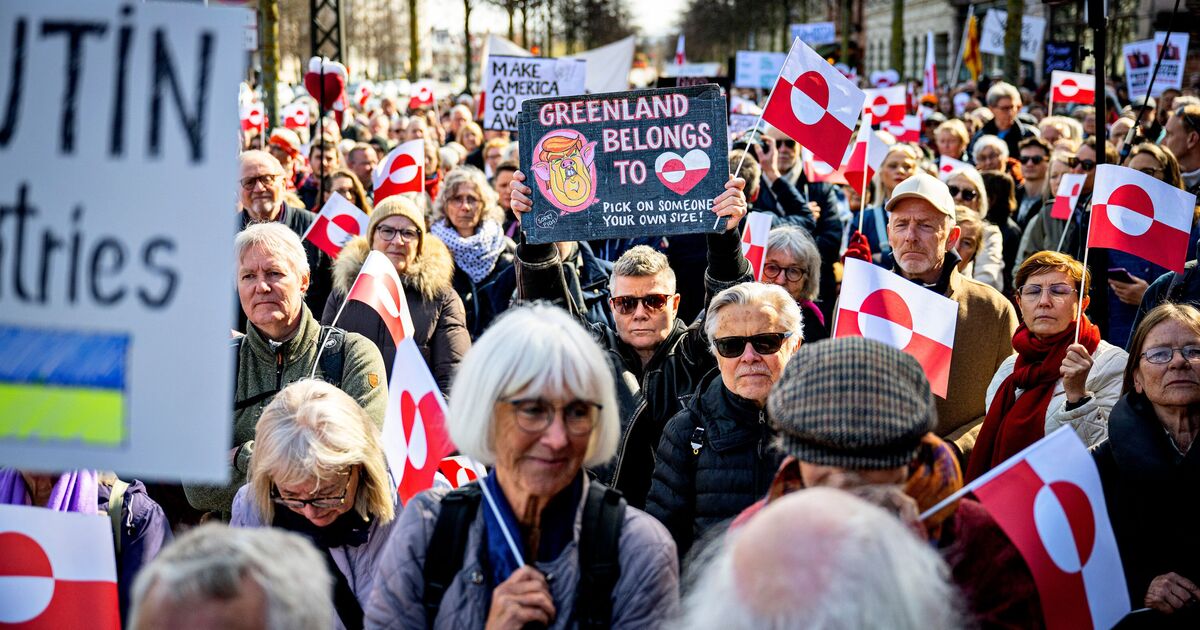
Donald Trump’s intensifying campaign to acquire Greenland has sparked grave concerns over the future of NATO, with leading experts and the Danish government warning that US intentions threaten the alliance’s very existence. This escalation follows a 20-day ultimatum issued by the White House demanding that Denmark negotiate a transfer of the territory.
The geopolitical tension has reached a breaking point as the administration deploys “special envoys” and suggests military force is a viable tool for continental expansion. Dr Dafydd Townley, a US foreign policy lecturer at the University of Portsmouth, argues that the current rhetoric represents a perilous break from historic norms. Dr Townley said: “Any military action undertaken by the US involving Greenland would probably lead to the end of NATO as we know it.
Certainly, this unprecedented activity – one NATO ally attacking another – would either lead to the US’s expulsion from the alliance, or Denmark’s withdrawal.
Its consequences on wider European security would also be catastrophic and could lead to reassessments of the continuation of the Five Eyes Partnership, for example.”
Dr Townley’s comments reflect a shifting European mindset in the wake of Mr Trump’s January 3 operation capturing Venezuelan President Nicolas Maduro.
While the Venezuela raid – hailed by Mr Trump as securing oil reserves – demonstrated US willingness for bold unilateral moves, Dr Townley stresses the distinction for Greenland.
Dr Townley explained: “There is a considerable difference between launching a covert extraction operation as it did in Venezuela, compared to annexing and occupying territory that would be required with Greenland.
Success in one doesn’t necessarily mean success in the other.
European leaders must, however, at least now consider that Mr Trump is prepared to use military force to achieve his strategic objective, which was unthinkable, and indeed comical, some two or three weeks ago.”
Regarding the appointment of Louisiana Governor Jeff Landry as a special envoy, Dr Townley views the approach as a disruption of traditional channels.
Dr Townley said “My first feeling is that ‘hybrid warfare’ is becoming a term that is perhaps overused.
“Using special envoys is not the same as this, but is bypassing traditional routes of diplomacy and will have an impact.”
Dr Townley noted: “I think this is partly the reason. Mr Trump, ever the businessman, is trying to establish alternative supply chains because the US’s reliance on Chinese imports weakens its position against China.
The Arctic region will continue to be an increasingly important contested region as climate change’s impact is opening up shipping lines and revealing opportunities to plunder the region of the rare earth minerals.”
Dr Townley also observed that this rhetoric mirrors a 1930s movement seeking to merge the US, Canada, and Greenland.
He said: “It’s very similar, but there are several differences.
“The movement was driven not by nationalism or capitalism but by the attempt to establish a technological elite. National security had little to do with it.”
Chatham House analysis published on January 6 aligns with these warnings, stating bluntly: “US threats to annexe Greenland following the attack on Venezuela should be taken seriously.”
The report warns that an attack on the Danish territory “would end NATO,” adding: “It is hard to see how the alliance would recover from a treaty breach as shocking as one ally attacking another to seize territory.”
The think tank further notes that such actions risk undermining the credibility of NATO’s Article 5 guarantee.
Chatham House counters the White House claim that full control is necessary for the “Golden Dome” missile defence system, pointing to the existing Pituffik Space Base under a 1951 agreement.
The analysis states “What is not clear is why Washington needs full control over Greenland to defend itself,” urging Europe to leverage economic weight while accelerating independent defence investments.
Denmark’s Prime Minister Mette Frederiksen has echoed these sentiments, warning that an attack “would end NATO.”
As tensions mount, both Chatham House and Dr Townley underscore the stakes: Mr Trump’s pursuit risks irreparably fracturing the post-war order.