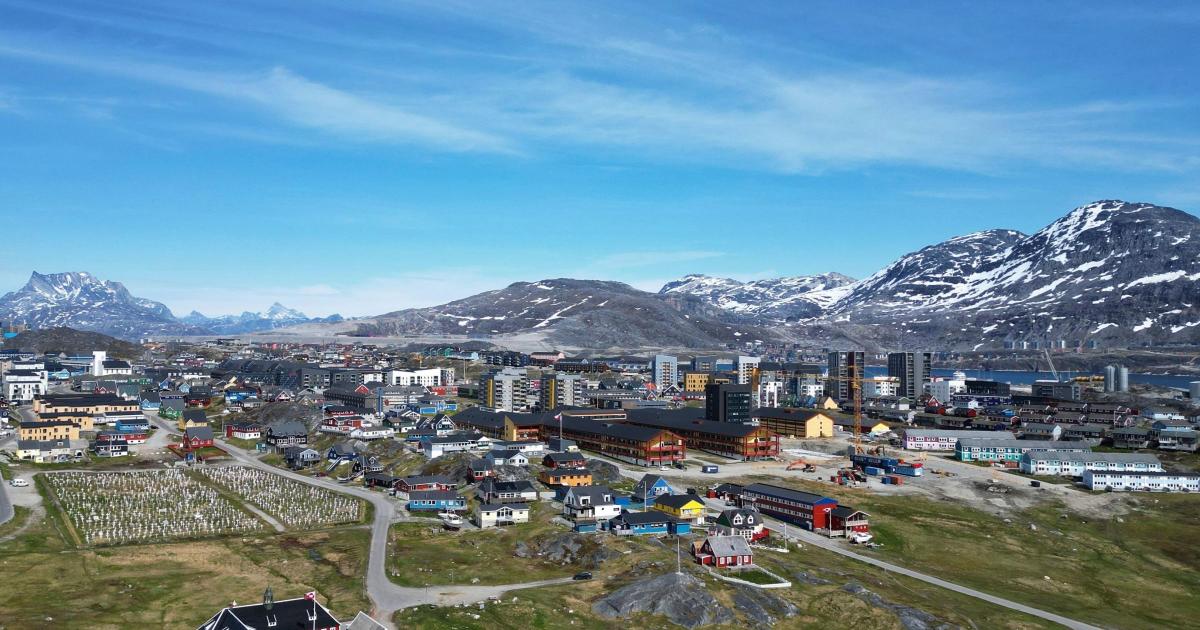
For Greenland, the danger is clear: remaining formally tied to Denmark but functionally dependent on US security leaves it one crisis away from an ultimatum. A hostile American administration would not need tanks or annexation. It could apply pressure through basing demands, economic leverage, or unilateral “security” actions justified by Arctic competition. Sovereignty would erode quietly, then suddenly be gone.
READ MORE: Could Donald Trump boost Greenland independence bid? Experts have say
For Denmark, the dilemma is worse. Copenhagen lacks the military capacity to defend Greenland against US pressure and cannot realistically confront Washington without triggering a catastrophic diplomatic rupture – or worse. Appeasement would hollow out Danish sovereignty; resistance would be symbolic at best. This is an unwinnable position.
There is, however, a realist escape hatch for both: Greenland voluntarily seeking admission as a province of Canada.
Canada changes the equation. Unlike Denmark, it is a continental power with its own Arctic strategy, credible military presence, and constitutional mechanisms for integrating vast northern territories. Unlike the United States, it has no incentive to strip Greenland for parts. A Canadian Greenland would fall under Nato, Norad, and collective defence arrangements – but crucially, with Ottawa, not Washington, as the primary sovereign authority.
READ MORE: Donald Trump may use military to conquer Greenland, White House says
For the US, this offers a face-saving off-ramp. Washington keeps Arctic access, radar coverage, and alliance stability without the reputational damage of coercion or outright seizure. For Denmark, it defuses an impending confrontation while preserving Western unity. For Greenland, it trades existential vulnerability for institutional protection – real sovereignty backed by real power.
This is not about ideals. It is about leverage, deterrence, and timing. Small nations survive by choosing the least dangerous patron before the most dangerous one chooses them. Becoming a Canadian province would not be capitulation; it would be a calculated act of self-preservation in an Arctic that no longer tolerates strategic ambiguity.
In realpolitik terms, Greenland’s Canadian option may be the last clean move left on the board.
Michael Collie
Dunfermline
SURELY, if Trump feels so insecure for his beloved America to the point of having the need to increase the already existing air force base on Greenland soil, then all he needs to do is ask for permission from the sovereign countries involved.
He expresses a love for the population of Greenland including a good relationship with the Danish government. Even Europe, for chrissakes! All he needs to do is what all other countries do where any possible similar situations might exist (UK for one): get on the phone and have a chat.
READ MORE: Donald Trump ‘very serious’ about annexing Greenland
Already, we see a fair chunk of the United States Air Force arriving in RAF Fairford and Mildenhall, no doubt as a result of a quick blether with his puppet, Keir Starmer, in Westminster (“No problem pal, plenty of aircraft landing space.”)
Donald Trump is wrong in threatening to send in armed forces if necessary. You cannot have one Nato country threatening another without arousing the wrath of the rest of Nato countries. Their are rules, including one for this threatened situation.
Nato was formed soon after World War Two with America (in 1949), the UK and other European countries in order to protect such countries from all and any threatened wars. Donald Trump is running the risk of destroying the North Atlantic Treaty Organisation if he “invades” Greenland.
As already stated, he has no need to make his obtuse threat. The US is already established there. If his desire is to expand that base then there is always a possible chance that Greenland and Denmark might agree.
Alan Magnus-Bennett
Fife
I’VE very much enjoyed the introductory episode of the online course by the Trimontium Museum on the Romans and their invasion of Scotland as a direct result of the promotional piece by David C Weinczok in Monday’s National (Course charges into big questions about Roman invasions of Scotland, Jan 5). If part one is any measure, this has the potential to be a very accessible project on the societal and geopolitical origins of our country. It even has the power, hopefully, to get Hugh Trevor-Roper birlin’ in his grave.
Thank you to the National. You might you consider the potential for serialisation in the Sunday edition of the paper.
Iain Bruce
Nairn