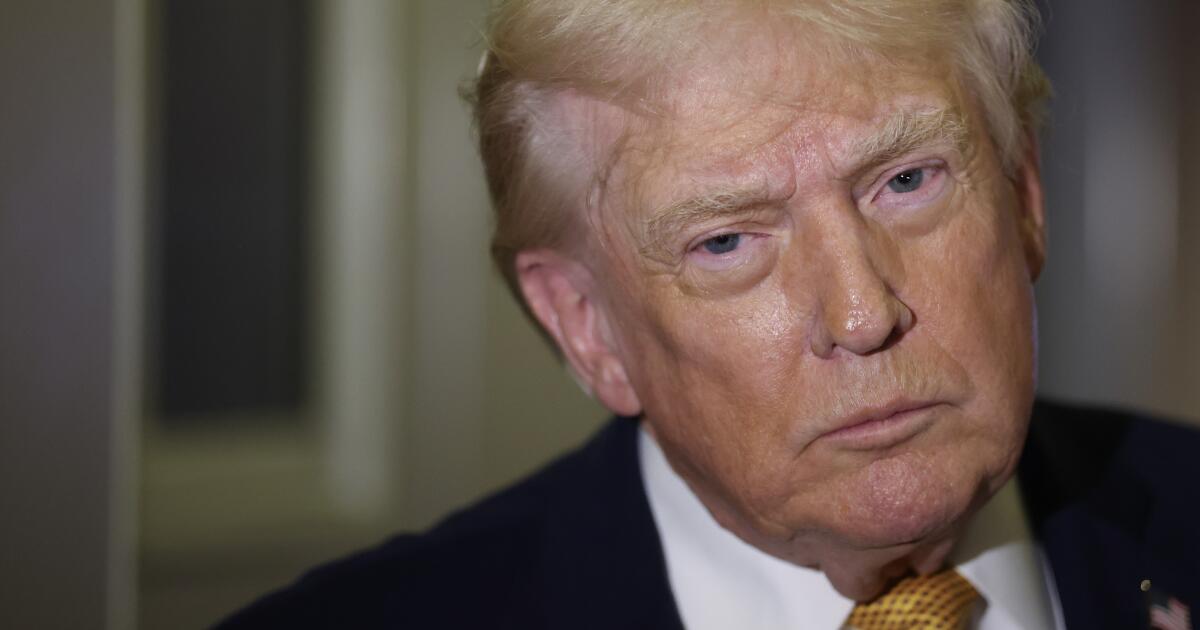
President Trump on Wednesday withdrew the United States from 66 international organizations and treaties, including the United Nations Framework Convention on Climate Change and the Intergovernmental Panel on Climate Change.
In a presidential memorandum, Trump said it is “contrary to the interests of the United States to remain a member of, participate in, or otherwise provide support to” the organizations, which also include groups geared toward education, economic development, cybersecurity and human rights issues, among others. He directed all executive departments and agencies to take steps to “effectuate the withdrawal” of the U.S. from the organizations as soon as possible.
While the president has already announced a withdrawal from the Paris climate agreement — an international treaty to limit global warming to under 2 degrees Celsius in order to prevent the worst effects of climate change — the latest move will further isolate the nation at a critical moment, experts said.
The U.N. Framework Convention on Climate Change is a global treaty created in 1992 and signed by nearly 200 countries with the aim of addressing climate change through coordinated international action, including limiting planet-warming greenhouse gases. Trump already raised eyebrows last year by refusing to attend or send any high-level delegates to the annual U.N. Conferences of the Parties meeting in Brazil, where California Gov. Gavin Newsom instead took on a starring role.
Simon Stiell, executive secretary of the U.N. Framework Convention, said the U.S. was instrumental in creating the organization and the Paris Agreement because “they are both entirely in its national interests.”
“While all other nations are stepping forward together, this latest step back from global leadership, climate cooperation and science can only harm the U.S. economy, jobs and living standards, as wildfires, floods, mega-storms and droughts get rapidly worse,” Stiell said in a statement early Thursday. “It is a colossal own goal which will leave the U.S. less secure and less prosperous.”
He added that the withdrawal will also mean less affordable energy, food, transport and insurance for American households and businesses, and fewer manufacturing jobs at a moment when every other major economy is ramping up its clean energy investments. The doors remain open for the U.S. to reenter in the future, he said.
Experts were also quick to denounce the move.
Withdrawing from the U.N. Framework Convention is a “shortsighted, embarrassing, and foolish decision,” Gina McCarthy, a former director of the U.S. Environmental Protection Agency, said in a statement.
“As the only country in the world not a part of the UNFCCC treaty, the Trump administration is throwing away decades of U.S. climate change leadership and global collaboration,” said McCarthy, who also served as the first White House national climate advisor and is now chair of the America is All In climate coalition.
David Widawsky, director of the World Resources Institute, called the move a “strategic blunder that gives away American advantage for nothing in return.”
“The 30-year-old agreement is the foundation of international climate cooperation,” Widawsky said. “Walking away doesn’t just put America on the sidelines — it takes the U.S. out of the arena entirely.”
Trump on Wednesday also withdrew the U.S. from the Intergovernmental Panel on Climate Change, the leading global scientific body studying global warming. Its major assessments published every six or seven years help inform climate policy around the world.
Pulling the U.S. out of the IPCC won’t prevent individual U.S. scientists from contributing, but the nation as a whole will no longer be able to help guide the scientific assessments, said Delta Merner, associate accountability campaign director for the Climate and Energy Program at the Union of Concerned Scientists, who has attended previous IPCC meetings.
“Walking away doesn’t make the science disappear, it only leaves people across the United States, policymakers and businesses flying in the dark at the very moment when credible climate information is most urgently needed,” Merner said. “This is a clear attempt to weaken scientific guardrails that protect the public from disinformation, delay and reckless decision-making. Such a move will make it easier for fossil fuel interests to distort the facts while front-line communities pay the price.”
Trump, who received substantial donations from oil and gas companies during his 2024 presidential campaign, has heavily promoted the development of fossil fuels such as oil, gas and coal. He has also taken several steps to limit scientific research and climate action in the U.S., including moving to dismantle the National Center for Atmospheric Research, one of the world’s leading climate and weather research institutions, in Boulder, Colo.
Last year, the Trump administration also fired hundreds of scientists working to prepare the congressionally mandated National Climate Assessment and removed the website that housed previous assessments.
Newsom called the president’s latest actions “brainless” and said the president is “surrendering America’s leadership on the world stage and weakening our ability to compete in the economy of the future — creating a leadership vacuum that China is already exploiting.”
“California will not back down in our leadership,” Newsom said in a statement. “As the world’s fourth-largest economy, the Golden State will continue working with states, cities, and international allies to lower energy costs, reduce toxic pollution, protect public health, and ensure Americans are not denied the enormous economic and health benefits of the clean energy future.”
Other climate, environment and energy groups Trump withdrew from on Wednesday include the International Renewable Energy Agency, the International Solar Alliance, the 24/7 Carbon-Free Energy Compact and the Inter-American Institute for Global Change Research, among many others.