WHAT DOES PUTIN DO NEXT?
Russia was building an empire long before Nato existed – in Tsarist form, in Soviet form and now in a Putinist form
What does Putin do next? Welcome to The i Paper’s opinion series in which our writers and experts take a deeper look at the future for the Russian leader.
• Putin is getting more desperate. It won’t end well
Sometimes the first sign of a coming aggression isn’t a tank – it may be a balloon.
Over Lithuania, they drift in from Belarus with cigarettes tied underneath. On radar they show up as unidentified objects in Nato airspace. Vilnius and other airports have already had to divert or halt flights dozens of times because of these “meteorological” balloons, stranding passengers and disrupting travel. What starts as “smuggling” is hardly separable from the Belarusian regime – and that regime is tied to Moscow, making this a direct challenge to European security.
No wonder people are concerned. I was recently approached on the street in Vilnius by a well-dressed woman in her forties. She asked, politely but pointedly, whether my daughter, whose birth was reported in the media last year, is still in Lithuania. The question caught me off guard, but it was purely geopolitical: because I comment publicly on security issues, people wonder whether I believe the country is safe for my family. I said yes.
Yet, Northeast Europe is already under siege – through a constant drip-drip-drip just below the threshold of open war. Russia’s confrontation with the West has moved into airspace, infrastructure, logistics and domestic politics.
Hybrid attacks are part of daily life. Researchers tracking Russia’s “shadow war” across Europe have documented nearly 200 suspected Russia-related hostile incidents on the continent since 2022, with the number nearly tripling between 2023 and 2024. The mood shows up at home too: a recent survey found roughly two-thirds of Lithuanians report heightened anxiety, tension or stress – up from just over half a year earlier.
Security chiefs have stopped speaking in euphemisms. In mid-December, MI6 chief Blaise Metreweli warned that we are operating “in a space between peace and war” – pointing to cyber attacks on critical infrastructure and drones buzzing airports and bases – with Russia seeking “to bully, fearmonger and manipulate, because it affects us all”.
One illustration are the incendiary-parcel cases: devices that ignited in European logistics hubs, including DHL facilities near Birmingham and at Leipzig/Halle. Western officials have treated them as part of a broader sabotage campaign – and in some accounts, a test run for starting fires aboard cargo aircraft. Russia, employing relatively cheap means, aims to show that European governments are slow, divided and unable to deal with the challenge.
Moreover, Nato’s Allied Air Command says its fighters were scrambled more than 400 times in 2024 to intercept Russian military aircraft approaching allied airspace. These flights routinely ignore basic rules – no flight plan, no contact with controllers, transponders off. For people in the Baltics, Russian planes at the edge of their airspace barely make the news anymore. But with drones and balloons, the threat feels closer at hand, and is that much harder to live with.
Nato’s strategic deterrence has held so far. The alliance has expanded to include Finland and Sweden. Germany is stationing a heavy armoured brigade in Lithuania – around 5,000 troops, plus civilian staff – a step unthinkable just a few years ago, and due to become fully operational later this decade. Yet deterrence is not static – it either strengthens relative to the threat, or it erodes.
Russia’s goal is to make Europeans feel weak today so it can bank outsized geopolitical gains before its own strengths ebb. German defence minister Boris Pistorius has warned that Europe needs to be “ready for war” by 2029 because Russian planning assumes a confrontation with Nato could become possible around that date. Intelligence assessments in Europe increasingly converge on the idea that the next four to five years are the critical window.
Against this backdrop, several paths lie ahead for Europe and the wider West.
One possibility is fragmentation. Support for Ukraine could fade – not through a single dramatic cut, but via a succession of smaller, delayed or diluted packages.
In such a world, Russia could consolidate its gains in Ukraine, shift more forces back toward the Baltic region and deploy larger formations close to the borders of Lithuania, Latvia and Estonia. The risk of a sudden full-scale invasion might remain low, but the capacity to intimidate – through local military superiority, energy pressure, trade restrictions and hybrid attacks – would grow.
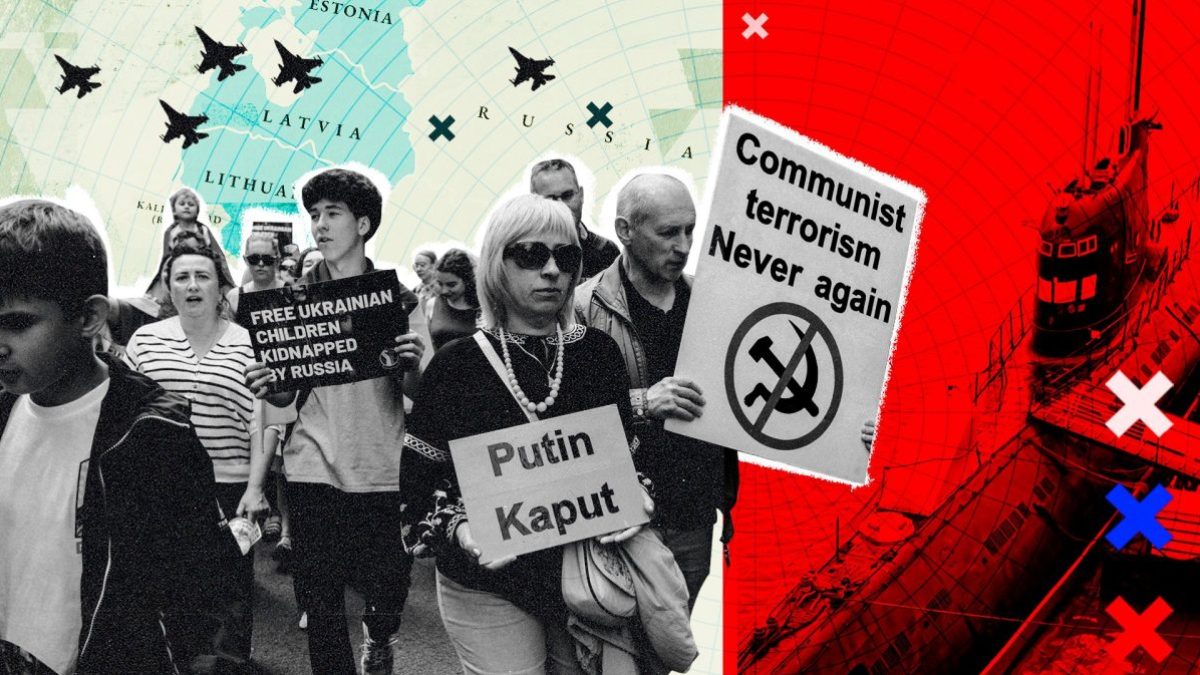
For people here, that doesn’t land as an abstract scenario. In 1940, the Baltic states were absorbed into the Soviet Union; deportations followed, with families packed onto trains and sent to Siberia. Independence was restored only in 1990/91. And Putin continues to deny the fact of the occupation, insisting the Baltics were incorporated to the Soviet Union with their consent. That is why “troops near the border” sounds less like signalling and more like a familiar script.
A second possibility is that Europe, together with transatlantic partners, decides to seize the initiative. That would mean accepting some military, financial and legal risk to take bold action, including the use of Russian assets frozen in the Western world, not just the interest they generate, to fund Ukraine’s defence and reconstruction at scale.
The third path is muddling through – the one closest to the current trajectory. Enough support is provided to keep Ukraine from collapsing, but not enough to change the balance. And that enables Russia to bet that Western resilience will fade.
Through all of this, one basic fact remains: Russia does not have to be in charge of Europe’s future. Most of what happens next will be decided in Europe’s own capitals. Hybrid attacks can be countered and punished. It is not easy or cheap, but the alternative is far more costly– in money, security and human lives.
As a Lithuanian, I don’t have the luxury of treating this as a theoretical debate. But as an academic, I also know how seductive the wrong story can be, especially the still-fashionable argument that actually the West is at fault or that Nato “created” Putin’s brutal Russia.
Historian Stephen Kotkin reminds us that the Kremlin of today is “not some deviation from a historical pattern”. Blaming ourselves assumes Russia would have turned out fundamentally different if the West had behaved differently. According to Kotkin, Russia’s autocracy, repression, militarism and suspicion of foreigners long predate Nato. And Nato enlargement left Europe better prepared to deal with that recurring pattern.

Russia was building an empire long before Nato existed – in Tsarist form, in Soviet form and now in a Putinist form that adds drones, cyber tools and nuclear swagger to an old instinct.
Kotkin notes that from Ivan the Terrible onward, Russian expansion was relentless for centuries; the ideology changed, the reflex did not. If Putin is rewarded in Ukraine, Eastern Europe does not merely face “more tension” – it risks being pushed back into a grey zone where sovereignty is treated as conditional, borders as negotiable, and intimidation as normal policy.
It is not a world anyone would be safe living in.