Slovakia and the Czech Republic will resume their long-standing format of joint government meetings, ending a pause that lasted nearly two years amid political tensions over Ukraine and EU policy.
“At today’s meeting with the prime minister, we agreed that we would continue the format of joint government consultations,” said Slovak Prime Minister Robert Fico.
The first joint cabinet meeting is expected to take place on 31 March in the Czech Republic.
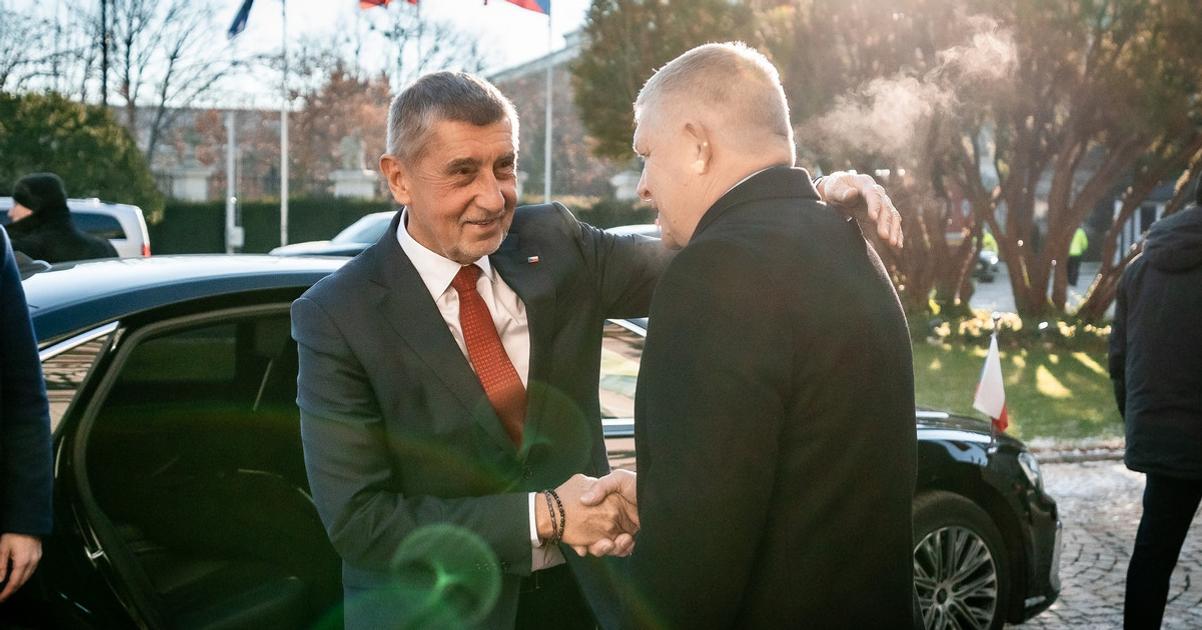
The decision was announced on Thursday, 8 January, in Bratislava by Fico and Czech Prime Minister Andrej Babiš, who made his first official visit to Slovakia since returning to office in December, despite having the flu. Fico welcomed the Czech counterpart with a warm embrace in the courtyard of the Government Office. Speaking in a video a day before the meeting, Fico said he was “very much looking forward to the talks”.
The visit was a rare one for the Slovak prime minister: since Fico’s return to power in 2023, Babiš is only the second EU prime minister to have travelled to Bratislava.
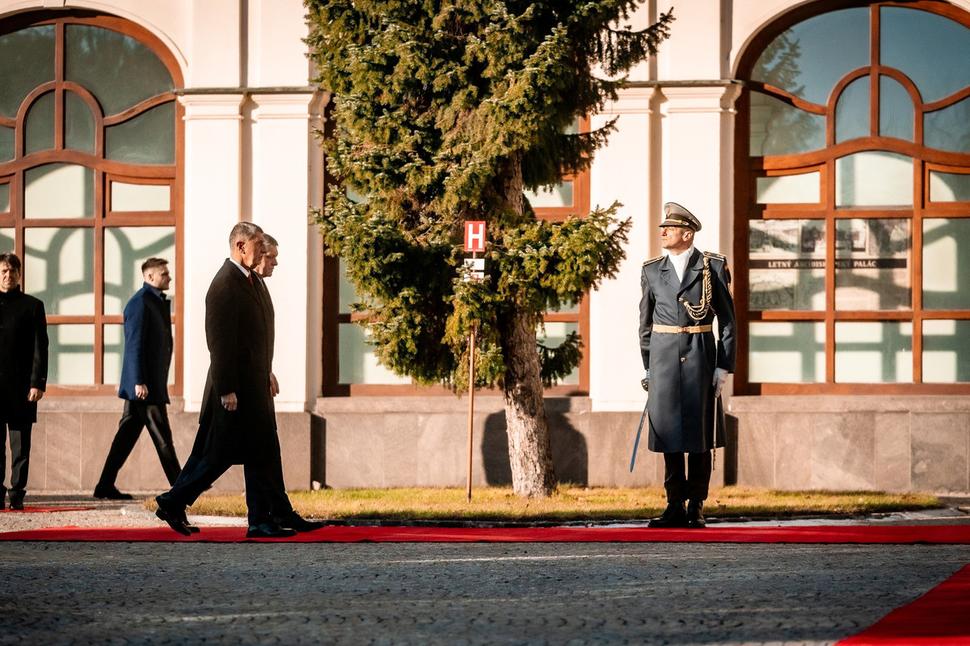
Czech Prime Minister Andrej Babiš and Slovak Prime Minister Robert Fico outside the Government Office in Bratislava on 8 January 2026. (source: Facebook – Robert Fico)
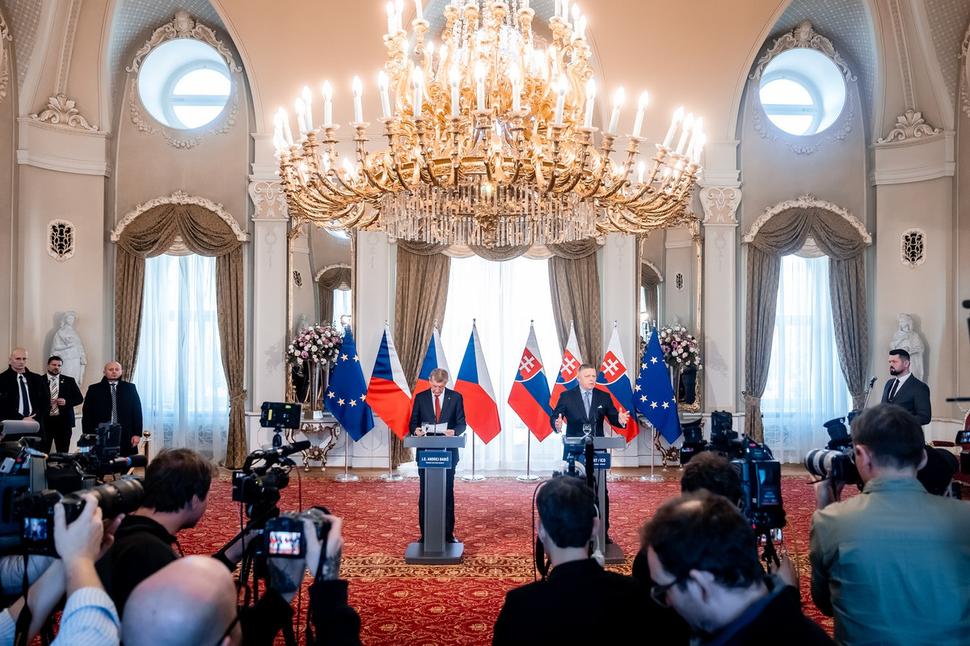
Andrej Babiš and Robert Fico during a press conference at the Government Office on 8 January 2026. (source: Facebook – Robert Fico)
The joint government meetings had been suspended in March 2024 by the previous Czech government under Prime Minister Petr Fiala, citing fundamental disagreements with Slovakia’s foreign-policy direction, particularly over Russia’s war in Ukraine.
“We do not consider it appropriate to hold intergovernmental consultations with the Government of the Slovak Republic in the coming weeks or months,” Fiala then said.
Until the March meeting, Czech ministers are expected to travel to Slovakia for bilateral, sector-level consultations with their Slovak counterparts. Czech Foreign Minister Petr Macinka visited in mid-December.
Fico said the two leaders discussed cooperation within the European Union, foreign affairs, energy policy, migration, emissions trading, housing, and cultural projects. He described Czech–Slovak relations as being built on what he called “loans of mutual trust” and said the meeting served as an “inventory” of shared priorities and upcoming challenges.
Babiš thanked Slovakia for its cooperation in the past and said he wants to build on earlier government-to-government relations from his previous term as prime minister. For Babiš, the trip to Slovakia was his first official foreign visit, in keeping with tradition rooted in the two countries’ shared Czechoslovak past.
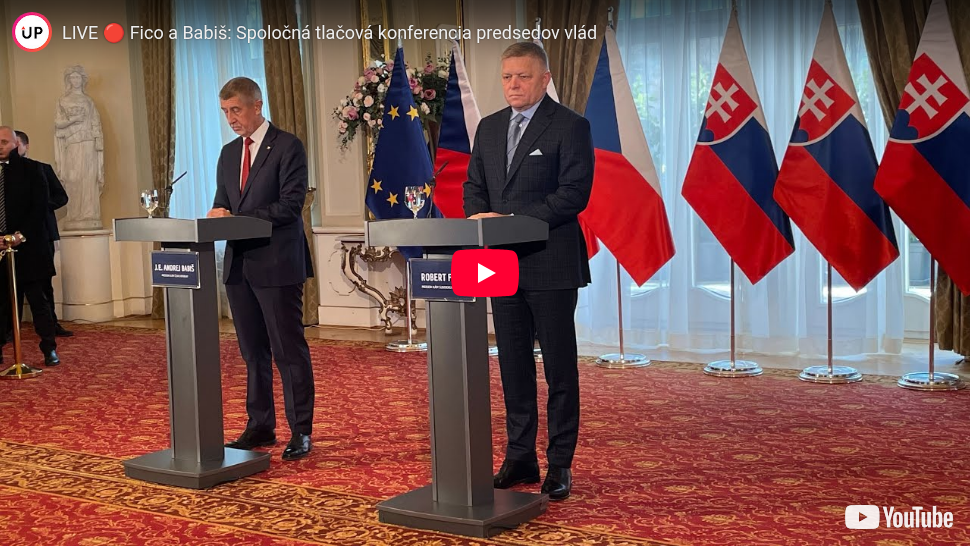
Energy security and gas transit through Czech territory
Energy security was a key topic of the talks. Fico said the Czech Republic would be a crucial transit country for gas supplies to Slovakia, particularly following a planned halt to Russian gas — a move he described as an ideologically driven EU decision that will take effect after 1 January 2028 and further limit gas transit routes.
According to Fico, the two sides discussed two concrete projects: a gas storage facility and a new connection point on the Czech–German border. Both projects are expected to be addressed in more detail at the joint government meeting scheduled for March.
Babiš said the Czech Republic is prepared to assist Slovakia once Russian gas flows end.
“Slovakia is an absolute priority for us,” he said, referring to the countries’ shared history of more than 70 years as a common state.
Nearly 70 percent of the gas imported into Slovakia in 2025 came from non-Russian sources, according to the state-owned gas company SPP. Russian gas continues to flow to Slovakia via the TurkStream pipeline, which runs under the Black Sea through Bulgaria and Hungary. Non-Russian supplies are delivered to the company SPP mainly via Austria and the Czech Republic.
Other figures from the Finnish-based Centre for Research on Energy and Clean Air (CREA) show that, despite the declining share of Russian supplies, Slovakia still paid a total of €113 million in November 2025. Of this, €68 million was spent on oil delivered via the Druzhba pipeline, with the remaining €45 million paid for gas.
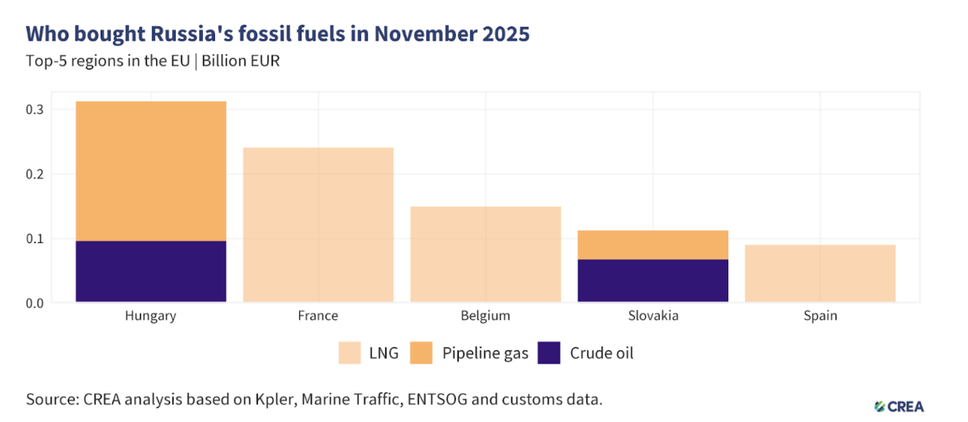
(source: CREA)
Speaking more broadly about energy, Fico criticised the European Commission for failing to deliver on commitments mandated by the European Council. He said the Commission was obliged to present, by the end of 2025, a plan showing how electricity prices would decrease.
“Zero. Nothing,” Fico said, adding that his government will pressure the Commission to fulfil its obligations, including commitments made to Slovakia in a formal letter.
The Slovak prime minister also proposed signing a memorandum on deepened cooperation, arguing that Czech–Slovak relations require a more strategic and institutionalised framework.
Concerns over EU competitiveness
Fico went on to say that the talks had also focused on the competitiveness of the EU, identifying high energy prices as the bloc’s biggest problem. He welcomed Babiš’s decision to approach European leaders with his own initiative on how to address the issue. Fico added that Slovakia would also come forward with a separate initiative based on a concrete case study.
As an example, Fico cited what he called a “textbook case” of the aluminium plant in Žiar nad Hronom, central Slovakia, arguing that the Green Deal (the EU’s plan to become climate-neutral by 2050) had led to the closure of a modern factory. Europe needs around five million tonnes of aluminium a year, he said, but produces only one million tonnes domestically. Around 20 percent of that European output, he added, could be produced in Žiar nad Hronom.
“However, the plant was operating at a loss, so it was shut down,” Fico said, referring to the Slovalco aluminium producer. “Now we import everything from China. Pollution levels in China are higher than those produced by Slovalco during aluminium production.”
“We agree on how to proceed on electricity prices by about 95 percent,” Fico said after his talks with Babiš, declining to comment in detail on Babiš’s initiative on emissions allowances. He added only that they shared the same objective.
According to Babiš, the aim was to “save Europe”. “If Europe continues down this path, it will not end well economically,” he said.
“We must stop the madness around the Green Deal,” Fico said, arguing that Europe would otherwise be unable to keep pace with China or the global south. He pointed out that electricity generated from gas in Slovakia now requires the purchase of an emissions allowance costing nearly €90, on top of the base electricity price. In the case of coal, the cost is even higher.
“We cannot have energy prices two or three times higher than in China. We are simply not competitive,” Fico said.
Slovakia wants the emissions trading system, a key Green Deal policy tool, to be suspended for four or five years — a move Fico described as a “holiday”.
Babiš recalled that he had raised concerns about emissions allowances as early as 2021, when he sent a letter to Brussels and to EU prime ministers calling for the price to be capped at €30. “Today we can see the impact,” he said, criticising the ETS1 (EU Emissions Trading System 1) directive.
The Czech prime minister claimed that the EU had predicted the price of an emissions allowance would reach €80 by 2050, a level that has already been reached. “The EU has a serious problem — companies are leaving because of cheaper energy elsewhere,” Babiš said.
Quoting from what he described as an unfinished letter to EU partners containing policy proposals, Babiš stressed that the debate concerned ETS1, not the future ETS2 system. He also criticised the EU for failing to recognise nuclear power and gas as clean energy sources, and called for measures to protect emissions allowance prices from excessive volatility.
“We are criticised for criticising,” Babiš said. “But we criticise because we see the catastrophe coming — and at the same time we are proposing solutions.”
He welcomed the announcement that an informal EU summit focusing on competitiveness would take place on 12 February in Belgium.