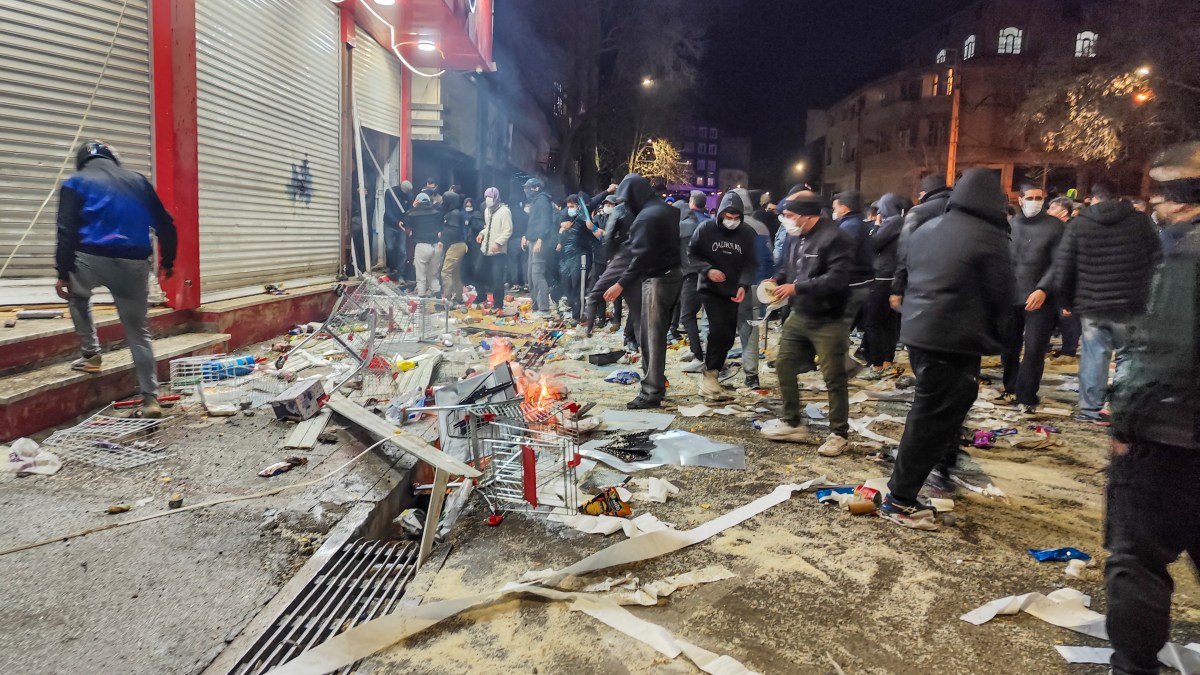
Crowds of demonstrators gathered in the streets of Tehran and other Iranian cities on Thursday night as nationwide protests entered their 12th day and a policeman was reported as the latest fatality.
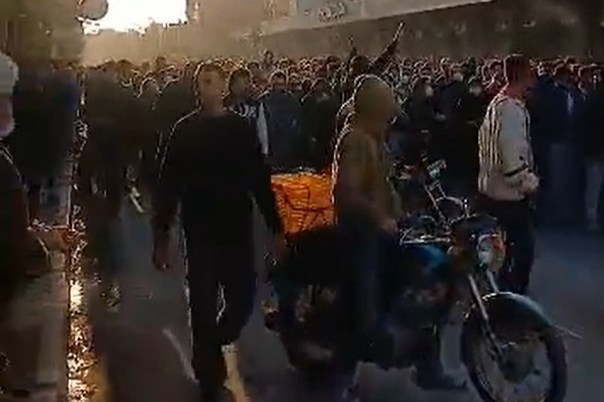
Videos shared online appeared to show hundreds of people marching against the Islamic regime and the state of the economy in the capital, as well as the northern cities of Babol, Karaj and Lahijan, close to the Caspian Sea, and on Kish Island, off the southern Gulf coast. Some chanted slogans calling for the return of the shah, the monarchy that was overthrown by the Islamic Revolution in 1979.
Other videos appeared to show vehicles set on fire by protesters in Sattar Khan, a district of Tehran.
A statue of Qasem Soleimani, the former Revolutionary Guards commander, was filmed being pulled down by protesters in the western city of Qaemyeh. Soleimani has been eulogised by the regime as a martyr since he was killed in a US drone strike in Baghdad in 2020.
The statue of Qasem Soleimani topples in Qaemyeh
AFP
Two Iranian Revolutionary Guards Corps soldiers were killed during protests in Kermanshah, west Iran, according to reports.
• Iran vows ‘no leniency’ to protesters despite Trump’s threats
President Pezeshkian had earlier pledged to crack down on price gouging in an attempt to mollify protesters, who began demonstrating against high costs and spiralling devaluation of the rial, Iran’s currency, on December 28. Several deadly clashes between demonstrators and security forces have followed as the government has struggled to contain the unrest.
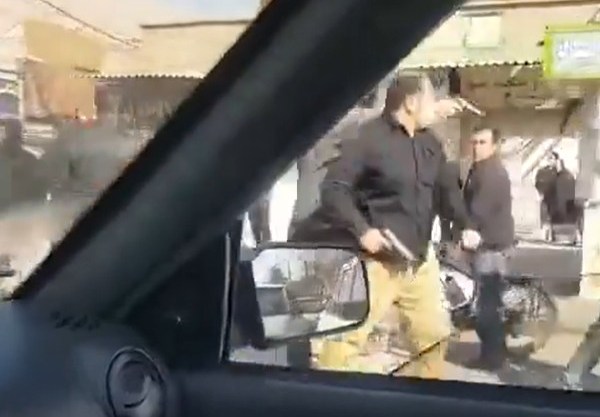
Gunmen have taken to the streets, which are crowded with protesters
Pezeshkian, who is a relative moderate, said his government would deal “seriously and decisively” with hoarding by businesses, adding that “people should not feel any shortage in terms of goods’ supply and distribution”.
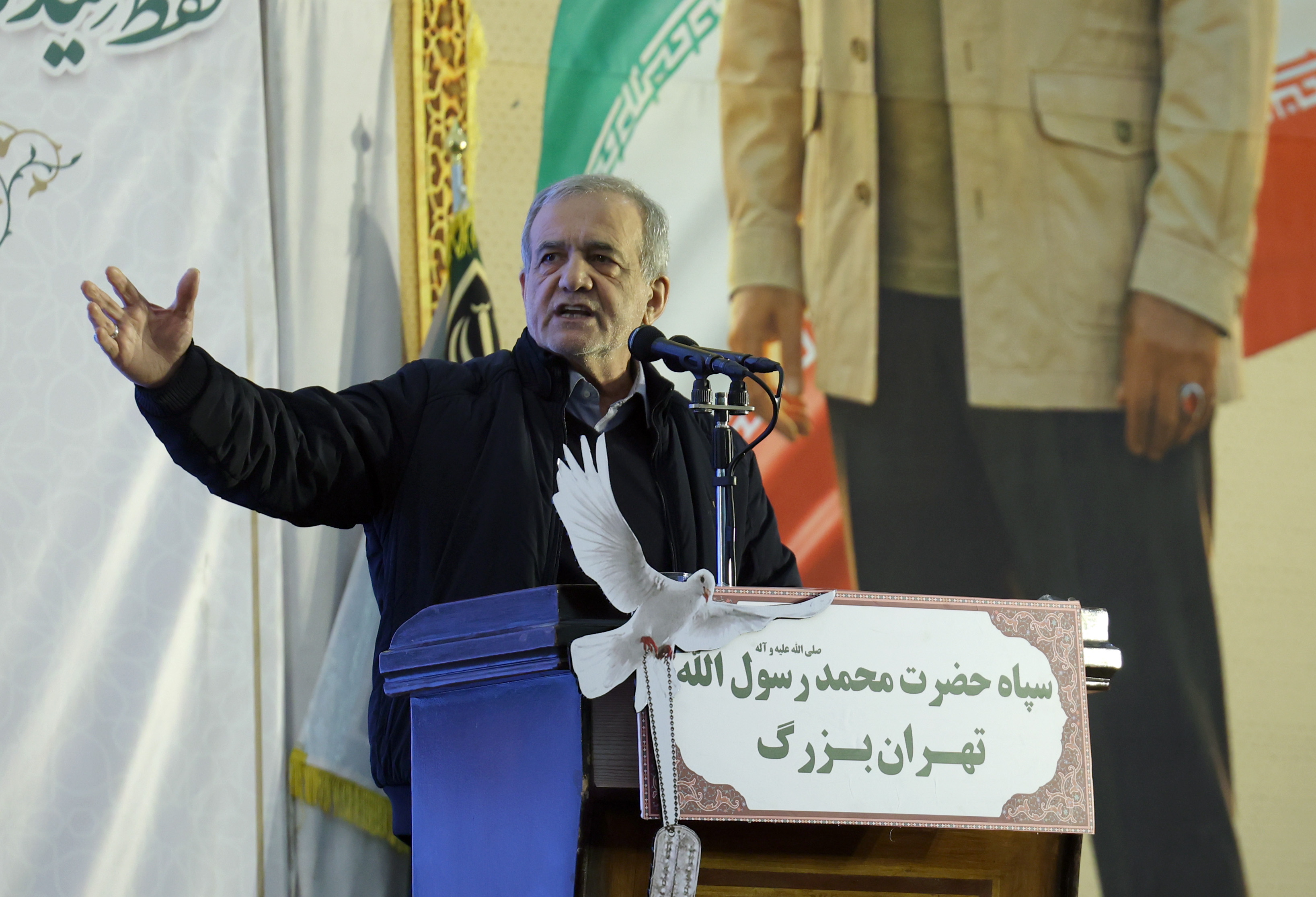
Pezeshkian
ABEDIN TAHERKENAREH/EPA
Hours before his comments, the authorities said a policeman had been stabbed to death during unrest near Tehran. At least 36 people have been killed since the start of the protests.
Reza Pahlavi, the son of the last shah of Iran and claimant to the deposed monarchy, had encouraged further demonstrations on Thursday. In a message on social media he said he had received reports that the “regime is deeply frightened and is attempting, once again, to cut off the internet” to thwart the protests.
Pezeshkian has repeatedly asked police to show restraint towards the demonstrators as the death toll rises and President Trump threatens to intervene militarily if the killings continue.
“Any violent or coercive behaviour should be avoided,” the Iranian president said in a statement on his website on Thursday, urging “utmost restraint” as well as “dialogue, engagement and listening to the people’s demands”.
However, Pezeshkian is not the highest authority in Iran and can be overruled by Ayatollah Khamenei, the supreme leader who has vowed to put the protesters “in their place”.
Protesters tore down a statue of Qasem Soleimani, the military leader killed by a US airstrike in 2020
On Thursday Trump repeated his warning to the Iranian government: “I have let them know that if they start killing people, which they tend to do during their riots — they have lots of riots — if they do it, we are going to hit them very hard,” he said in an interview with Hugh Hewitt, a conservative radio host.
“We’re watching it very closely,” the US president said of the unrest. “They know, and they have been told very strongly, even more strongly than I am speaking to you right now, that if they do that they are going to have to pay hell.”
On Wednesday, the US denounced an attack by police on the Imam Khomeini Hospital in the western city of Ilam as “savage”. Amnesty International said police fired shotguns and tear gas to enter the hospital and assaulted medical workers. The attack “exposes yet again how far the Iranian authorities are willing to go to crush dissent”, the human rights group said.
The protests are the largest in the country since 2022 and have taken on an added urgency after Trump’s threat. Iran’s leadership is reeling from the devastating war with Israel and strikes by the US last summer, and feels increasingly exposed.
Cars set ablaze across Tehran
Some protesters have welcomed Trump’s threats. Video circulating on social media showed one person covering a street sign in Tehran with a new one that read “Trump Street”.
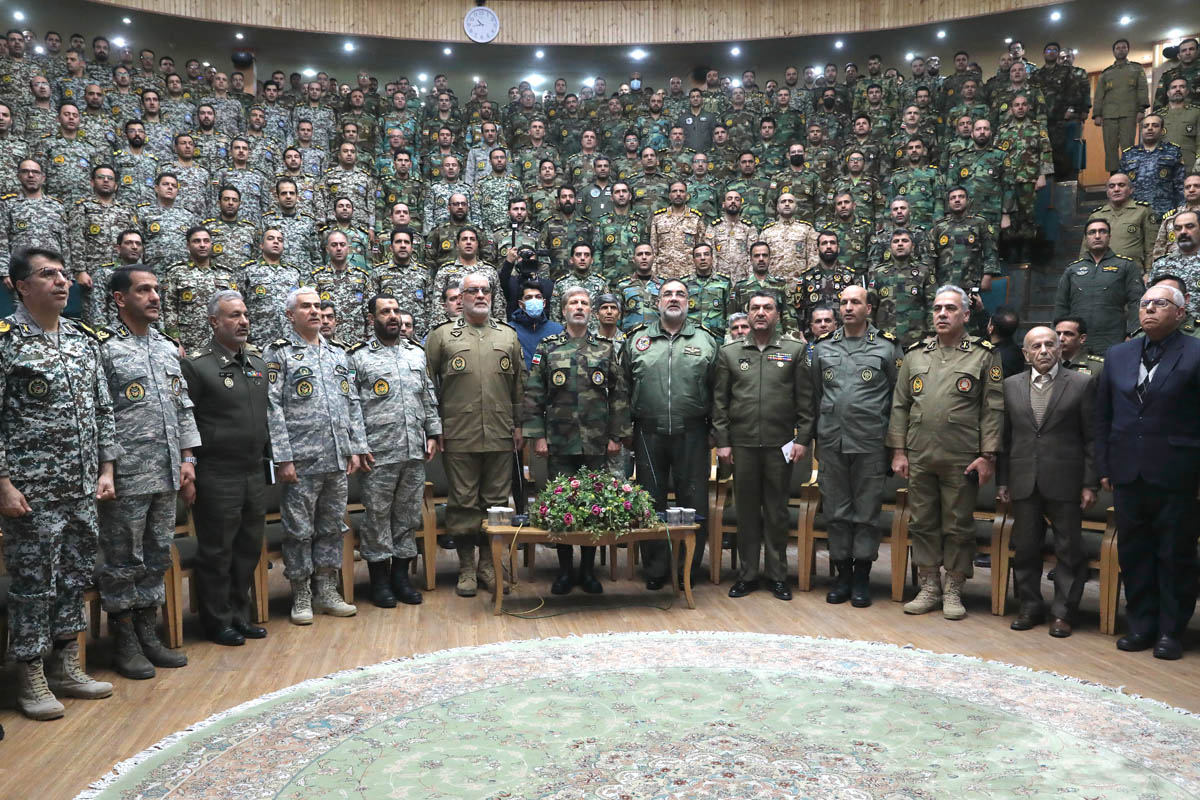
Major General Amir Hatami, seventh from left in front row, threatened the US and Israel over their “escalation of hostile rhetoric”
IRANIAN ARMY MEDIA OFFICE/AFP/GETTY IMAGES
Iranian officials have defied threats from the US and Israel, escalating their repression and issuing their own threats in response. “The Islamic Republic of Iran considers the escalation of hostile rhetoric against the Iranian nation a threat and will not tolerate its continuation without responding,” Major General Amir Hatami, the Iranian military chief, said.