A plant brought from Alaska is spreading across Iceland’s poor soils, helping to curb desertification and reforest the country, but it threatens native ecosystems and reignites the debate about how far it’s worth going to “save nature.”
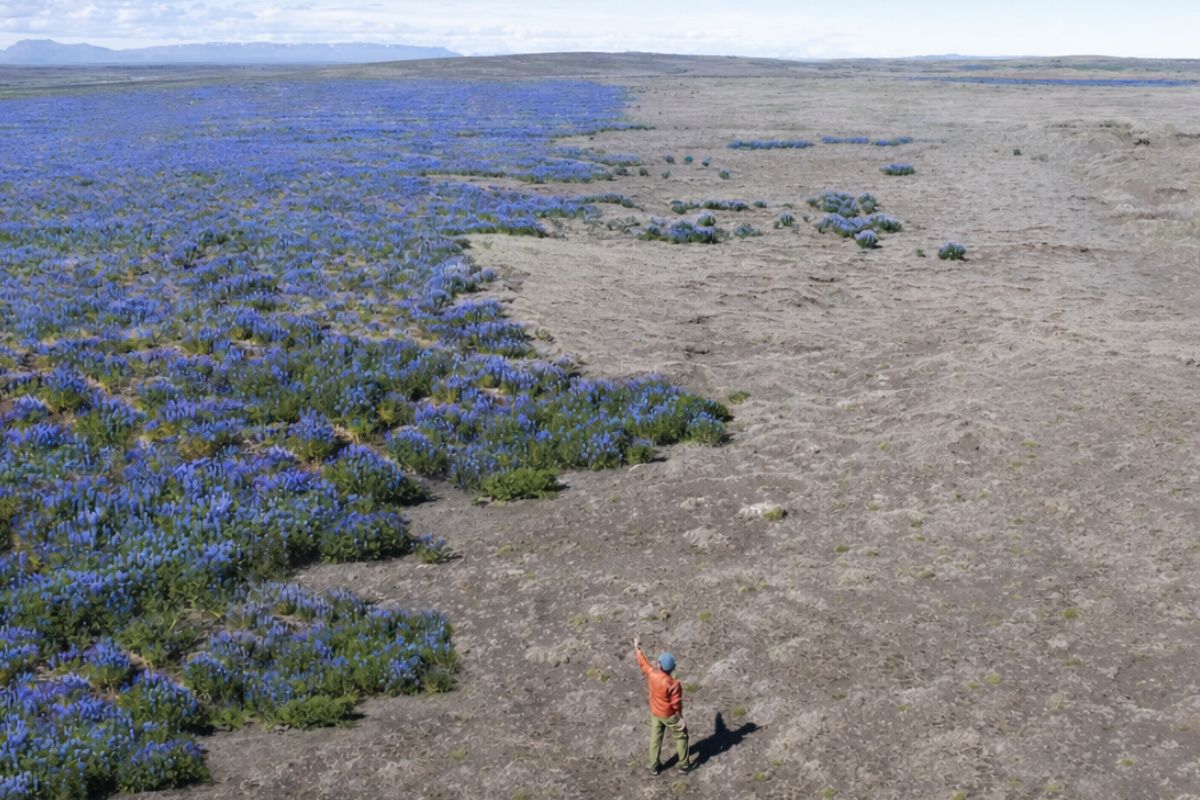
The contrast is stark. On one side, expanses of bare, stony, wind-swept soil. On the other, entire swathes of intense purple covering former areas of sand and gravel. It is there, in the expanding deserts of Iceland, that an exotic plant has become a symbol of one of the most troubling environmental debates of our time: Using an invasive species to curb desertification and restore forests, even at the cost of native biodiversity..
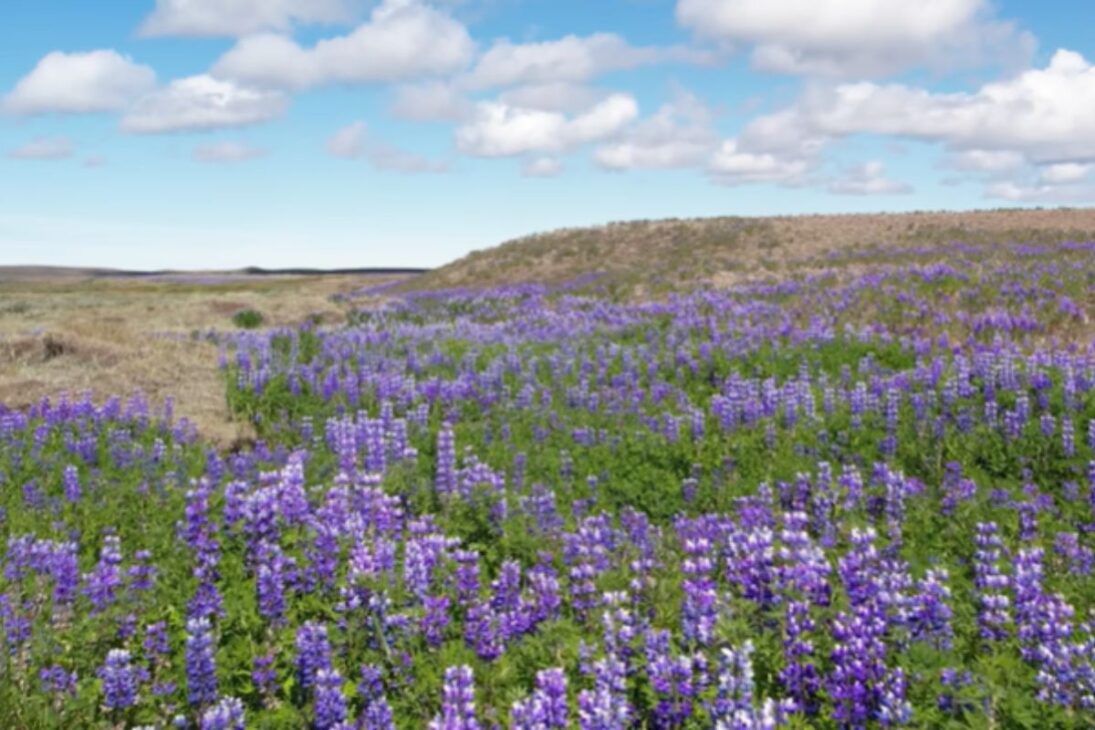
The protagonist of this story is… Lupinus nootkatensis, the Alaskan wolf-owl. In just a few decades, it went from two spoonfuls of seeds brought from Alaska to spread across entire landscapes, paint hillsides purple, fertilize dead soils, and at the same time, raise alarm among ecologists, ornithologists, and defenders of the island’s original habitats.
The dilemma is straightforward: To what extent is it worthwhile to combat desertification using a species that can dominate everything around it?
Iceland is spectacular, but rapidly becoming desert.
Iceland sells the world an image of unspoiled landscapes, volcanoes, glaciers, and green fields. The ecological reality is much harsher.
Much of the country is, in practice, a mosaic of degraded soils, cold deserts, and areas undergoing active desertification..
Centuries of deforestation, overgrazing, and erosion have stripped the island of much of its original vegetation cover. In many places, what remains is poor, stony, unstable soil, unable to retain water or nourish more demanding plants.
The Icelandic deserts continue to expand day by day., pushed by wind, rain and lack of vegetation cover.
It is in this scenario that lupina emerges as a radical solution. While many native species are unable to establish themselves in these destroyed soils, the purple plant does the exact opposite: it occupies first what everything else rejects.
From two spoonfuls of seeds to the purple explosion in the deserts.
The story begins in 1945. After a trip to Alaska, Hákon Bjarnason, then director of the Icelandic Forest Service, returns home with something seemingly insignificant: two spoonfuls of seeds. Lupinus nootkatensis.
The idea was simple and ambitious at the same time: to use the plant as a restoration tool in poor soils.
Bjarnason knew that lupine was a type of legume and nitrogen fixerThat is, it is capable of enriching the soil by associating its roots with bacteria that extract nitrogen from the air and deposit it in the soil.
In a country with depleted soils and increasing desertificationThe promise was tempting: a plant that self-fertilizes, grows in sand and gravel, holds the soil, and even prepares the ground for other species.
For decades, The wolf was welcomed with open arms in Iceland.It was seen as an ally of restoration, cheaper than planting grasses, beautiful in the landscape, and efficient in areas where almost nothing grew.
There was even a door-to-door campaign with small “elves” containing a birch seed and a lupine seed inside, to encourage people to plant both together.
But this initial enthusiasm had a blind side: no one knew for sure what would happen when such an aggressive species encountered an entire country full of fragile, desertified soils with little competition.
How the purple plant combats desertification in practice.
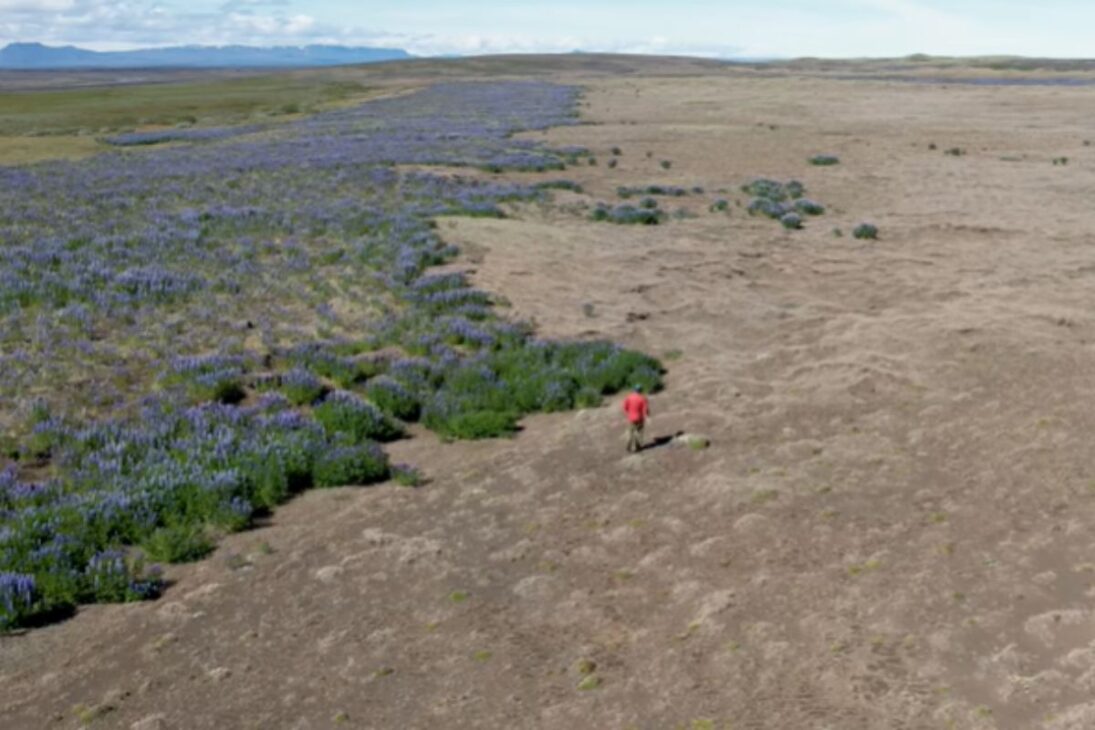
Today, one only needs to look at a typical transition: On one side, a cold desert of sand and stone; on the other, a dense swath of lupine forest advancing year after year.In many areas, it is literally the only plant capable of reclaiming the land.
A Lupinus nootkatensis It has a set of characteristics that make it perfect for curbing desertification:
It grows in sandy, stony and even bare gravel soils.
It can reach up to 1,20 m height and live up to 20 years.
A single individual with approximately 25 flowering stems can produce thousands of seeds in a season.
On flat surfaces, the lupine carpet advances. between 1 and 3 meters per year…and it can go even further up steep slopes, carried by wind and water.
Upon settling in, The plant changes the soil from the inside out.The root system, associated with nitrogen-fixing bacteria, It injects fertility where there was previously virtually no life.Organic matter increases, soil structure improves, and moisture is retained better.
This new environment is beginning to attract other actors in the ecological chain. Invertebrates like earthworms return, transforming detritus into humus., the dark and rich fraction of the soil.
This humus further improves fertility, feeds a web of microorganisms, and paves the way for grasses, shrubs, and, in some cases, trees.
on the surface, Lupine areas have become feeding grounds for birds that benefit from the abundance of invertebrates.And the landscape, once gray or brown, gains a purple carpet visible even from a distance. That is why many Icelanders and tourists see the plant as a symbol of hope against desertification.
The other side: when combating desertification threatens native nature.
If the story ended here, the wolf would be almost unanimously praised. But it doesn’t end here. The same aggressiveness that allows the plant to withstand desertification and colonize deserts makes it a powerful invader in sensitive native ecosystems..
Aerial images show that The lupine already covers about 0,4% of Iceland’s land surface.At first glance, it seems like a small amount.
But the number is alarming when compared to another statistic: Only about 1,5% of the country is covered by forests.If nothing is done, the plant’s growth curve tends to be exponential, especially in the case of a species that reproduces so efficiently.
The most worrying impact falls on native habitats such as swamps and thickets of low shrubs…where species such as blueberries and other plants typical of Iceland thrive. These environments are important not only for the flora, but also for the fauna they support.
One of the most cited examples is… European Golden Plover, a migratory bird beloved by Icelanders, whose annual arrival symbolically marks the beginning of summer.
With the expansion of the lupine plant over the former heaths and fields of low shrubs, Nesting areas are being overtaken by the purple carpet., altering the pattern of habitat available to the species.
In simple terms, In halting desertification with lupine, Iceland risks losing some of its native vegetation and the ecosystems that define the island’s ecological identity.What was once a tool for restoration is simultaneously becoming a source of pressure on the original biodiversity.
Between restoring and dominating: the dilemma of the “useful” invasive species.
The big question that ecologists and managers are trying to answer today is no longer whether the lupine is good or bad, but rather How to coexist with an invasive species that is already deeply embedded in the landscape and is, at the same time, an ally against desertification and a threat to native ecosystems?.
A pragmatic consensus is emerging in many circles:
The lupine will likely not be eradicated from Iceland. Dispersal has already occurred, the seeds are in the soil, and total control would be unrealistic.
It is extremely valuable in areas of severe desertification.where virtually no native species can establish themselves on their own.
At the same time, it needs to be strictly controlled in areas of high ecological value., such as habitats for sensitive native plants and key areas for birds like the golden curlew.
In practice, this means using the plant. strategically, as a temporary restoration tool in deserts and highly degraded soils, while simultaneously investing in monitoring, containment and, when necessary, removal in areas that still harbor well-structured native vegetation.
The case of the lupine also exposes a greater discomfort: The future of restoration on a rapidly desertifying planet may depend, in some places, on species that were not “rightfully” there in the past..
And this forces entire societies to rethink what “original nature” means in a profoundly altered world.
Desertification, restoration and the future of the Icelandic landscape
The advance of deserts in Iceland is real, and the Lupinus nootkatensis shows, in practice, that It is possible to halt desertification and create fertile soil where before there was only gravel and sand..
At the same time, the potential price is high: loss of native habitats, simplification of landscapes, and dependence on an invasive species to sustain part of the recovery.
The discussion about the lupine is, in fact, a reflection of something larger. In a world where Desertification is increasing, the climate is changing, and entire ecosystems are collapsing.It is likely that this type of dilemma will become increasingly common.
Between acting with imperfect tools or doing nothing and watching the degradation progress, the choice is rarely simple.
For Iceland, the challenge now is to find a point of equilibrium between curbing desertification, restoring forests, and protecting what remains of its native flora and fauna., without transforming the wolf’s purple into the new dominant color of the entire landscape.
In your place, would you prioritize combating desertification using lupina, even with the risk to native species, or would you advocate limiting the use of this invasive plant as much as possible to protect what remains of the original ecosystems?