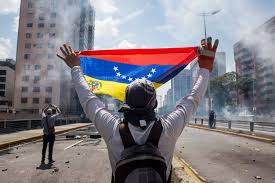
Apart from the reports of growing resistance in the Americas against the American intervention in their respective domestic politics, there are few takers of the US President Donald Trump’s new assertive “avatar” in the contemporary uncertain geopolitics. Few believe it will enhance the prestige and bargaining power of Trump or his country.
There are reports of anti-US rallies in Colombia and Cuba and the possibility of anti-American sentiments engulfing most of the western hemisphere.
According to Colombia’s leftwing president, Gustavo Petro, these rallies were taking place after the indication of Trump that he favoured the idea of military action in Colombia in near future.
Petro had further revealed his apprehension regarding his fear of American invasion recently before thousands of his supporters at a rally in Bolívar plaza in Colombia’s capital, Bogotá.
The scholars of international affairs across the continents are in unison that apart from the growing alienation of the common people in the region after the military intervention in Venezuela, it unfortunately, may also validate the ongoing Russian aggression in Ukraine. In other words, it concedes the concept of the “ jungle raj “ that any stronger military power can attack any sovereign country with impunity; thus making the UN irrelevant. Further, it may also provoke China to be more assertive in global politics, especially in Asia. China may invade Taiwan to annex it anytime, if it is assured of American involvement in other regions. India also has nearly 3000 kilometres of border with Tibet under the Chinese occupation. China has been claiming the Indian state, Arunachal, as South Tibet and is keen to annex it
In other words, there is a worldwide consensus that the gunboat American diplomacy does not create the same fear or awe it used to cause about a quarter century ago. Earlier, Washington used to assert its predominant role in the western hemisphere without any substantial resistance. The Cuban crisis in the sixties, perhaps , was a watershed when the Union of Socialist Soviet Republics or the USSR was prevented from setting up missiles loaded with the nuclear warheads in Cuba.
The world sighed with relief, when the USA -USSR standoff ended. The then US President, John F. Kennedy, and the general secretary of the USSR, Nikita Khrushchev decided to engage themselves seriously for peace.Later, the US and USSR decided to have a hotline for maintaining peace initiatives to avoid any nuclear catastrophe.
During the nineties, the USSR was fragmented into 19 sovereign countries, including the successor states such as the Russian Federation and Ukraine. In the global theatre, however, following the collapse of the USSR, the US emerged as the only Super Power on the earth. Later, China was also included in this network, having a hotline with Washington and Moscow.
In recent years, China, with its unprecedented economic power accompanied by a formidable defence system, is seen as being more assertive in world politics. In the US, many consider China
as a rival to the US as a super power.
Imitating the US
Beijing’s growing ambition for a super power status is being noticed worldwide. China might not have fully imitated America’s gunboat strategy, but it is being noticed that it has adopted a wolfish aggressive approach in diplomacy, especially while dealing with India.
It is not being ruled out that Washington might have confided in Beijing and also perhaps, Moscow before kidnapping the president of
Venezuela.
It is believed also cannot be ruled out that before the well planned kidnapping of the Venezuelan President Nicolas Maduro and his wife Cilia by the American Delta force, Beijing and Moscow were kept in the loop. However, it has become difficult for the West to justify the Operation Kidnapping of a sitting president before any international forum. It is also being recalled that the doctrine, US President James Monroe had announced during his seventh annual State of the Union Address to the Congress in 1823 was only against the European powers colonizing the Americas. It was not for justifying any interference of Washington in the internal affairs of any country.
The New York Drama
The abducted Venezuelan president was brought in handcuffs and was
accompanied by his wife Cilia Flores like criminals before a federal court at Lower Manhattan, while the UN Security Council, just about a few kilometres to the north from the court, was busy in a face-saving exercise for President Donald Trump. Indeed, like a traditional ritual, a dozen countries condemned the US “crime of aggression”, but no substantial proposal for correcting this international crime.The UN secretary general António Guterres, however, suggested the operation constituted a breach of international law.
The representatives of two countries, Russia and China, present in the UN Security Council appeared to be really amused by the kidnapping of the president of a sovereign country and his trial in a New York court. For them, this American action not only justifies their aggressions against respective neighbours, it also finally allows them to be more and more aggressive in their respective areas.
With this action, Trump has justified the Russian aggression in Ukraine as well as any bid of the Dragon to annex Taiwan.
History Repeats
History offers a warning that in May 2003, the then US President George W. Bush was getting photographed beneath a “Mission Accomplished” banner and declared victory in Iraq. What followed was not stabilization, but fragmentation—an insurgency, a legitimacy crisis, and years of costly entanglement. Venezuela now sits at a similar inflection point. Removing Maduro could open the door to a durable transition. It could just as easily draw the United States into a dangerous quagmire or a similar dangerous engagement, it had faced in Vietnam and Afghanistan.
There are reports that Washington is keen to install Venezuelan opposition leader María Corina Machado, who recently won the Nobel Peace Prize. However, she has suggested the name of Edmundo González, to be recognized as the rightful leader of the nation. He was widely seen as the legitimate winner of the 2024 presidential election in the country.
Machado rose to global prominence last year with her win of the prestigious Nobel Peace Prize.
Religious Rivalries
The West has always been defining or interpreting the political differences by introducing religious or cut differences among the rivals. In this ongoing political crisis in Venezuela, Trump knowingly or otherwise identified with the white evangelical Christians. During his rallies Trump
takes on the symbols, rhetoric and agenda of Christian nationalism. A vocal segment of his Christian supporters in the US, particularly white evangelicals and Christian nationalists, view Trump as “anointed by God” or divinely ordained to lead America back to its supposed “Judeo-Christian roots”.
On the other hand, Maduro
adheres to a left-wing socialist and anti-imperialist political ideology known as “Chavismo,” which combines elements of Bolivarianism and 21st-century socialism. He, however, finds himself closer with the Chinese for his socialist views as well as the role of Roman catholic order in rejuvenation of modern China.
Maduro has not overtly emphasized a strong personal religious identity, b
but he has been associated with a rewritten, pro-Chávez version of “The Lord’s Prayer” that was recited at party meetings. He has also made statements with religious overtones in a political context, such as declaring that “Jesus Christ was a young Palestinian unjustly crucified by the Spanish Empire”.
It, perhaps, has prompted the Vatican to formally reject the “Doctrine of Discovery” in March 2023, repudiating the 15th-century papal bulls that justified colonial land seizure and Indigenous subjugation, stating these decrees didn’t reflect Catholic faith, were manipulated by colonial powers, and failed to recognize Indigenous rights, acknowledging the immense harm caused by these concepts and assimilation policies.
It is also true that the father of modern China, Sun Yat-sen was baptized as a Christian by an American Congregationalist missionary in Hong Kong in 1884. He had adopted the Christian name “Rixin” (meaning “new day”), and thus had laid a strong ties between Beijing and the countries adhering to the faith.
Gopal Misra has been associated with national and international media. His books on journalism and geo-politics have been well-appreciated. Views are personal.