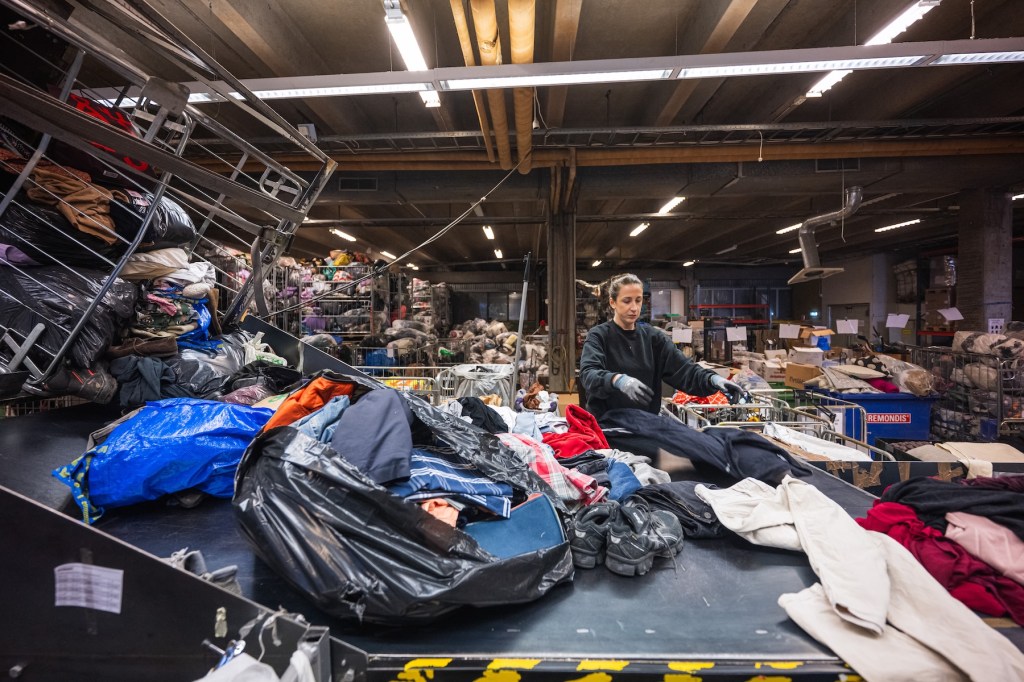
A new report warns that digital product passports will fall short of enabling large-scale textile-to-textile recycling unless European Union policymakers address data gaps and low digitization across the value chain.
That’s because almost 75 percent of the EU’s post-consumer textiles are incinerated or landfilled at the end of life, the European Environment Agency found. Why? The EU’s textile sector still favors linear production models, according to the Centre for European Policy Studies (CEPS)—a Brussels-based think tank that examines EU affairs and provides a platform for debate.
That’s why, according to CEPS, addressing this mismanaged textile waste (some 5-plus million tons, per the EEA’s estimates) by transitioning to a system of durable, digital tools—those of a more circular than linear make and model—is “essential to reducing waste, emissions and virgin resource dependency,” the center recently reported; as an independent analyst (and critic) of European policy, CEPS has been conducting rather robust, primarily-in-house policy research since 1983.
The international think tank shared a January 2026 policy brief written in the context of PESCO-UP: A four-year Horizon Europe and EU-funded textile recycling project.
In essence, PESCO-UP champions two crucial policy briefs within the EU’s textile recycling landscape: the digital product passport (DPP) and extended producer responsibility (EPR) schemes. The idea is to aggregate “actionable insights” to inform the relevant players—policymakers and industry executives, NGOs and standards bodies—on practical deployment of DPP and EPR under the upcoming framework’s law.
The acronym is a direct reference to these textile blends’ chemical abbreviations (polyester and cotton) and the project’s primary goal (upcycling). The EC’s Community Research and Development Information Service (CORDIS) platform reported that the project’s formal name is “textile fiber recycling from mixed streams of PESCO textiles,” used for purposes such as EU grant documentation.
On that note, PESCO-UP is led by VTT, the largest research and technology company and research center in Finland, conducting applied research. The PESCO-UP consortium is EU-wide—spanning partners like Valmet and Vegea, Rester and Reverse Resources—to collectively cover the complete lifecycle of textile recycling.
The project’s technologies span all processes throughout the textile recycling value chain. Identification and sorting benefit from digitized material identification systems, while tools like the DMP improve supply-and-demand matching through specific data-sharing practices.
Name aside, the project focused on a combination of mechanical and chemical separation technologies to achieve a targeted 90-95 percent material processing efficiency from polyester/cotton (PES/CO) blends, CEPS explained. Its objective—ensuring circularity and encouraging stakeholder(s) collaboration—began at the start of 2024 and will wrap at the end of 2027.
To hit those objectives, PESCO-UP is developing a Digital Material Passport (DMP) and a digital marketplace to bridge information gaps between stakeholders.
“While not enshrined in EU law, the DMP is also relevant for textile circularity,” the policy brief reads. “Compared to the DPP, the DMP focuses specifically on materials rather than entire products—and only targets value chain actors rather than including consumers.”
It’s of particular interest for textile recycling, CEPS said, considering the sector’s traceability tools need to tackle a ton of topics: fabric construction, fabric composition, fabric finishes, to name a few, alongside chain of custody data.
The PESCO-UP DMP data structure, for instance, was designed for drop-in compatibility—intended to “feed” any future DPPs with this super-specific and broken-down data.
The project interviewed 20 (classified) companies about the challenges and constraints they face when using such traceability and transparency tools. In response, PESCO-UP presented three proposals to policymakers: establish clear data priorities; support consumer awareness and engagement; improve interoperability of data and policies.
The Brussels-based organization said its policy brief enters the arena at an opportune moment; an ESPR Delegated Act (DA) for textiles is expected by 2027, with a recommended phased rollout of the DPP to a “comprehensive version” by 2033(ish).