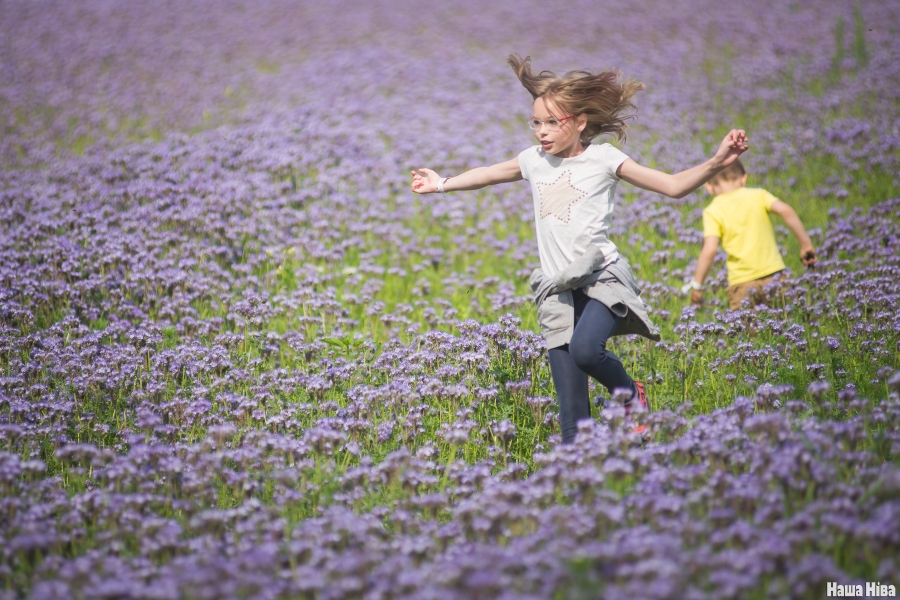
Illustrative photo. Photo: Nasha Niva
“Our Stance is to Raise Children Not as Maximalist Belarusians, But as Happy Ones”
Olga, lives in Poland:
“No matter where I live, I still remain Belarusian. My ancestors are Belarusians (although in emigration it would be much more beneficial for me to have some Polish grandmother to simplify legalization).
Among my lullabies for my youngest child, there is a lullaby by “Pesnyary” (a famous Belarusian folk-rock band). My library has books in Belarusian, in my time I did a lot to popularize the country in general and the provinces in particular, my home is still in Belarus, and it consistently annoys me when people say ‘Belorussiya’ (the Russianized name for Belarus).”
Yes, my native language and the native language of my children is Russian; I was born and lived my whole life in a Russian-speaking environment; I think, dream, and write in Russian, but I am not going to cancel this fact and will not allow others to either. It is part of my identity.
Sometimes I get asked here, ‘If you’re from Belarus, why don’t you speak Belarusian?’ but I’m not ashamed of it, it’s funny, because most often these are people from another country who themselves recently spoke Russian and were not at all embarrassed by it.
I know the Belarusian language well, I can switch to it without problems if I meet an appropriate interlocutor, but frankly, this doesn’t happen often.
I immensely respect Belarusians who speak Belarusian in everyday life, create a suitable environment for their children, attend events, and consciously transmit the Belarusian cultural code. But personally for me, this is an additional effort in an already not-so-simple life.
Does this make me less Belarusian? I doubt it. My husband and I don’t pretend to be Poles, we always say where we’re from, and we gladly respond to our own. We only have blue passports and a very Belarusian mentality.
Our children know who they are by nationality and where their homeland is, but our honest adult position is to raise them not as some maximalist Belarusians, but as happy, thoughtful, and flexible and adaptable people who can choose what language to speak and where to live. Now it is much more important to remain human than Belarusian, Ukrainian, or Portuguese.”
“My Son is a True Belarusian,” and it is He Who Raises Me as a Belarusian”
Irina, lives in the USA:
“I confess: I myself would have failed as someone who could raise their child as a Belarusian. I moved to the States 18 years ago – I plunged headfirst into a new life, made new acquaintances, and cut off old ties or barely maintained them.
Then I married a local guy, had a child. Although my husband said: ‘Speak Russian with our son more – let him know the language of his ancestors,’ – I sometimes switched to English when communicating with the child. It was easier for him; just compare – what’s simpler to say: ‘I want to be picked up!’ or ‘Up!’; to ask for ‘cookies’ and ‘cookie’.”
I sang lullabies from my childhood to my little one, played cartoons about ‘Smeshariki’ and ‘Fixies’, and read fairy tales. But I didn’t have the goal for the child to know the language well, for example, to be able to write in Russian.
When my son went to school, they asked why I, addressing him, called him Timofey (and I really do call him that, in honor of his grandfather – my dad, although for everyone else, he is, of course, Timothy). Upon learning that I was from Belarus, they offered to provide him with a teacher so he could learn his native language.
His native language is Russian, of course. But the school administration, apparently, didn’t grasp the ‘trick’ with two state languages in my country and started looking for a teacher who could teach my son Belarusian. And they found one! It’s not a teacher at all, but one of the residents of our city, an engineer. So my Tim became the only one in his class to attend additional Belarusian lessons.
I am, indeed, very grateful to my son’s teacher: he managed to instill in my child an interest and love for his ‘native language’. When the school did projects about family and ancestry, he helped my son search for our roots. And it turned out that my maiden name is on the list of nobility of the Grand Duchy of Lithuania (GDL). Since then, my son has become interested in the history of his homeland.
With an American surname, he could easily forget about his roots and his Belarusian identity (because mom wasn’t particularly good friends with the language at school), and say he’s American, but no – he emphasizes when introducing himself that he is Belarusian, studies the language, culture, history, communicates online with guys, including those from Belarus. And I learn more about my homeland thanks to him.
They say that not only do we raise our children, but they also raise us. This is certainly true: my son is a true Belarusian, and it is he who raises me as a Belarusian.”
“Children Compete to See Who First Recognizes This or That Song from My Playlist of Belarusian Hits”Alexander, lives in Lithuania:
“It was with the birth of my first son in 2006 that I began to use the Belarusian language not only at special events, but also in everyday life. Because I had a great desire for my children to truly grow up as Belarusians, and in this sense, the language issue became one of the essential criteria for my self-identification.
For me, Belarusian identity, both my own and my children’s, is like an additional secret dimension in life. It’s the opportunity to have and carry something truly unique, incredibly strong and touching. Something that stays with you forever, no matter what country you find yourself in, where you work, or what difficult circumstances you encounter. And, of course, I long for such a dimension to appear in my little ones too.
It’s like being part of some virtual team, remaining in it, ‘rooting’ for it, no matter what. And, it seems to me, it is precisely through language that this invisible connection is transmitted most easily and deeply. (An additional direction of my Belarusian identity was sport, but after 2020, most of our athletes lost their place in this ‘team’ of mine).
Frankly, in the 2010s in Minsk, raising children as Belarusians was perhaps no easier than it is now in emigration. Yes, we bought books at ‘Gallery Ў’, took the little ones to Voityushkevich concerts and various festivals like ‘Grunwald’, found an almost underground school ‘Kraina Syabrou’ (Country of Friends) and even founded our own Belarusian-language children’s club ‘Zorachki’ (Little Stars), which is still active. But all of this was a small subcultural drop in a large Soviet-Russian ocean.
And therefore, conveying to them an understanding of Belarus’s independence and distinctiveness, and the desire to specifically ‘be Belarusians,’ was quite difficult.
After 2020, everything changed: the number of people ready not just to feel, but to act, significantly increased. This is especially felt here, in Vilnius.
Children abruptly fell out of the dominant Russian linguistic and cultural environment, quickly becoming not just bilingual, but expanding the number of languages to four or five. While earlier the proportions were 90 to 10, now roughly equal shares of what they hear are English, Belarusian, and Russian, with a little space left for Lithuanian and Spanish.
We actively use what the environment and technology provide.
Here, in the city center, at Vilenskaya 20, there is the Belarusian House, where something happens almost every day and a rich library operates. The little ones attend the Belarusian theater group Varta, and with the choir ‘Svitanak’ (Dawn), my elder daughter even sang at the Christmas reception of Tsikhanouskaya’s Office.
Regarding gadgets, we also have our rules: among the few applications on which their iPhones have no time restrictions are ‘Knižny Voz‘ (Book Cart) and ‘Children’s Bible’. Thanks to ‘Kinakipa‘, we watched ‘Home Alone’ in Belarusian before Christmas. And although there aren’t many fairy tales from Maliyanych on the channel (and those that exist, the children have learned by heart), every such ‘grain’ plays a huge role.
Even the car ride to school turns into a game: children compete among themselves to see who first recognizes this or that song from my playlist of Belarusian hits. These are our little traditions.
For me, being Belarusian means practicing my Belarusian identity daily, and not just frying draniki (potato pancakes) once a year on some National Culture Day at school. It’s similar to how it is with religion: everyone is accustomed to thinking it’s enough to go to church on Easter to bless a willow branch to call themselves Orthodox Christians. I, however, am proud that my children specifically *practice* their Belarusian identity.
Through such activities, they have also started to use the language more often at home. And a real Christmas miracle for me was receiving a postcard from my younger daughter, who, on her own, without anyone’s prompting, decided to sign it specifically in Belarusian. In such moments you realize: it’s all not in vain.”
“Sweden Allows Migrant Children to Study Belarusian Language in Schools”Sergey, lives in Sweden:
“I have been speaking Belarusian since I fell in love with a young Belarusian language teacher – now she is my wife. We have a little daughter – she is 1.5 years old. She isn’t very talkative yet, as she’s still small, but she does pronounce some words like ‘tata’ (daddy), ‘baba’ (grandma), ‘dzieda’ (grandpa), and ‘lyalya’ (baby/doll).
Of course, we have a long way of upbringing ahead of us, but we are taking small steps – we play lullabies for our daughter, read fairy tales in Belarusian. Last year, grandma and grandpa came to visit us from Belarus – they brought books (and even Klyshka’s ‘Primer’ among them).
It’s still early for us to think about school, but in a Facebook community, it was written that Sweden allows migrant children to study Belarusian – you just need to fill out a special form. If 3-5 people gather, the school will add Belarusian to the timetable. By the way, the Ambassador of Sweden to Belarus records fairy tales in Belarusian for Belarusian children before Christmas.
There are many Belarusians in Sweden who speak Belarusian flawlessly; they conduct lessons and organize events like readings in libraries. From time to time, we go there. These are warm meetings that gladden and warm the heart.
I understand that our daughter will not be exactly like my wife and me – she will grow up in Sweden, but we will do everything so that she also knows where she comes from and does not forget her roots. For in this lies her strength.”
“We Should Not Strive to Assimilate Completely, Because That Way We Will Lose Ourselves”
Olga, lives in Poland:
“I am now 42 years old, and my children are 14 and 7. And, of course, my cultural code differs from theirs – and this will inevitably influence their self-identity.
I lived in Belarus for 37 years, and grew up in such a multicultural environment – I grew up not even on Belarusian literature, but on such a ‘trasianka’ (a Belarusian-Russian mixed language): we had many dialect words used in the Polotsk region, and there were also many Polish words, because my grandmother was Polish.
And yes, I, of course, know literary Belarusian, but in the family, with neighbors, on the street, we spoke a different language – such a mixture of languages.
I grew up on Belarusian songs and fairy tales, and in the Catholic tradition – and at first the language of prayers and services for me was Polish, and later – Belarusian.
All of this is no longer present in my children. My youngest daughter was not yet 3 years old at the time of our move – and now she speaks Polish most of the time. Yes, she hears Belarusian speech from time to time – but unfortunately, she no longer has the same level of understanding as I do. Unfortunately, there are no longer great-grandparents with whom she could communicate and who could pass on part of the code to her.
My elder daughter is a teenager, and it’s even harder for them; they are as if divided: they lived 9-10 years there, then came to a different environment, as if transferred from one herd to another. Unlike her younger sister, she communicates more with Belarusians and Ukrainians, although Poles are also in her environment.
Despite the fact that I received Polish citizenship, I will still be Belarusian for the rest of my life, because I grew up in Belarus – my roots are there, my parents remained there. As best I can, I pass this on to my children: I tell them about Polotsk, about Princess Ragneda and Polotsk Sophia, about the Radziwills. The elder one traveled a lot with me around Belarus – she remembers everything.
I play Belarusian films and songs; both my daughters grew up with lullabies and ‘Kupalinka’ (a folk song), they listen to N.R.M. (a rock band), and when my elder daughter sees a poster with Voityushkevich, she laughs: ‘Mom, your favorite man is performing again’.
Someone might say this is not enough. But I tell myself that I am at least doing something to pass on a piece of my code to my children.
Yes, they will definitely have a different life – that’s a fact, one shouldn’t indulge in illusions. But I tell my daughters that we should not strive to assimilate completely, because that way we will lose ourselves. You shouldn’t be ashamed that you grew up not in this country, that you are ‘from a different dough’ – that’s your strength, your plus, not a minus.
I myself am proud to be from Belarus. And my Polish friends sometimes say: ‘Well, everything works out for you here just because you’re from the East – you’re stronger.’ I don’t argue with them.