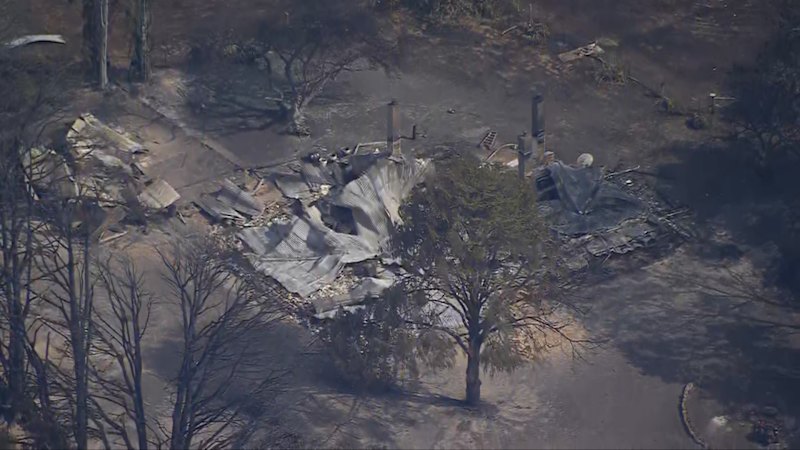
A behemoth fire burning in Victoria’s far north-east has grown ahead of more dangerous fire conditions on Sunday.
However, milder conditions in the coming days are expected to give firefighters a better chance at containing blazes, which are expected to burn for weeks.
The Longwood fire stood stable at 142,421 hectares on Saturday evening, while the Walwa fire stretching over the NSW border grew to 93,456 hectares – an increase of some 400 hectares.
A high fire danger rating was declared for Victoria’s north for Sunday, while in the state’s south, State Control Centre spokeswoman Reegan Key said conditions would be low to moderate.
“We do have those cooler conditions, and the winds will abate over this week on and off, so it’s better conditions for firefighters to be able to direct attack fires,” Key told this masthead on Saturday.
It was too early to determine what communities down south could still be caught up in fires in the Otways, which remained at emergency level on Saturday night, Key said.
A total fire ban would still be in effect across Victoria on Sunday, to ensure “we don’t have more fires while conditions are good”, Key said.
The main town under threat from the Walwa blaze was the town of Corryong in Victoria’s far north-east. Late Saturday communities in the Mitta Valley were directed to leave immediately.
Temperatures on Saturday at Corryong reached the mid-30s, the Bureau of Meteorology’s Daniel Sherwin-Simpson said.
The nearby Hunters Hill weather station was recording humidity in the single digits.
“The heat and the dryness are still lingering up there, which is unfortunate for them. The winds are a bit more variable, but also lighter because of that. So it makes things unpredictable,” Sherwin-Simpson said.
Corryong is forecast to reach a maximum of 33 degrees on Sunday. Melbourne is forecast to reach a top of 19 degrees, while Apollo Bay on the Great Ocean Road should hit 17 degrees.
No significant rainfall was forecast over the fire grounds in the next couple of days.
“There could be a couple of spots that make it up into the north-east, around the Walma fire and more central parts around that Longwood fire,” Sherwin-Simpson said.
“But really the bulk of the rainfall is going to stay south of the ranges so I don’t think it’ll help out those major fires a huge amount.”