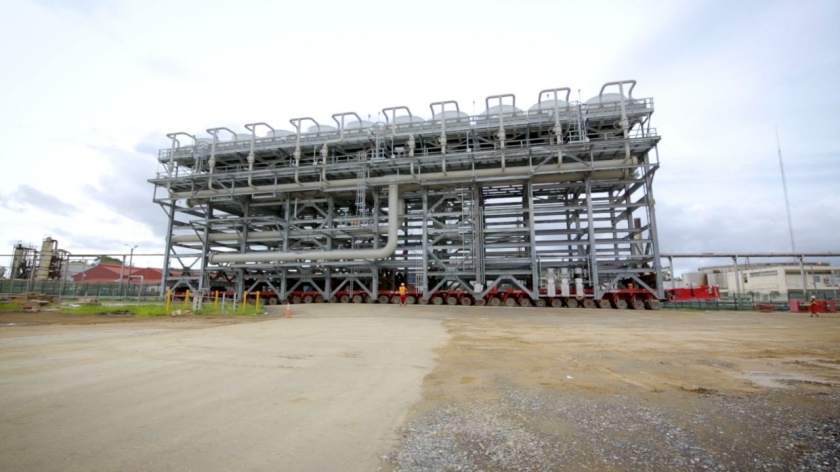
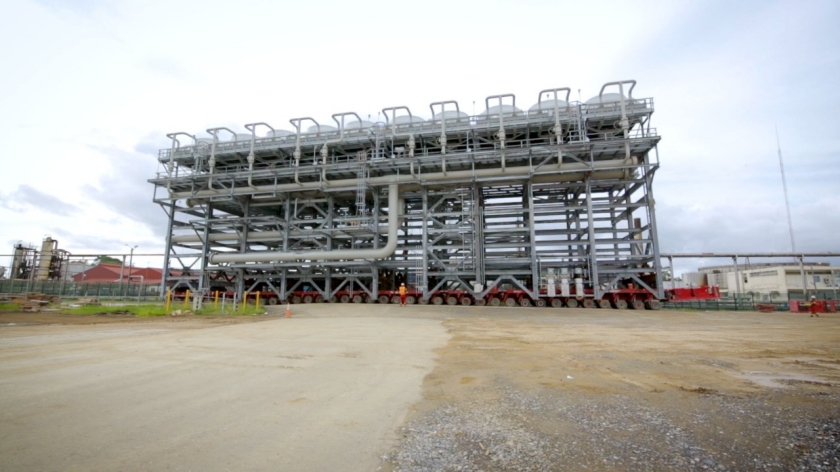
 (Image courtesy Of BP)
The National Gas Company of Trinidad and Tobago Limited (NGC) has acquired compression assets from BP Trinidad and Tobago. The Trinidad Region Onshore Compressor (TROC) positions NGC as a stronger player in the regional natural gas sector while ensuring reliability and sustainability across the country’s gas network.
“This acquisition represents a most significant achievement for NGC and for Trinidad and Tobago’s energy sector,” said NGC Chair Gerald Ramdeen. “It reflects our new, bold, and strategic vision to guarantee energy security and safeguard the best interests of NGC, our country, and the investments made on behalf of our people.”
TROC is a key component of Trinidad and Tobago’s gas infrastructure. Located onshore, the facility maintains line pressure and optimizes gas flow from upstream producers to downstream customers via NGC’s 56-inch (142-cm) Cross Island Pipeline (CIP), which spans from Guayaguayare to Atlantic LNG in Point Fortin. The system operates at discharge pressures of up to 1200 psi (82 bar), which is essential for moving gas efficiently from offshore and onshore fields to downstream consumers and LNG facilities.
The Trinidad Region Onshore Compressor is designed to deliver compression capability for Trinidad and Tobago’s natural gas network. The acquisition addresses a critical gap left by the unitization of Atlantic LNG trains negotiated in November 2024. Without compression capability, NGC faced challenges in delivering gas to Atlantic LNG, limiting potential benefits from unitization. With TROC now under NGC’s control, uninterrupted gas flow to Atlantic LNG is guaranteed — unlocking the full value of prior agreements.
“By acquiring TROC and bringing this asset under NGC’s management, we are reinforcing our commitment to operational excellence and ensuring that our customers and stakeholders benefit from a more resilient and efficient gas network,” said Edmund Subryan, acting president of NGC.
NGC owns, maintains, and operates the Trinidad and Tobago’s transmission and distribution gas pipeline network of approximately 620 miles (1000 km) which comprises both offshore and onshore segments. The network’s installed capacity is currently 4.4 bcf/d and supplies power generation firms, global scale petrochemical plants, and a wide range of light manufacturing and commercial enterprises.